
Table of Contents
Executive Summary
As the global economic and technological landscape undergoes a profound transformation in 2026, Reliance Industries Limited stands at the epicenter of a historic pivot. Traditionally recognized as a petrochemical and hydrocarbon conglomerate, the company has aggressively repositioned itself as a multifaceted technology and sustainable energy behemoth. This white paper provides a deep dive into the strategic maneuvers that are reshaping the long-term trajectory of the company. We will examine three interconnected pillars of this transformation: the ambitious ten billion dollar green energy gambit centered around integrated gigafactories, the unprecedented one hundred ten billion dollar commitment over seven years to build a sovereign artificial intelligence infrastructure, and the rigorous balance sheet management required to fund these capital-intensive transitions without compromising the coveted A-minus credit rating.
The synergy between these initiatives is not merely coincidental; it is a meticulously designed ecosystem. The cash flows generated from the legacy Oil-to-Chemicals business are being intelligently recycled to fund the green energy transition. In turn, the massive captive renewable energy generated by these new assets serves as the foundation for the artificial intelligence infrastructure, solving the critical bottleneck of power costs in high-performance computing. This integrated approach not only mitigates terminal value risks associated with fossil fuels but also positions the conglomerate for a massive valuation rerating, transitioning from a traditional sum-of-the-parts industrial multiple to a premium technology and platform ecosystem valuation. This paper unpacks the financial, operational, and strategic intricacies of this multi-decade vision.
1. The Green Energy Gambit: Capital Allocation and Long-Term Valuation
The global transition toward sustainable energy has accelerated, and legacy hydrocarbon assets face increasing scrutiny from global capital markets. For Reliance Industries Limited, the Oil-to-Chemicals segment has historically been the primary engine of cash flow generation. However, recognizing the inevitable decline in terminal value multiples for fossil-fuel-dependent operations, the company has embarked on a massive decarbonization and green energy initiative, headlined by a ten billion dollar investment to develop the Dhirubhai Ambani Green Energy Giga Complex in Jamnagar, Gujarat. This sprawling complex is designed to house five fully integrated gigafactories, creating a domestic supply chain that spans the entire renewable energy spectrum.
The Five Pillars of the Giga Complex
The strategic brilliance of the Jamnagar Giga Complex lies in its end-to-end integration, mirroring the vertical integration strategy that made the company’s petrochemical business highly profitable. The five critical manufacturing facilities include:
- Integrated Solar Photovoltaic Module Factory: Utilizing highly advanced heterojunction technology and moving toward perovskite-tandem cell innovations, this facility aims to push module efficiency beyond twenty-eight percent. By establishing massive domestic capacity, the company mitigates supply chain vulnerabilities and heavy reliance on imported solar components.
- Advanced Energy Storage Battery Factory: Addressing the intermittency of renewable energy, this facility focuses on utility-scale and commercial energy storage solutions, reducing dependency on volatile noble metal supply chains through advanced alternative chemistries.
- Electrolyser Factory: This plant is dedicated to the production of green hydrogen, forming the backbone of the company’s aggressive one-one-one target: producing one kilogram of green hydrogen for one dollar within one decade.
- Fuel Cell Factory: Designed to convert hydrogen into motive and stationary power, providing a scalable alternative to internal combustion engines for heavy transport and industrial applications.
- Power Electronics Factory: Manufacturing the critical inverters, transformers, and control systems required to seamlessly integrate these diverse energy sources into the broader electrical grid.
Valuation Impact: O2C Assets versus Green Energy Multiples
From a capital markets perspective, the divergence in valuation multiples between traditional Oil-to-Chemicals assets and pure-play green energy assets is stark. Traditional refining and petrochemical businesses typically trade at enterprise value to earnings before interest, taxes, depreciation, and amortization multiples of five to seven times. These suppressed multiples reflect the cyclicality of commodity prices, geopolitical vulnerabilities, and the looming threat of stranded assets due to global carbon taxation and environmental, social, and governance mandates. Conversely, integrated renewable energy and clean technology companies command significant premiums, often trading at multiples exceeding fifteen times, driven by secular growth trends, predictable regulatory support, and long-term sustainability mandates.
By executing the ten billion dollar green energy gambit, the company is effectively initiating a massive multiple arbitrage. The robust, albeit mature, cash flows from the Oil-to-Chemicals business are acting as the funding mechanism for a high-growth, high-multiple future. Furthermore, by targeting one hundred gigawatts of renewable energy capacity by 2030, the company is ensuring that its internal energy costs are slashed by an estimated twenty-five percent. This internal cost reduction immediately expands operating margins across its legacy manufacturing base, effectively decarbonizing the Oil-to-Chemicals business while simultaneously birthing a new, high-margin revenue vertical. The long-term valuation rerating hinges on this successful transition, shifting the narrative from a cash-cow industrial giant facing terminal decline to an integrated clean energy pioneer capturing the entire value chain of the future energy economy.
2. AI Infrastructure as the Next Frontier: Catalyst for a Tech Company Rerating
In February 2026, Reliance Industries Limited fundamentally altered the global technology landscape by announcing a staggering one hundred ten billion dollar investment over seven years dedicated to building India’s sovereign artificial intelligence infrastructure. This initiative, driven by the digital subsidiary Jio Platforms, marks the most aggressive pivot from a traditional conglomerate model to a platform-centric technology valuation. The core philosophy underpinning this investment is the democratization of artificial intelligence, operating under the premise that India cannot afford to rent intelligence from the Global North, just as it previously refused to accept exorbitant costs for mobile data.
Building Sovereign Compute Capacity
The primary bottleneck in the global artificial intelligence arms race is not a lack of algorithmic innovation or engineering talent; it is the sheer scarcity and exorbitant cost of computational infrastructure. The company’s one hundred ten billion dollar capital expenditure plan aggressively attacks this constraint through the deployment of gigawatt-scale data centers. The initial rollout features a massive, multi-gigawatt artificial intelligence-ready data center park in Jamnagar, with an initial capacity of one hundred twenty megawatts expected to come online in the second half of 2026, eventually scaling to three gigawatts. This localized, sovereign compute infrastructure ensures that national data residency requirements are met, an increasingly critical factor for enterprise and government adoption in a fragmenting geopolitical landscape.
The Power Equation: Merging Green Energy with AI
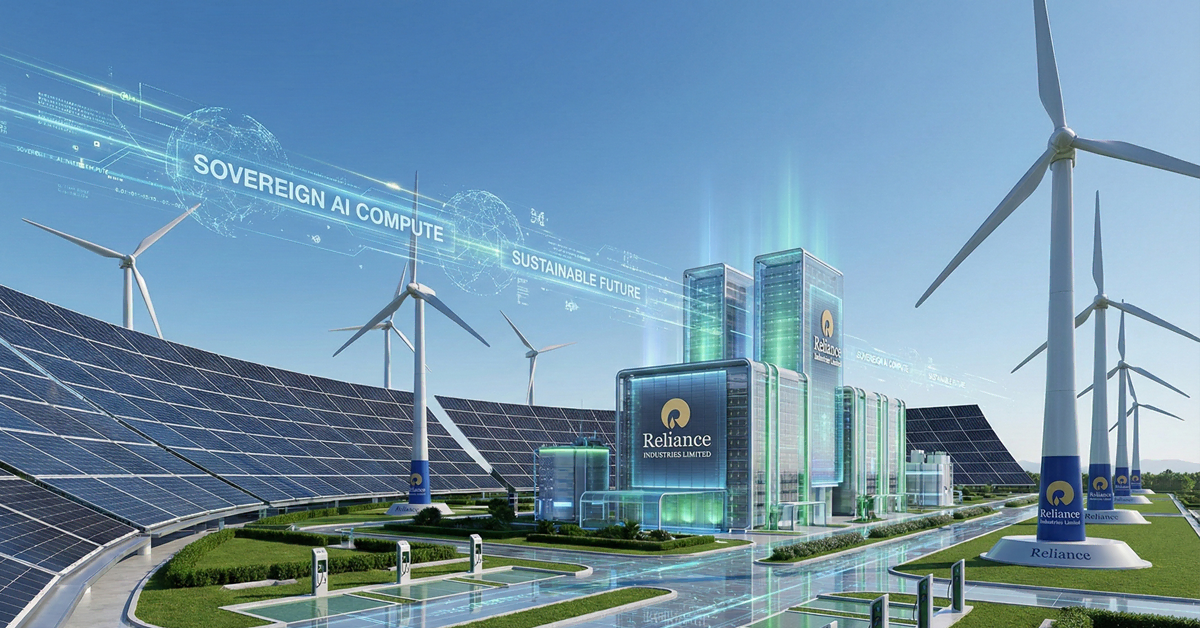
The intersection of the company’s green energy investments and its artificial intelligence ambitions is where the true competitive moat is established. Approximately sixty to seventy percent of the operating expenditure for an artificial intelligence data center is consumed by power and thermal cooling requirements. Global hyperscalers face significant challenges in securing affordable, sustainable baseline power. The company bypasses this constraint entirely by directly powering its data center infrastructure with the captive surplus green energy generated by the Jamnagar Giga Complex. By linking its massive solar and renewable footprint to its compute infrastructure, the marginal cost of computing is driven down exponentially. This structural cost advantage allows the company to offer artificial intelligence processing, training, and inference at a fraction of global market rates, catalyzing massive domestic adoption across manufacturing, healthcare, agriculture, and retail.
Edge Computing and the Telecom Synergy
Beyond centralized mega-data centers, the investment strategy includes a highly dense, nationwide edge computing network deeply integrated with the Jio 5G and broadband network. Edge computing pushes processing power closer to the end-user, drastically reducing latency. For artificial intelligence applications that require real-time processing, such as autonomous logistics, smart manufacturing, and responsive agricultural sensors, low latency is non-negotiable. By leveraging its dominant position as India’s premier telecom operator, the company transforms its network from a simple data pipe into an intelligent, distributed operating system. This capability enables specialized platforms like JioShikshak for education and JioArogyAI for healthcare to operate seamlessly across the subcontinent, breaking down language and accessibility barriers.
The Tech Company Valuation Rerating
The ultimate financial objective of this infrastructure rollout is a structural rerating of the corporate valuation. Conglomerates traditionally suffer from a holding company discount, where the combined entity trades at a lower valuation than the sum of its individual parts. By heavily weighting its forward capital expenditure toward high-growth digital and artificial intelligence platforms, the company is actively shedding its industrial identity. The transition is designed to position Jio Platforms as a global technology hyperscaler, warranting the premium multiples enjoyed by Silicon Valley tech giants. As artificial intelligence integration drives enterprise cloud adoption, digital-native business creation, and an explosion in consumer digital services, the predictable, high-margin software and platform revenues will heavily dilute the cyclical industrial earnings. This shift paves the way for highly lucrative value-unlocking events, such as the widely anticipated demergers and initial public offerings of the digital and retail arms, which will firmly establish the company as a premier global technology powerhouse.
3. Decarbonization and the Balance Sheet: Maintaining the A-Minus Credit Rating
A strategic vision encompassing a ten billion dollar green energy buildout and a one hundred ten billion dollar artificial intelligence infrastructure rollout naturally invites intense scrutiny regarding balance sheet leverage and financial stability. Historically, such massive capital expenditure cycles carry the risk of severe credit degradation. However, the company has managed to undertake this capital-intensive transition while maintaining a robust A-minus credit rating from international rating agencies such as Standard and Poor’s. Understanding how this financial equilibrium is maintained requires an analysis of shifting cash flow dynamics, strict financial leverage policies, and strategic capital recycling.
The Changing Composition of Operating Cash Flow
The bedrock of the company’s credit stability is the fundamental restructuring of its earnings profile. Over the past decade, massive investments in the consumer-facing retail and digital services businesses have matured, transforming them from capital sinks into formidable cash engines. By the end of fiscal year 2026, the digital services segment and the retail business are projected to contribute approximately sixty percent of the total operating cash flow. The volatile, cyclical hydrocarbon and Oil-to-Chemicals segments will account for the remaining forty percent. This inversion is crucial for credit rating agencies. Consumer businesses offer highly visible, predictable, and sticky recurring revenues, significantly reducing the overall volatility of corporate earnings. The continuous expansion of wireless subscribers, regular tariff hikes leading to higher average revenue per user, and an expanding retail footprint provide an annuity-like cash flow stream that effortlessly services existing debt and funds future expansion.
Strict Adherence to Leverage Targets
Management has instituted an exceptionally disciplined financial policy that serves as the ultimate guardrail against over-leveraging. The internally mandated leverage target requires the net debt to earnings before interest, taxes, depreciation, and amortization ratio to remain strictly below one point zero times. Even as the company absorbs the heavy front-loaded capital expenditures required for the renewable energy and artificial intelligence initiatives, earnings growth is projected to outpace the rate of debt accumulation. Consolidated corporate earnings are forecast to expand steadily, moving toward the two trillion Indian rupee mark by fiscal year 2026. This massive profitability scale ensures that the adjusted debt to operating earnings ratio remains highly comfortable, typically hovering between one point five and one point six times on an adjusted basis through fiscal year 2027. This predictable leverage profile provides immense comfort to bondholders and rating agencies, underpinning the strong A-minus rating.
Capital Recycling and Asset Monetization
Another critical lever in the company’s financial strategy is its proven capability to execute massive capital recycling events. During previous periods of high capital intensity, the company demonstrated an unparalleled ability to attract global private equity and strategic investors, raising tens of billions of dollars by selling minority stakes in its digital and retail subsidiaries. This approach effectively deleveraged the parent company balance sheet while securing long-term strategic partnerships. Looking ahead to the massive funding requirements of the artificial intelligence and green energy era, the company retains massive optionality. The potential initial public offerings of Jio Platforms and Reliance Retail stand as massive liquidity events. Listing these entities would provide independent currency for growth, diverse fund-raising avenues, and a massive equity cushion that protects the consolidated balance sheet from taking on excessive long-term debt. Furthermore, as the green energy gigafactories stabilize and secure long-term power purchase agreements, the company can monetize these predictable cash flows through infrastructure investment trusts or strategic offtake partnerships, effectively self-funding the clean energy vertical.
Navigating the Capital-Intensive Transition
Ultimately, the transition from fossil fuels to a low-carbon, high-compute future is inherently capital intensive. The construction of solar farms, the manufacturing of electrolysers, and the deployment of advanced graphical processing units require massive upfront cash outflows years before corresponding revenues are realized. The company is managing this “valley of death” through sheer scale and diversification. The legacy hydrocarbon assets, despite their long-term terminal value challenges, continue to generate massive free cash flow today. This cash acts as the internal venture capital fund, subsidizing the future while external debt is kept at highly manageable levels. The ability to seamlessly sequence these investment cycles, ensuring that legacy cash cows fund emerging stars without breaching internal leverage limits, is the defining characteristic of the company’s financial management in 2026.
Conclusion
Reliance Industries Limited is orchestrating one of the most complex and ambitious corporate transformations in modern economic history. The strategic pivots analyzed in this white paper are not isolated initiatives but components of a highly integrated, self-reinforcing ecosystem. The ten billion dollar Green Energy Gambit addresses the existential threat of climate change and terminal value compression in the hydrocarbon sector by building a domestic, vertically integrated renewable energy supply chain. This clean energy foundation is then brilliantly leveraged to power the one hundred ten billion dollar artificial intelligence infrastructure, providing a structural cost advantage that will democratize advanced computing across the Indian subcontinent and position the company as a premier global technology player.
Crucially, this aggressive expansion into the technologies of the future is underpinned by masterful financial engineering. By expanding the stable cash flows of its digital and retail consumer businesses, enforcing strict deleveraging metrics, and retaining the optionality for massive asset monetization, the company guarantees its operational resilience and secures its elite credit standing. The result is a corporate entity that is shedding its traditional industrial constraints, successfully navigating the complex balance between decarbonization, technological supremacy, and pristine financial health. As the intelligence era unfolds, the company’s synchronized investments across green electrons and artificial neural networks are poised to create unprecedented, durable economic value for decades to come.