
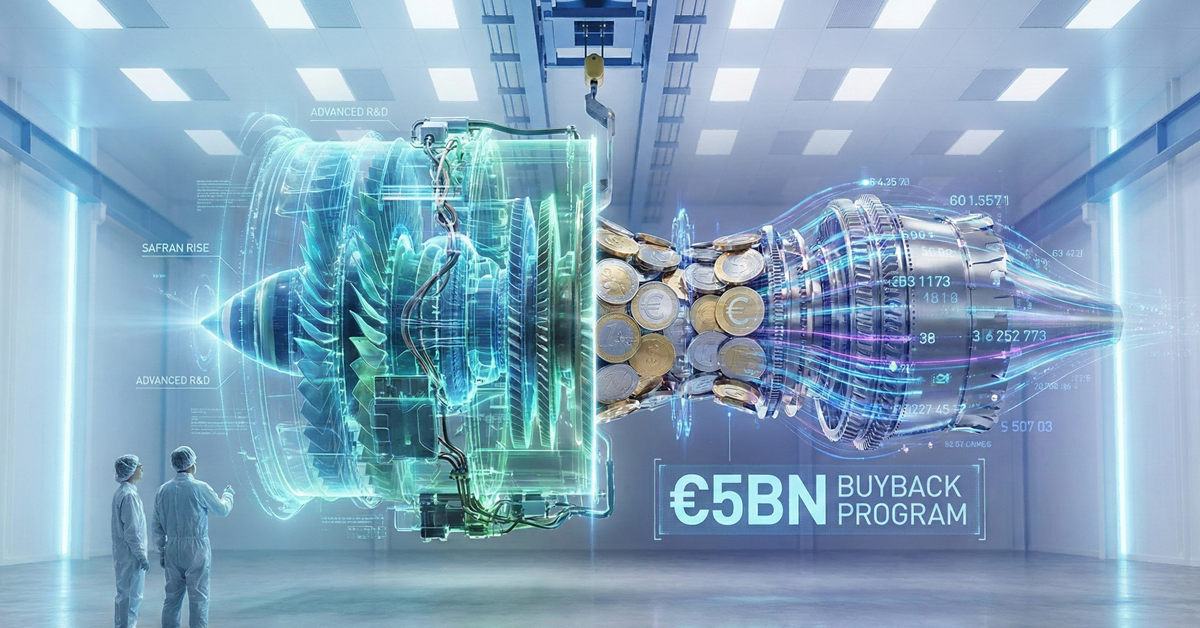
Safran SA stands at a critical juncture in its corporate evolution. As a global leader in aerospace propulsion, equipment, and defense, the company finds itself navigating a complex macroeconomic landscape defined by high interest rates, supply chain volatility, and an urgent industry-wide mandate for decarbonization. The core of Safran’s financial narrative currently revolves around a massive €5 billion share buyback program, running alongside a robust €2 billion annual Research and Development (R&D) expenditure. This report evaluates the tension between returning immediate value to shareholders through buybacks and securing long-term dominance through technological innovation.
Table of Contents
The Foundations of Safran Financial Strength
To understand the current capital allocation strategy, one must first recognize the structural advantages of Safran’s business model. The company operates largely as a duopoly player in the narrowbody engine market through CFM International, its 50/50 joint venture with GE Aerospace. The LEAP engine family, which powers the Boeing 737 MAX and much of the Airbus A320neo family, provides a predictable, long-term revenue stream through high-margin aftermarket services. This “razor-and-blade” model generates significant free cash flow, providing the “dry powder” necessary for both aggressive shareholder returns and intensive capital reinvestment.
In a high-interest environment, the cost of capital rises, making the hurdle rate for internal projects higher. However, Safran’s balance sheet remains exceptionally strong. With a net debt to EBITDA ratio that remains conservative, the company has the flexibility to pursue a dual-track strategy that many of its peers might find prohibitive. The question is not whether Safran can afford both, but whether the current weighting is optimized for the decade ahead.
The €5 Billion Buyback: Logic and Limitations
The announcement of a €5 billion share buyback program, intended to be executed through 2025, represents a significant statement of confidence from the board. In the context of the current interest rate environment, buybacks serve several distinct purposes for Safran.
First, buybacks provide a floor for the stock price. By reducing the number of outstanding shares, Safran increases its earnings per share (EPS) even if net income remains flat. In an era where investors are skeptical of growth stocks due to higher discounting of future cash flows, the immediate accretion provided by buybacks is highly attractive. For Safran, the buyback is partly funded by the disposal of non-core assets and the steady stream of cash from the civil aftermarket, which recovered faster than expected post-pandemic.
However, the opportunity cost of buybacks in a high-interest environment is non-trivial. When interest rates are at 4% or 5%, the “yield” on a buyback must significantly exceed the risk-free rate plus a risk premium to be considered the most efficient use of capital. If Safran’s shares are perceived as undervalued, the buyback is an excellent investment. If, however, the aerospace cycle is nearing a peak or if supply chain constraints limit future deliveries, committing €5 billion to equity reduction might be viewed as a missed opportunity to deleverage or acquire distressed competitors.
R&D: The Engine of Future Growth
Parallel to the buyback program is Safran’s commitment to spending approximately €2 billion annually on R&D. In the aerospace sector, R&D is not a luxury; it is a survival mechanism. The industry is currently facing its greatest technological shift since the introduction of the jet engine: the transition to sustainable aviation. Safran’s R&D focus is primarily directed toward the RISE (Revolutionary Innovation for Sustainable Engines) program.
The RISE program aims to develop an open-fan engine architecture capable of reducing fuel consumption and CO2 emissions by more than 20% compared to current engines. This is a multi-billion euro bet on the future of narrowbody flight. Beyond propulsion, Safran is investing heavily in hybridization, electrical systems, and sustainable aviation fuel (SAF) compatibility. In a high-interest environment, these long-dated R&D projects are technically more “expensive” in a Net Present Value (NPV) calculation because future cash flows are discounted more heavily. Yet, the strategic cost of falling behind in the race for green aviation would be catastrophic.
Safran’s R&D strategy also includes a significant portion of self-funded R&D versus customer-funded R&D. By maintaining a high level of self-funding, Safran retains greater control over its intellectual property and future margins. This R&D spend acts as a formidable barrier to entry, ensuring that Safran and GE remain the primary choice for airframe manufacturers for the next thirty years.
Evaluating the Balance: Shareholder Value vs. Industrial Edge
The tension between the €5 billion buyback and the €2 billion R&D budget is a microcosm of the broader debate in corporate finance: short-term optimization versus long-term resilience. To determine if Safran has struck the right balance, we must look at the internal rate of return (IRR) of both paths.
R&D in aerospace typically has a long gestation period—often 10 to 15 years before a product enters service—but it results in a 30-to-40-year tail of service revenue. The IRR of a successful engine program like the LEAP or its successor is historically far higher than the cost of equity. Therefore, cutting R&D to increase buybacks would be a strategic error that would erode Safran’s competitive moat. Conversely, excessive R&D without a path to commercialization can lead to “gold-plating” technology that the market cannot afford.
The current €2 billion annual R&D spend appears to be the “sweet spot” for Safran. It allows the company to lead the RISE program while simultaneously upgrading its equipment and defense portfolios. The €5 billion buyback, meanwhile, utilizes excess cash that the company cannot efficiently absorb into R&D without hitting diminishing returns. There is a limit to how many engineers can be effectively deployed on a single project before productivity drops.
The Impact of the High-Interest Environment
The shift from a zero-interest-rate policy (ZIRP) to a normalized interest rate environment has changed the math for Safran’s treasury department. In the past, debt was so cheap that companies would borrow specifically to fund buybacks. Safran has moved away from this. Its buybacks are largely funded by operations and asset sales, which is a much more sustainable approach when debt servicing costs are high.
Furthermore, high interest rates affect the supply chain. Many of Safran’s smaller suppliers are struggling with the cost of debt, leading to production bottlenecks. One could argue that a portion of the €5 billion buyback fund might be better utilized as a strategic reserve to support the supply chain or to vertically integrate through targeted M&A. By acquiring key suppliers who are struggling in the current financial climate, Safran could secure its production ramp-up and improve long-term margins more effectively than by simply retiring shares.
The Role of Defense and Diversification
Safran is not just an engine company. Its Defense and Aerosystems divisions provide a hedge against the cyclicality of commercial aviation. In the current geopolitical climate, defense spending is increasing across Europe and NATO. Safran’s investments in optronics, navigation systems, and drone technology are yielding high returns. The capital allocation strategy must account for the fact that these divisions require different R&D intensities and offer different margin profiles than the propulsion business.
The buyback program serves to simplify the investment case for shareholders who might otherwise be concerned by the complexity of Safran’s diverse holdings. It signals that the company is disciplined and will not “waste” cash on empire-building acquisitions that do not meet strict return criteria. This discipline is particularly valued by institutional investors during periods of economic uncertainty.
Strategic Risks and Sensitivities
The “optimal” balance Safran has struck is sensitive to several external shocks. If the aviation industry’s transition to net-zero requires a move toward hydrogen propulsion faster than anticipated, the €2 billion R&D budget may prove insufficient. Developing a hydrogen-capable ecosystem is exponentially more expensive than iterating on current gas turbine technology.
Similarly, if the global economy enters a prolonged recession, the cash flow from the civil aftermarket—the engine of Safran’s buyback program—could dry up. In such a scenario, the company would likely have to pause the buyback to protect its R&D pipeline. The hierarchy of capital use at Safran is clear: operational requirements first, R&D second, dividends third, and buybacks last. The fact that they can currently fund all four is a testament to their operational efficiency.
Comparison with Global Peers
When compared to its primary competitor, Rolls-Royce, or its partner, GE Aerospace, Safran’s capital allocation appears remarkably stable. Rolls-Royce has spent the last several years restructuring and focusing on debt reduction rather than buybacks. GE Aerospace, following its spin-off, has also initiated aggressive shareholder return programs but faces different legacy liabilities. Safran’s ability to maintain a massive buyback while leading the world in next-generation engine R&D (via the RISE program) positions it as the most balanced player in the “Big Three” of aerospace propulsion.
Safran’s strategy also contrasts with the US-based defense primes, which often prioritize buybacks to an extent that critics argue hampers long-term innovation. Safran’s French and European heritage often results in a more stakeholder-centric approach, where maintaining a technological lead and providing high-quality employment are weighted alongside shareholder returns. This cultural nuance provides a level of “patient capital” that is beneficial for long-cycle aerospace projects.
Conclusion: The Path Forward
Safran’s capital allocation strategy is a sophisticated response to a high-interest, high-stakes era in aviation. The €5 billion buyback program is not merely a “giveaway” to shareholders; it is a calculated use of excess liquidity in a market where EPS growth is highly prized. Simultaneously, the €2 billion R&D expenditure ensures that the company does not sacrifice its future for a short-term stock price boost.
The optimal balance for Safran lies in its flexibility. By funding these initiatives through organic cash flow rather than expensive debt, the company maintains the agility to pivot if the macroeconomic or technological environment shifts. For the long-term shareholder, the value lies not just in the reduced share count, but in the assurance that Safran is building the engines that will define the next fifty years of flight.
In conclusion, Safran is successfully threading the needle. It is rewarding the patience of its investors while aggressively funding the innovations required to remain at the pinnacle of the aerospace industry. As long as the civil aftermarket continues to perform and the RISE program hits its technical milestones, Safran’s dual-track strategy represents a gold standard for industrial capital allocation in the 2020s.