
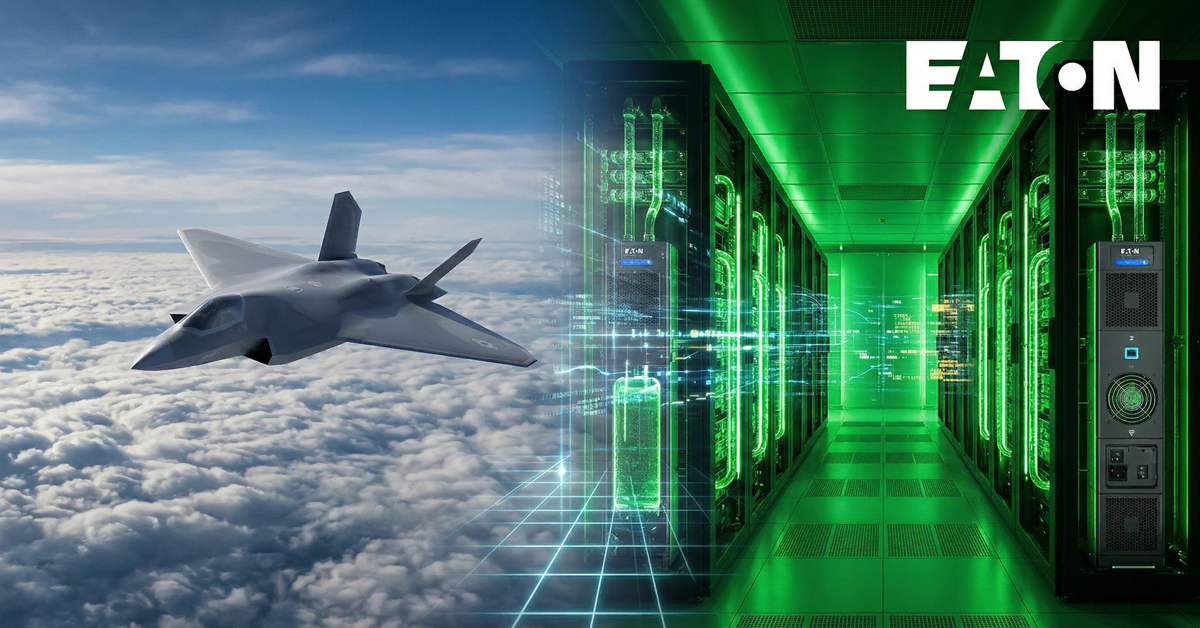
Eaton Corporation has fundamentally repositioned its enterprise architecture to capture outsized returns in two of the most critical secular growth markets of the current decade: intelligent electrical power management and next-generation aerospace and defense systems. This comprehensive investor report deeply examines the underlying mechanics of Eaton’s growth trajectory, anchored by the exceptional fourth-quarter 2025 financial results. While the explosive expansion of the data center market often dominates financial headlines, this report identifies Eaton’s Aerospace segment as the stealth growth driver of the portfolio. Supported by the strategic one point five five billion dollar acquisition of Ultra Precision Control Systems and a rapidly expanding 2026 defense backlog, the Aerospace division serves as a high-margin, stabilizing counterweight to the inherent volatility of technology-driven capital expenditure cycles. Furthermore, this analysis explores how Environmental, Social, and Governance principles have transitioned from compliance metrics to powerful financial catalysts, directly propelling Eaton’s dominance in the burgeoning green data center market. The convergence of these factors creates a highly defensive yet growth-oriented investment profile for the coming decade.
Table of Contents
Strategic Metamorphosis: From Industrial Conglomerate to Power Management Leader
Over the past several years, Eaton has executed a masterful portfolio transformation. By systematically divesting cyclical, lower-margin industrial segments, the company has concentrated its capital and engineering resources into highly complex, mission-critical end markets. As of the end of 2025, Eaton’s core identity is definitively bifurcated into Electrical and Aerospace power management. This metamorphosis is not merely cosmetic; it represents a fundamental rewiring of the company’s margin profile and cash flow generation capabilities. In 2025 alone, Eaton deployed thirteen billion dollars in strategic capital allocation, acquiring companies that possess deep technological moats and high barriers to entry. This aggressive yet disciplined execution of the Execute for Growth strategy has insulated the company from broad macroeconomic headwinds, positioning it to capitalize on the dual tailwinds of global electrification and re-militarization.
The impending spin-off of the Mobility business marks the final major step in this structural purification. By shedding the legacy vehicle and e-mobility operations, Eaton will emerge in 2026 as a pure-play entity focused almost entirely on markets characterized by secular growth, massive backlogs, and pricing power. This strategic clarity allows management to funnel research and development dollars directly into the high-yield avenues of data center infrastructure and advanced aerospace engineering, compounding shareholder value at an accelerated rate.
Aerospace and Defense: The Stealth Growth Driver
In the contemporary investment landscape, the market’s hyper-fixation on artificial intelligence and cloud infrastructure has largely overshadowed the quiet, relentless growth of Eaton’s Aerospace segment. However, a granular examination of the company’s operational metrics reveals that aerospace is serving as a stealth growth driver with unparalleled margin expansion potential. During the fourth quarter of 2025, the Aerospace segment reported record quarterly sales of one point one billion dollars, representing a fourteen percent year-over-year increase. More importantly, the segment achieved record operating margins of twenty-four point one percent, an expansion of one hundred and twenty basis points from the prior year.
Eaton’s aerospace portfolio is deeply entrenched in both commercial aviation and military defense platforms. The company provides critical subsystems, including fluid conveyance, motion control, fuel systems, and engine solutions. These are not commoditized components; they are highly engineered, customized systems required for the safe operation of modern aircraft. The barriers to entry in this sector are astronomically high, defined by stringent regulatory certifications and decades-long development cycles. Once an Eaton component is designed into an airframe or engine platform, it virtually guarantees a multi-decade stream of high-margin aftermarket revenue. As global commercial airlines continue to renew their fleets to achieve better fuel efficiency, and as defense departments globally increase spending in response to rising geopolitical instability, Eaton’s aerospace division is capturing value at every stage of the aircraft lifecycle.
Furthermore, the aftermarket business model in aerospace acts as a compounding revenue machine. The initial sale of an original equipment manufacturer component is merely the entry point. Over the twenty to thirty-year lifespan of a commercial airliner or military jet, those components require continuous maintenance, repair, and overhaul services. Eaton’s robust distribution network and proprietary in-house technologies ensure that the company captures the lion’s share of this high-margin recurring revenue, driving the segment’s profitability steadily upward regardless of short-term fluctuations in new aircraft deliveries.
Strategic Expansion: The Impact of the Ultra PCS Acquisition
The crown jewel of Eaton’s recent aerospace strategy is the acquisition of Ultra Precision Control Systems from the Cobham Ultra Group, owned by private equity firm Advent International. Announced in June 2025 and slated for closure in the first half of 2026, the one point five five billion dollar transaction is a masterstroke of synergistic portfolio expansion. Ultra Precision Control Systems, headquartered in the United Kingdom, is a premier designer and manufacturer of mission-critical systems, including electronic controls, sensing technologies, weapon carriage and stores ejection systems, and advanced ice-protection equipment.
To fully grasp the financial impact of this acquisition, investors must look beyond the initial price tag. Ultra Precision Control Systems is estimated to generate two hundred and forty million dollars in sales in 2025, implying a valuation multiple of approximately six point five times sales. While this multiple may appear elevated at first glance, it is entirely justified by the target’s margin profile and strategic placement on legacy and next-generation defense platforms, including the F-35 Lightning II fifth-generation fighter jet. The acquisition seamlessly integrates with Eaton’s previous two point eight billion dollar purchase of Cobham Mission Systems in 2021, creating a powerhouse of defense engineering capabilities.
By bringing Ultra Precision Control Systems under the Eaton umbrella, the company significantly expands its content per aircraft. Furthermore, the defense electronics and sensing capabilities acquired through Ultra Precision Control Systems allow Eaton to move up the value chain, transitioning from a provider of mechanical and fluid systems to a supplier of integrated, intelligent mission-control systems. This technological elevation is expected to be highly accretive to the Aerospace segment’s already robust operating margins. The alignment of United Kingdom and United States operations also broadens Eaton’s access to highly classified and lucrative defense contracts across NATO member states, effectively insulating the company against regional budgetary fluctuations.
Examining the 2026 Aerospace Backlog: A Stabilizing Counterweight
The true power of the Aerospace segment lies not just in its current revenue generation, but in its profound forward visibility. At the close of the fourth quarter of 2025, Eaton reported a sixteen percent year-over-year growth in its aerospace backlog, alongside a rolling twelve-month book-to-bill ratio of one point one. This expanding backlog is a critical metric for 2026 and beyond, serving as a stabilizing, high-margin counterweight to the broader portfolio.
To understand this dynamic, investors must contrast the Aerospace segment with the Electrical Americas segment. In the fourth quarter of 2025, the Electrical Americas segment saw data center orders surge by an astounding two hundred percent. While this hyper-growth is incredibly lucrative, it is inherently tied to the capital expenditure cycles of major technology companies and hyperscale cloud providers. The technology sector is notoriously cyclical; capital expenditures can be abruptly halted or deferred in response to rising interest rates, shifting macroeconomic outlooks, or changes in advertising revenues. This historical volatility presents a latent risk to pure-play electrical infrastructure companies that are overly dependent on silicon valley expenditure cycles.
Conversely, aerospace and defense contracts operate on an entirely different temporal horizon. Defense budgets are legislated years in advance, and major procurement programs span decades. Commercial aircraft order books stretch out for five to ten years. When economic turbulence strikes, defense departments do not typically cancel active fighter jet programs, nor do major airlines completely halt their long-term fleet modernization plans. Therefore, Eaton’s sixteen percent backlog growth in aerospace represents locked-in, virtually guaranteed future revenue.
If the artificial intelligence capital expenditure super-cycle were to unexpectedly cool in late 2026 or 2027, Eaton’s expanding aerospace backlog would continue to churn out high-margin revenue, smoothing out the company’s consolidated earnings profile and protecting shareholder returns. This dual-engine growth model, balancing explosive, tech-driven electrical growth with deep, predictable aerospace stability, is the defining strength of Eaton’s corporate structure. It transforms the enterprise into an all-weather compounder of wealth.
Beyond Electrification: ESG as a Financial Catalyst
While the aerospace segment provides the structural ballast, the electrical segment provides the explosive upward thrust, driven by a profound shift in how corporations view Environmental, Social, and Governance criteria. Historically, ESG initiatives were often relegated to corporate social responsibility reports, viewed by financial analysts as a compliance cost rather than a revenue driver. For Eaton, however, ESG has fundamentally evolved into a powerful financial catalyst, perfectly aligning with the company’s core competencies in power management and distribution.
This dynamic is most acutely visible in the green data center market. The global digital economy is currently undergoing a structural transformation catalyzed by artificial intelligence and large language models. AI workloads require unprecedented computational density. A standard server rack in a traditional cloud data center might consume between seven and ten kilowatts of power. In stark contrast, high-density AI server clusters packed with advanced graphics processing units can demand between thirty and one hundred kilowatts per rack. This exponential increase in power density creates severe thermal management and energy consumption challenges that threaten to destabilize local electrical grids.
Data centers currently consume a massive portion of global electricity, a figure that is projected to more than double by the end of the decade. Consequently, hyperscale operators are facing immense pressure from regulators, investors, and their own corporate mandates to achieve net-zero carbon emissions. They cannot simply build more traditional data centers; they must build highly efficient green data centers. This imperative has shifted the procurement conversation from simple cost-minimization to a desperate search for sustainable architectural solutions.
Engineering the Green Data Center Market
The global green data center market is projected to reach over five hundred billion dollars by the end of the decade, and Eaton is positioned as the premier infrastructure provider in this sustainable technology arms race. Achieving a low Power Usage Effectiveness ratio, the gold standard metric for data center efficiency, requires sophisticated, integrated hardware and software solutions that only a handful of global players can deliver at scale.
Eaton’s portfolio directly addresses these ESG-driven demands. The company provides high-efficiency uninterruptible power supplies that minimize energy loss during power conversion. Furthermore, as air cooling becomes physically inadequate for high-density AI racks, Eaton’s advanced thermal management and liquid cooling distribution systems are becoming indispensable. Liquid cooling removes heat up to twenty-five times more efficiently than air, drastically reducing the energy required for thermal management and directly improving a facility’s ESG profile. The announced acquisition of Boyd Thermal further solidifies Eaton’s dominance in this specific technological niche.
Beyond the rack level, Eaton enables data centers to integrate seamlessly with renewable energy grids. The company’s microgrid solutions, energy storage systems, and proprietary energy management software allow data center operators to store excess renewable energy generated during off-peak hours and deploy it during peak demand. This capability is critical for facilities attempting to match their energy consumption with carbon-free electricity on a twenty-four-hour basis. By turning data centers from passive energy consumers into active, grid-interactive assets, Eaton is essentially rewriting the economics of digital infrastructure.
The financial impact of this ESG alignment is staggering. In the fourth quarter of 2025, Eaton’s Electrical Americas segment reported a thirty-one percent year-over-year increase in its backlog, with data center revenues growing approximately forty percent. The total pipeline of announced mega-projects in North America stands at nearly one trillion dollars, and Eaton is currently winning approximately forty percent of the projects it bids on. Cancellation rates remain historically low at around thirteen percent. By providing the exact technologies required for corporations to meet their environmental goals, Eaton has turned global ESG mandates into an unparalleled multi-year revenue runway.
Fourth Quarter 2025 Financial Overview and 2026 Outlook
Eaton’s fourth-quarter 2025 financial results serve as quantitative proof of the qualitative strategic advantages discussed throughout this report. The company generated total quarterly revenues of seven point zero five billion dollars, a thirteen percent increase from the prior year, driven by a robust nine percent organic growth rate. This top-line expansion was matched by exceptional operational efficiency, resulting in a record consolidated segment operating margin of twenty-four point nine percent, surpassing the high end of management’s own guidance.
Bottom-line performance was equally impressive. Eaton delivered record adjusted earnings per share of three dollars and thirty-three cents for the fourth quarter, representing an eighteen percent year-over-year increase. For the full year 2025, adjusted earnings per share reached twelve dollars and seven cents, up twelve percent over 2024. The Electrical Global segment also demonstrated strong momentum, with revenues reaching one point seven billion dollars and margins expanding by two hundred basis points to nineteen point seven percent.
Looking ahead to 2026, Eaton’s management has issued highly confident guidance, projecting adjusted earnings per share between thirteen dollars and thirteen dollars and fifty cents. Organic growth is forecasted to remain exceptionally strong at seven to nine percent, with overall segment margins expanding further to a range of twenty-four point six to twenty-five percent. The company’s balance sheet remains a fortress, with robust free cash flow generation easily supporting the planned integration of Ultra Precision Control Systems, the Boyd Thermal acquisition, and ongoing internal research and development investments. As the company continues to execute its strategic roadmap, capital allocation will remain a primary driver of shareholder value creation.
Conclusion
Eaton Corporation represents a rare intersection of deep-value industrial stability and hyper-growth technology exposure. By strategically acquiring assets like Ultra Precision Control Systems, the company has fortified its Aerospace segment, ensuring a growing, high-margin backlog that insulates the broader portfolio from macroeconomic shocks and cyclical tech downturns. Simultaneously, by recognizing and capitalizing on the shift of ESG from a compliance burden to a financial catalyst, Eaton has embedded itself into the core architecture of the exploding green data center market. As the world rapidly electrifies, digitizes, and modernizes defense infrastructure, Eaton’s dual-engine growth strategy provides investors with a highly compelling risk-adjusted return profile, extended visibility, and sustained margin expansion capabilities well into the next decade.