
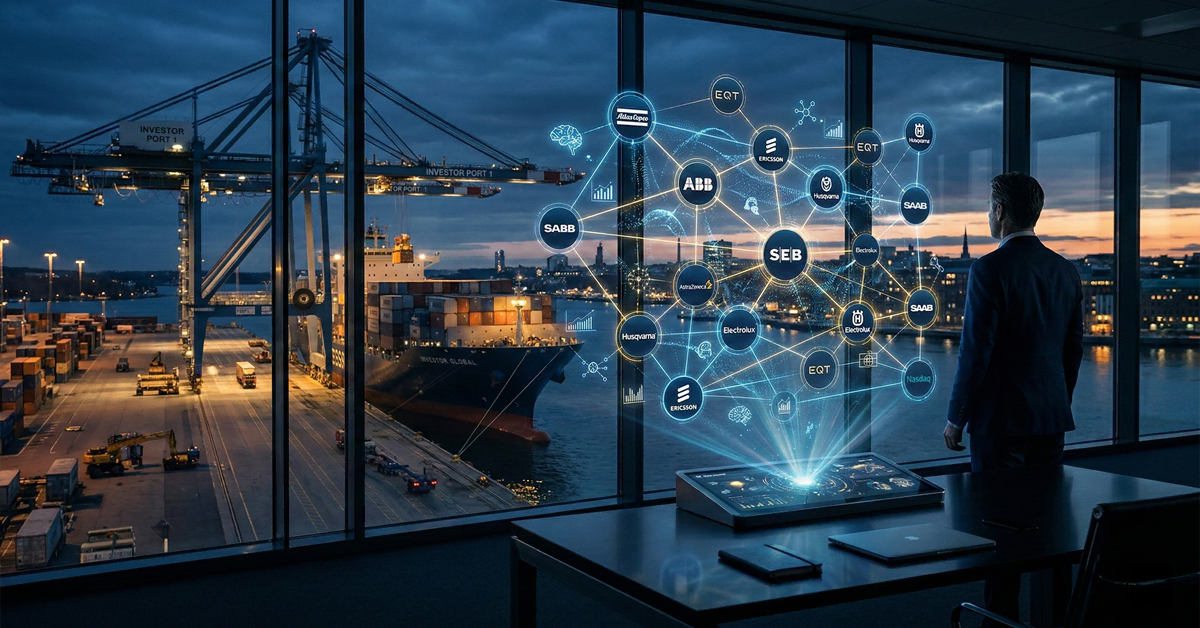
Investor AB enters 2026 as a bastion of the Nordic industrial model, a period marked by significant macroeconomic shifts and technological acceleration. As the largest industrial holding company in the Nordics, Investor AB’s portfolio represents a microcosm of the global economy, spanning healthcare, financial services, and heavy industrial engineering. With a net asset value that recently surpassed the SEK 1.1 trillion milestone, the company’s performance is increasingly viewed as a bellwether for European industrial resilience. This report examines three critical pillars of the Investor AB investment thesis: the management of the 2026 macroeconomic “headwinds,” the systemic integration of artificial intelligence across its network of 24 portfolio companies, and the evolving capital allocation strategy that balances aggressive add-on acquisitions with strategic stakes in legacy champions like Ericsson.
Table of Contents
The Performance Pillar: Navigating the 2026 Macroeconomic Matrix
The transition from 2025 into 2026 has been defined by a complex interplay of geopolitical and economic variables. For Investor AB, whose portfolio companies generate the vast majority of their revenue outside of Sweden, the primary challenges have manifested as trade tariffs, currency volatility, and a persistently lukewarm global demand environment. However, the 2025 year-end results, which saw an adjusted net asset value growth of 14 percent, suggest that the company’s “engaged ownership” model is providing a significant cushion against these external shocks.
Trade Tariffs and the Reconfiguration of Supply Chains
One of the most pressing headwinds for 2026 is the intensification of trade barriers. Companies within the Investor AB portfolio, particularly those in the “Listed Companies” segment such as Atlas Copco, ABB, and Electrolux, are highly exposed to global trade flows. The imposition of increased tariffs in the United States and reciprocal measures in the European Union and China have forced a rapid reconfiguration of supply chains. Electrolux, in particular, faced substantial tariff-related cost increases in 2025, which it initially offset through price increases. However, the “lukewarm” demand environment of early 2026 has limited the further use of pricing power, shifting the focus toward internal cost efficiency and localized manufacturing.
Investor AB’s strategy during this period has been to support its companies in becoming “local in every market.” By encouraging portfolio companies to build manufacturing footprints closer to their end-consumers, Investor reduces the impact of cross-border duties. For instance, Mölnlycke and Atlas Copco have accelerated investments in regional hubs, effectively turning a trade risk into a competitive advantage by shortening lead times and reducing carbon footprints. The 2026 strategy is less about waiting for tariff relief and more about mastering the art of “glocal” operations.
Currency Volatility: The SEK vs. USD Dynamic
Currency fluctuations have historically been a double-edged sword for Swedish exporters. In the latter half of 2025 and moving into 2026, the Swedish Krona (SEK) has shown signs of relative strength against a softening U.S. Dollar (USD). For Investor AB, which reports in SEK but holds assets with global earnings, a stronger Krona acts as a translation headwind. During 2025, Patricia Industries—Investor’s arm for wholly-owned subsidiaries—saw its total return impacted by negative currency effects, despite strong organic growth in constant currency terms.
To manage this in 2026, Investor AB maintains a conservative leverage profile, which stood at 2.1 percent at the start of the year. This low leverage allows the company to absorb translation losses without compromising its ability to invest. Furthermore, the diversification of the portfolio acts as a natural hedge; while industrial exporters may suffer from a stronger SEK, the domestic-facing financial assets and the healthcare subsidiaries, which often have higher margins and more inelastic demand, provide stability. The management’s focus remains on the “organic growth in constant currency,” which reached 5 percent in the major subsidiaries at the end of 2025, proving that the underlying business engines are robust regardless of the exchange rate volatility.
Managing “Lukewarm” Global Demand
The “lukewarm” demand environment cited by CEO Christian Cederholm is perhaps the most insidious of the 2026 headwinds. Unlike a sharp recession, which triggers immediate and drastic cost-cutting, a period of stagnant growth requires a more nuanced “efficiency-first” approach. Investor AB has responded by doubling down on operational excellence. Within the portfolio, there is a clear mandate to improve EBITA margins through “value engineering” and sourcing optimizations. The goal for 2026 is to ensure that even in a low-growth environment, earnings growth can be achieved through margin expansion. The resilience of companies like Saab, which is benefiting from a structural increase in European defense spending, also serves to offset the cyclical softness in consumer-facing sectors like household appliances.
AI and Technological Integration: The Investor Network Effect
While many investment firms treat artificial intelligence as a speculative theme, Investor AB has approached AI as an industrial necessity. The company leverages its unique “network effect” to drive AI adoption across its 24 portfolio companies. This is not merely about implementing chatbots; it is about the structural integration of machine learning and generative models into the core R&D, manufacturing, and sales processes of its holdings.
AstraZeneca and the Modella AI Benchmark
A prime example of Investor AB’s technology strategy is AstraZeneca’s recent acquisition of Modella AI. By integrating advanced foundation models into its oncology research, AstraZeneca is attempting to shorten the drug discovery lifecycle—a move that could significantly enhance the long-term value of Investor’s largest listed holding. Investor AB facilitates this by creating “knowledge-sharing circles” among its business teams. When one portfolio company successfully implements an AI-driven solution for predictive maintenance or supply chain optimization, the insights are disseminated across the network. This collective intelligence allows smaller subsidiaries within Patricia Industries to benefit from the R&D muscle of the larger listed giants.
Operational Efficiency Through Automation
In the industrial segment, the focus of AI in 2026 has shifted toward the “Industrial Internet of Things” (IIoT) and autonomous systems. Companies like Atlas Copco and ABB are increasingly selling “outcomes” rather than just equipment. By using AI to monitor the health of compressors and robots in real-time, these companies can offer predictive service contracts that generate high-margin recurring revenue. For Investor AB, this shift toward software-enabled services is critical for future-proofing the portfolio. The adoption of AI is also a key tool in navigating the labor shortages and rising wage costs seen in many of the markets where Investor operates. Automation is no longer just about replacing labor; it is about augmenting the existing workforce to reach levels of precision and efficiency that were previously unattainable.
Data Governance and Sustainability
Investor AB also recognizes that AI adoption brings new risks, particularly regarding data governance and energy consumption. As part of its 2026 sustainability mandate, Investor requires its portfolio companies to report on the ethical use of AI and the carbon footprint of their digital infrastructure. The “Sustainability Pillar” is thus intrinsically linked to the “Technology Pillar.” By ensuring that AI adoption is both efficient and responsible, Investor AB is positioning its companies to meet the increasingly stringent regulatory requirements of the European Union, such as the AI Act.
Capital Allocation Strategy: Add-ons vs. Platforms
The capital allocation strategy of Investor AB has undergone a subtle but significant evolution. In 2025, the company facilitated approximately SEK 24 billion in add-on acquisitions. This focus on “bolt-on” growth reflects a preference for lower-risk, high-synergy investments within existing business lines, particularly within the Patricia Industries segment.
The Logic of the SEK 24 Billion Add-on Strategy
The heavy weighting toward add-ons in 2025 and 2026 is a calculated response to high interest rates and market uncertainty. Add-on acquisitions, such as Nova Biomedical’s expansion or the recent moves by Laborie and Permobil, are typically easier to integrate and offer immediate margin accretion. These acquisitions allow Investor’s subsidiaries to consolidate their market positions, gain new technologies, or enter adjacent geographies without the “platform risk” of a completely new entry. For the investor, this represents a disciplined use of capital that prioritizes the “compounder” effect over the “big hit” speculative acquisition.
Platform Investments: The Case of Atlas Antibodies
Despite the focus on add-ons, Investor AB continues to look for new “platform” investments. The acquisition of Atlas Antibodies remains a lighthouse example of this strategy. Platforms are intended to be high-growth engines in sectors where Investor sees a long-term structural tailwind—in this case, life sciences and proteomics. The 2026 strategy for platforms involves a “buy and build” approach. Unlike the listed companies, where Investor is a minority owner, Patricia Industries’ platforms are often wholly-owned, giving Investor more control over the capital allocation and strategic direction of the company. However, the hurdle rate for new platforms in 2026 is higher than in previous years, given the lukewarm demand and the need to maintain a “fortress balance sheet.”
Doubling Down on Listed Giants: Ericsson and Atlas Copco
A notable aspect of the recent capital allocation is the increased stake in listed core holdings. In 2025, Investor allocated SEK 2.3 billion to increase its ownership in Ericsson and Atlas Copco. This “doubling down” on existing champions reflects a belief that these companies are undervalued by the public markets relative to their long-term potential in the 5G/6G and industrial automation cycles. In the case of Ericsson, Investor’s increased stake is a strong vote of confidence in the company’s ability to navigate the geopolitical complexities of the telecommunications industry. For the shareholder, this strategy offers a blend of “growth through subsidiaries” and “value through listed holdings.”
The EQT Partnership: Co-investment and Synergy
The relationship with EQT remains a vital component of the capital allocation framework. The co-investment in Fortnox alongside EQT 10 in 2025 demonstrates a new level of collaboration. By investing alongside EQT’s funds, Investor AB can participate in high-growth technology deals while leveraging EQT’s specialized expertise. This hybrid model allows Investor to gain exposure to earlier-stage or more aggressive growth opportunities than it would typically pursue through its core portfolio. In 2026, the cash flow from EQT investments—which reached SEK 1.2 billion in Q4 2025 alone—provides a significant portion of the capital used for both dividends and new investments.
Conclusion: The Resilience of the Active Ownership Model
Investor AB enters the mid-point of 2026 as a remarkably resilient entity. By balancing the “defensive” qualities of its diversified listed holdings with the “offensive” growth of its wholly-owned subsidiaries and EQT investments, the company has created a structure that is uniquely suited to the current era of volatility. The headwinds of tariffs and currency fluctuations are being managed not through financial engineering, but through deep industrial transformation and the systemic adoption of AI.
The capital allocation strategy remains disciplined, favoring high-synergy add-ons while selectively doubling down on core holdings that represent long-term value. With a leverage ratio that remains well within the target range and a track record of outperforming the SIXRX return index for over fifteen consecutive years, Investor AB continues to prove that “engaged ownership” is a superior model for creating long-term shareholder value. For the 2026 investor, Investor AB offers a rare combination of stability, income through a steadily rising dividend (proposed at SEK 5.60 for 2025), and exposure to the most critical technological trends of the decade.