
Table of Contents
Executive Summary
McDonald’s Corporation enters 2026 at a pivotal junction in its storied history. Under the strategic umbrella of “Accelerating the Arches,” the company has transitioned from a period of defensive consolidation to one of the most aggressive expansionary phases ever recorded in the Quick Service Restaurant (QSR) industry. This report provides a comprehensive analysis of the three core pillars defining the current investment narrative: the long-term trajectory toward 50,000 global restaurants by 2027, the granular execution of 2,600 new unit openings in 2026, and the financial discipline required to manage a 3.7 billion to 3.9 billion dollar capital expenditure budget while maintaining industry-leading Return on Invested Capital (ROIC).
The overarching theme for McDonald’s is “growth through scale and speed.” By leveraging a massive digital ecosystem, a refined core menu, and a high-efficiency development engine, the company aims to solidify its dominance against increasing competition. While macroeconomic headwinds such as wage inflation and fluctuating consumer sentiment persist, the McDonald’s system—comprising company operations, franchisees, and suppliers—has demonstrated a unique ability to compound value through market cycles.
1. The 2027 Goal: The Trajectory to 50,000 Restaurants
The announcement of the 50,000-restaurant target by the end of 2027 represents the fastest period of growth in the company’s 70-year history. To put this into perspective, it took McDonald’s 33 years to reach its first 10,000 locations. The current roadmap calls for adding approximately 9,000 net new units in a fraction of that time. This acceleration is not merely about physical footprint but is a data-driven response to untapped demand in both mature and emerging markets.
Geographic Distribution and Strategic Segmentation
The path to 50,000 units is segmented across three primary market categories, each playing a distinct role in the “Accelerating the Arches” strategy:
- International Developmental Licensed (IDL) Markets: This segment is the primary engine for raw unit growth. Of the 9,000 planned additions, approximately 7,000 are slated for IDL markets. China remains the crown jewel of this strategy, with a target to reach 10,000 restaurants in that market alone by 2028. The company’s recent move to increase its minority stake in the China business underscores its confidence in the region’s long-term urbanization trends and middle-class expansion.
- International Operated Markets (IOM): Mature markets such as the UK, Germany, France, and Australia are seeing a renewed focus on “in-fill” development. The goal here is to increase convenience and capture delivery demand by placing restaurants closer to where customers live and work. Roughly 1,900 new units are allocated to this segment through 2027.
- The United States: After years of net unit stability or slight contraction, the U.S. market has returned to growth mode. The target of 900 new domestic units focuses on suburban expansion and high-growth corridors where population shifts have outpaced the existing McDonald’s footprint.
The “Fastest Period of Growth” Philosophy
Management’s confidence in this rapid expansion stems from the “flywheel effect” created by digital and delivery capabilities. Traditionally, restaurant development was limited by physical trade areas. However, with delivery now accounting for a significant portion of systemwide sales, the “effective” trade area for a single location has shifted. New units are being designed with smaller dining rooms and dedicated delivery pick-up windows, reducing the footprint required for profitability and allowing for placement in higher-density urban environments where traditional full-scale restaurants were once unfeasible.
2. 2026 Unit Targets: Strategic Implementation of 2,600 Openings
As we navigate 2026, the immediate focus is on the execution of 2,600 gross restaurant openings. This target serves as the critical bridge to the 2027 goal and represents a significant step up from previous years. The distribution of these openings provides a clear look at where McDonald’s sees the highest immediate ROI.
The 750 Unit Focus: U.S. and IOM Performance
Of the 2,600 planned openings, approximately 750 are located within the U.S. and International Operated Markets. While the IDL markets provide the volume, the U.S. and IOM units provide the margin. These are predominantly company-owned or traditional franchised models where McDonald’s holds significant real estate control. The 2026 strategy for these 750 units includes:
- Small-Format Innovation: The continued testing and scaling of “CosMc’s” and other beverage-centric, small-format concepts. These units require less capital to build and operate, targeting the high-margin afternoon snack and beverage occasion.
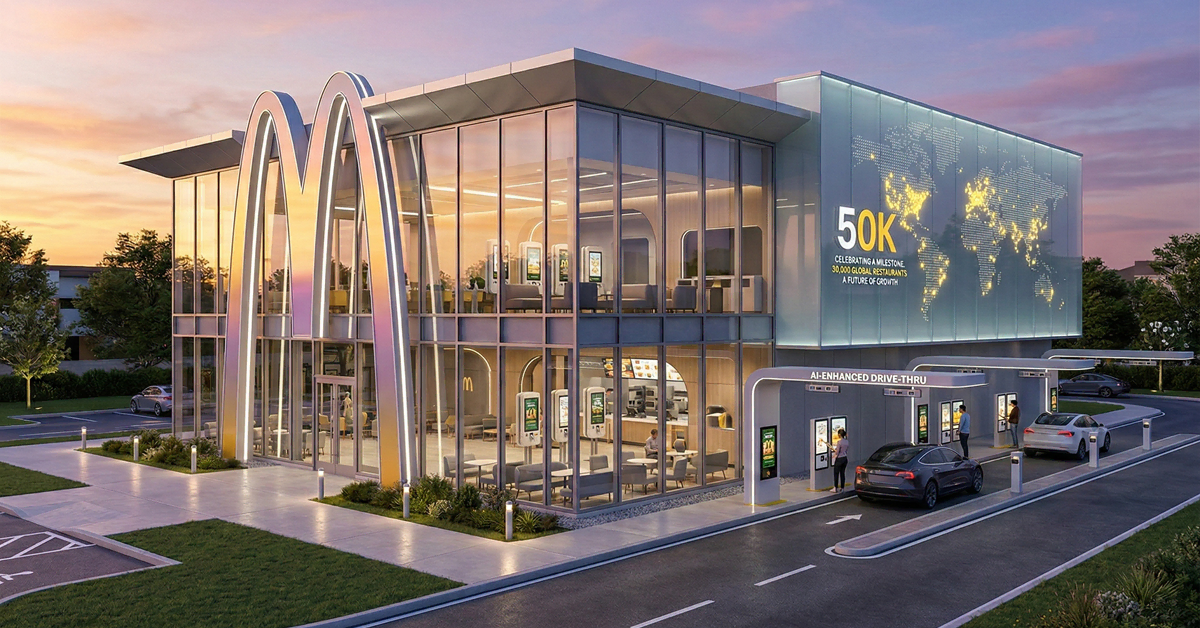
- Digital-First Design: New 2026 units are being built “Digital-First.” This means integrated kiosks, enhanced drive-thru lanes with AI-driven menu boards, and dedicated lanes for mobile order-and-pay customers. The goal is to maximize throughput, which is the primary driver of same-store sales growth in mature markets.
- Modernization: A portion of the 2026 budget is dedicated to “Project North Star,” the initiative to modernize existing locations to the latest global standards, ensuring brand consistency across the expanding fleet.
Operational Readiness and Supply Chain Synchronization
Opening 2,600 restaurants in a single year requires unprecedented coordination with global suppliers. McDonald’s has leveraged its scale to secure long-term contracts for kitchen equipment, signage, and construction materials, effectively insulating itself from the localized inflationary pressures that often plague smaller competitors. This supply chain advantage is a key reason why the company can maintain an aggressive opening schedule while others are pulling back on development.
3. Capital Expenditure Efficiency: The 3.7B to 3.9B Dollar Equation
The financial backbone of this expansion is the projected 2026 capital expenditure (CapEx) budget of 3.7 billion to 3.9 billion dollars. To an outside observer, this represents a massive increase in spending. However, for the investor, the critical metric is not the absolute dollar amount but the Return on Invested Capital (ROIC) that this spending generates.
Analyzing ROIC Impact
Historically, McDonald’s has maintained an ROIC that is significantly higher than the industry average, often exceeding 25% to 30%. The current CapEx plan is designed to sustain these levels through three primary mechanisms:
- New Store Economics: New units are reaching “cash-on-cash” payback periods faster than in previous decades. This is largely due to the higher average unit volumes (AUV) driven by delivery and digital ordering. A new store today starts with a built-in digital audience, reducing the traditional “ramp-up” period for a new location.
- Technology as a Multiplier: A significant portion of the 3.7 billion to 3.9 billion dollar budget is allocated to technology—specifically the partnership with Google Cloud and the deployment of a universal software system. By automating routine tasks and optimizing labor scheduling through AI, the company is increasing the profitability of every dollar spent on physical infrastructure.
- Asset Recycling: McDonald’s continues to act as a premier real estate company. The CapEx spent on land and building acquisition is often offset by the long-term stable rental income and royalties paid by franchisees. This “capital-light” model for operations, supported by a “capital-heavy” model for real estate ownership, creates a unique defensive-growth hybrid for shareholders.
Free Cash Flow and Dividend Sustainability
Even with the elevated CapEx, McDonald’s expects to maintain a free cash flow conversion rate in the 90% range. This is a testament to the cash-generative nature of the franchise model. For investors, this ensures that the aggressive growth strategy does not come at the expense of the dividend. McDonald’s remains a “Dividend Aristocrat,” and the 2026-2027 plan is specifically engineered to grow the earnings base required to support continued dividend hikes and share repurchases.
4. Strategic Growth Catalysts: The M-C-D Pillars
The success of the 50,000-restaurant goal relies on more than just real estate; it requires a compelling consumer proposition. The “M-C-D” (Marketing, Core, 4Ds) framework is the operational engine driving traffic to these new and existing units.
Marketing: Brand Relevance and Value Leadership
In 2026, McDonald’s is doubling down on “Value Leadership.” As global consumers face “cost-of-living” pressures, the company’s ability to offer a tiered pricing strategy—ranging from the entry-level “Dollar Menu” variants to premium signature burgers—is its greatest competitive advantage. Marketing efforts are moving away from traditional media and toward personalized offers delivered through the loyalty program, which aims to reach 250 million active users by 2027.
Core: Beef, Chicken, and the Beverage Opportunity
The menu strategy is focused on the “Core” products that drive the highest volume:
- Chicken: The company has identified chicken as a major growth vector. The “McCrispy” brand has been successfully scaled globally, and 2026 will see the introduction of new chicken-based innovations aimed at capturing the “snacking” and “health-conscious” segments.
- The Best Burger Initiative: By 2026, the “Best Burger” operational changes—designed to deliver hotter, juicier patties and toasted buns—will be implemented in nearly all global markets. This improves the quality of the core beef lineup without adding significant operational complexity.
- Coffee and McCafe: With the beverage market growing faster than the food market, McDonald’s is prioritizing its coffee business. The goal is to make McCafe a global destination for specialty coffee, rivaling dedicated coffee chains in convenience and price.
The 4Ds: Digital, Delivery, Drive Thru, and Development
Digital sales now account for over 40% of systemwide sales in the top six markets. The “4Ds” are the operational manifestations of this digital shift. By 2027, the company expects 30% of delivery orders to originate within its own mobile app, allowing it to capture valuable customer data and avoid the high commissions associated with third-party delivery platforms. The Drive Thru remains the primary channel for the U.S. market, and 2026 will see further rollouts of “Ready on Arrival” technology, which uses geofencing to ensure a customer’s order is prepared exactly as they pull into the parking lot.
5. Risk Assessment and Macroeconomic Considerations
No investment report is complete without a discussion of the risks associated with such an ambitious expansion plan. For McDonald’s, the risks are primarily external and operational.
Franchisee Economics
The “three-legged stool” (Company, Franchisees, Suppliers) is only strong if all three legs are profitable. Increased CapEx requirements and the push for modernization can put a strain on franchisee margins, particularly in a high-interest-rate environment. McDonald’s management must balance its desire for rapid growth with the financial health of its operators. In 2026, the company is focused on providing financial support and incentive programs to ensure franchisees can meet the 2027 unit targets without compromising service levels.
Labor and Regulation
Wage inflation remains a persistent challenge in the U.S. and Europe. Additionally, new regulations regarding fast-food labor (such as the FAST Act in California) create a more complex operating environment. McDonald’s response to these pressures is automation. The capital being spent today on AI and kitchen robotics is a direct hedge against the long-term trend of rising labor costs.
Geopolitical Volatility
As a global brand, McDonald’s is often a proxy for Western corporate presence. Geopolitical tensions in the Middle East and shifting trade dynamics in Asia can impact regional performance. However, the company’s “International Developmental Licensed” model mitigates much of this risk, as the local partners bear the majority of the operational and capital risk in these volatile regions.
6. Conclusion: The Investor’s Verdict
The McDonald’s of 2026 is no longer just a hamburger chain; it is a high-tech real estate and data company that happens to sell food. The trajectory to 50,000 restaurants is an ambitious, yet fundamentally sound, extension of the company’s existing strengths. By focusing on unit expansion in high-growth markets and reinvesting in efficiency-driving technology in mature markets, the company is positioning itself to capture a larger share of the global “food away from home” market.
For the long-term investor, the 3.7 billion to 3.9 billion dollar CapEx budget should be viewed as a necessary and productive investment in the future. The company’s focus on ROIC ensures that this capital is not being “spent” but rather “deployed” to generate superior returns. As the digital ecosystem matures and the 2026 unit targets are met, the resulting increase in systemwide sales and royalty streams will likely continue to drive shareholder value through the end of the decade.
The “Golden Arches” are being reinforced for a digital age. The scale, brand power, and financial discipline of McDonald’s Corporation make it a core holding for those seeking a combination of defensive stability and aggressive growth potential. As we look toward 2027, the successful execution of the current unit and capital targets will be the primary catalyst for the next leg of the company’s valuation expansion.