
Table of Contents
Executive Summary
As of early 2026, Medtronic plc (NYSE: MDT) has reached a critical structural and operational inflection point. Following several years of portfolio rationalization and a concerted effort to decentralize its business units, the world’s largest pure-play medical technology company is demonstrating its strongest organic growth in over a decade. The current fiscal year, 2026, has been characterized by the aggressive adoption of Pulsed Field Ablation (PFA) technologies, the commercial ramp-up of the Hugo robotic-assisted surgery (RAS) system, and the high-profile separation of its Diabetes business into a standalone entity, MiniMed. For investors, Medtronic represents a unique combination of defensive value and “growth-at-a-reasonable-price” (GARP) potential, backed by a robust R&D pipeline and a shifting margin profile.
Financial Performance and FY2026 Outlook
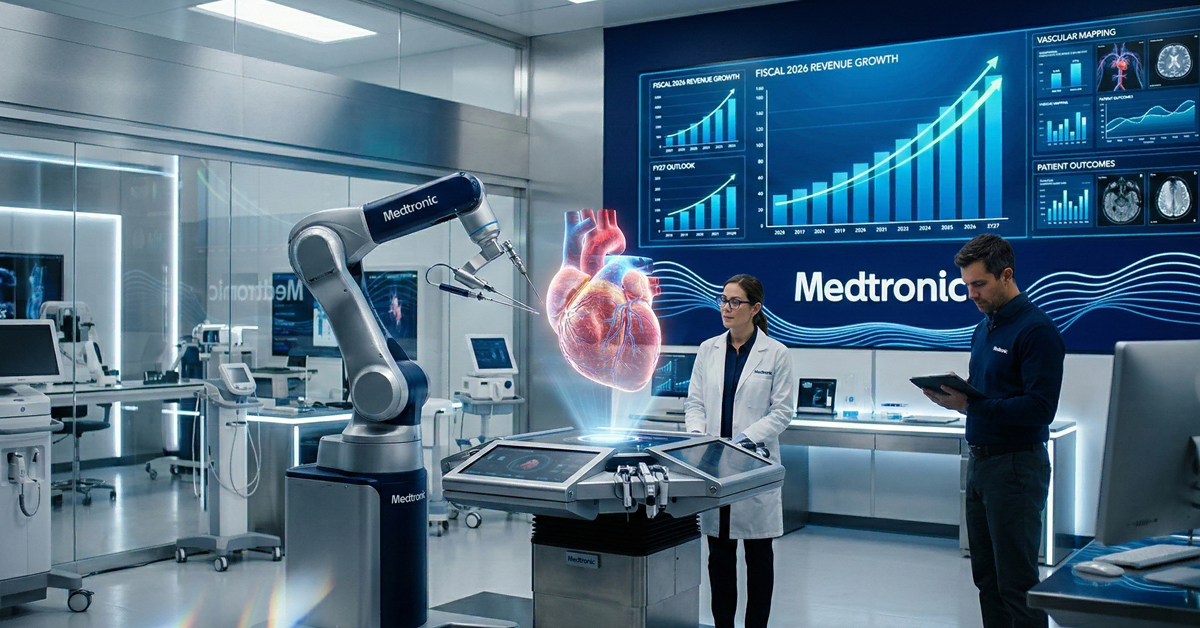
Medtronic’s third quarter of fiscal year 2026 (Q3 FY26) served as a definitive confirmation of the company’s operational turnaround. Reporting revenue of $9.017 billion, the company achieved an 8.7% increase as reported and a 6.0% increase on an organic basis. This performance exceeded consensus estimates and represented the highest enterprise revenue growth for the company in ten quarters. The momentum was broad-based, though specifically driven by the Cardiovascular and Diabetes segments.
Management has reiterated its full-year 2026 guidance, projecting organic revenue growth of approximately 5.5%. On the profitability front, non-GAAP diluted EPS is guided at $5.62 to $5.66. While Medtronic has faced industry-wide headwinds—including a potential $185 million impact from global tariffs—the company has managed to maintain its guidance, signaling strong underlying operational leverage and successful cost-efficiency programs. The focus for 2026 remains on “G&A leverage,” where the company aims to grow operating expenses at a slower rate than revenue, thereby expanding margins in the latter half of the decade.
Segment Analysis: Cardiovascular Portfolio and the PFA Revolution
The Cardiovascular Portfolio remains the crown jewel of Medtronic’s operations, contributing $3.457 billion in Q3 FY26 revenue, an increase of 13.8% as reported. Within this segment, the Cardiac Ablation Solutions (CAS) business has emerged as a hyper-growth engine, surging 80% year-over-year. This explosive growth is almost entirely attributed to the rapid adoption of Pulsed Field Ablation (PFA) technologies.
Medtronic’s Affera mapping and ablation platform, along with the Sphere-9 catheter, have allowed the company to take significant market share in the $13 billion electrophysiology market. Unlike traditional thermal ablation, PFA uses electrical fields to create lesions, which offers a higher safety profile by being tissue-selective. Medtronic’s PFA platform grew nearly 200% worldwide in the most recent quarter, and the company is on track to double its CAS revenue to a $2 billion trailing run rate by the first half of fiscal year 2027. The upcoming commercial launch of Sphere-9 in Japan and expanded indications for ventricular tachycardia (VT) in 2026 are expected to provide further tailwinds.
Medical Surgical Portfolio: The Hugo RAS and AI Integration
The Medical Surgical Portfolio, reporting $2.173 billion in revenue (up 4.9%), is currently in the midst of a multi-year product cycle centered on the Hugo robotic-assisted surgery system. Having secured FDA clearance for urologic procedures in late 2025, the U.S. commercial ramp-up is now in full swing. Hugo is designed to address the high cost and space barriers associated with legacy robotic systems, offering a modular, portable design that can be moved between operating rooms.
A key differentiator for Medtronic in the surgical space is the Touch Surgery digital ecosystem. This AI-powered data and analytics technology has surpassed 1,000 global installations. By integrating AI into the operating room, Medtronic provides surgeons with real-time feedback and video analytics, which enhances procedure predictability and training. In 2026, the company plans to seek expanded indications for Hugo in hernia and general surgery, which will significantly increase its total addressable market in the United States and Europe.
Neuroscience: Leading in Precision Medicine
Medtronic’s Neuroscience Portfolio reported $2.558 billion in revenue, driven by strong performance in Cranial & Spinal Technologies (CST) and Neuromodulation. The flagship product in this segment is the Stealth AXiS platform, which saw its commercial launch in early 2026. Stealth AXiS integrates robotics with advanced navigation, allowing for high-precision spinal and cranial surgeries.
The company is also seeing success with the NeuroGuard IEP Carotid Stent and the Percept PC deep brain stimulation (DBS) system. By leveraging Sensing-enabled DBS technology, Medtronic is moving toward “closed-loop” therapies that can automatically adjust stimulation based on a patient’s unique brain signals. This level of personalization is a major competitive advantage against peers like Abbott and Boston Scientific in the neuromodulation space.
The MiniMed Spin-Off: Strategic Rationale and Value Creation
One of the most significant events of 2026 is the planned separation of the Diabetes business. Operating under the revived “MiniMed” brand, the business filed for its initial public offering (IPO) in late 2025. The IPO, valuing the entity at approximately $7.86 billion, is the first step in a two-stage separation process expected to be completed by the end of the 2026 calendar year.
The decision to spin off Diabetes is strategic. While the segment is currently growing rapidly—up 14.8% to $796 million in Q3 FY26—it operates on a different commercial model than Medtronic’s core medtech businesses. MiniMed is a direct-to-consumer, pharmacy-channel-heavy business that requires different capital allocation and R&D priorities. For Medtronic, the separation allows for a more intense focus on its highest-margin growth drivers. For shareholders, the spin-off unlocks the value of the MiniMed 780G system and the Simplera sensor, which have seen massive success in the EMEA region and are gaining traction in the U.S. market.
Strategic Growth Pillar: Hypertension and the Symplicity Spyral
Medtronic is pioneering a new market in the treatment of hypertension through its Symplicity Spyral renal denervation (RDN) system. Hypertension, often called “the silent killer,” affects over 1 billion people globally. The Symplicity Spyral offers a minimally invasive, one-time procedure to permanently lower blood pressure by denervating the nerves in the renal arteries.
In 2026, Medtronic launched its “Go Beyond” direct-to-consumer campaign in the U.S., resulting in a 50-fold increase in patient inquiries. With clinical data now supporting the long-term safety and efficacy of RDN, and with reimbursement pathways widening, this platform is positioned to become a multi-billion dollar revenue contributor over the next five years. This represents a classic Medtronic strategy: building a completely new therapeutic market where it holds a dominant, first-mover position.
AI-Enabled Healthcare: The Digital Transformation
Medtronic is no longer just a hardware company; it is becoming a digital health leader. The integration of artificial intelligence across its portfolio is exemplified by GI Genius, the first FDA-cleared AI-assisted colonoscopy system. GI Genius helps physicians detect polyps that might be missed by the human eye, with studies showing a 50% reduction in missed polyps.
Furthermore, the company’s AI efforts extend to its pulse oximetry and patient monitoring systems, where predictive algorithms can alert clinicians to potential respiratory failure or cardiac events hours before they occur. In the 2026 investment landscape, Medtronic’s ability to monetize “insight-driven care” through software subscriptions and service contracts is a key component of its long-term margin expansion strategy.
Mergers, Acquisitions, and Capital Allocation
Medtronic’s M&A strategy in 2026 has shifted toward “tuck-in” acquisitions that bolster existing pipelines. A notable example is the exercise of the option to acquire CathWorks, an Israeli company specializing in AI-powered coronary imaging. This acquisition strengthens Medtronic’s Interventional Cardiology business by adding non-invasive FFR (Fractional Flow Reserve) capabilities.
The company’s capital allocation priority remains its dividend. Medtronic is a member of the S&P 500 Dividend Aristocrats index, having increased its dividend for 48 consecutive years. In May 2025, the board approved another increase, signaling confidence in the company’s cash flow generation despite the heavy R&D investments required for the Hugo and PFA rollouts. Currently, the dividend yield remains attractive for income-oriented investors, providing a solid floor for the stock price.
Risk Factors and Market Challenges
Despite the positive momentum, investors must weigh several risk factors. First, the medical device industry is highly sensitive to changes in global trade policy. Medtronic’s FY26 guidance includes a significant buffer for tariffs, but any further escalation in trade tensions could pressure gross margins. Second, the Hugo RAS system faces stiff competition from Intuitive Surgical’s Da Vinci platform, which has a massive installed base and deep institutional loyalty. Medtronic’s success in robotics depends on its ability to prove superior cost-of-ownership and clinical outcomes.
Additionally, the separation of the Diabetes business is not without execution risk. While the IPO has been well-received, the full spin-off will be slightly dilutive to Medtronic’s EPS in the short term (estimated at $0.01 to $0.02 per month until the full split). Finally, regulatory hurdles remain a constant; any delays in FDA clearances for new Hugo indications or next-generation PFA catheters could slow the projected revenue acceleration.
Valuation and Analyst Consensus
As of March 2026, Medtronic’s stock is trading in the $97 to $100 range. Wall Street analysts maintain a consensus “Buy” rating, with an average 12-month price target of $111.92. This suggests an upside of approximately 15% from current levels, not including the dividend yield. Analysts are particularly bullish on the company’s “operational turnaround” narrative, noting that the mid-single-digit organic growth is now sustainable rather than a post-pandemic recovery fluke.
The company’s forward P/E ratio is currently more attractive than many of its peers in the medtech space, such as Boston Scientific or Stryker, which often trade at higher premiums. This valuation gap is expected to narrow as Medtronic demonstrates consistent margin expansion and completes the MiniMed spin-off, which will result in a “purer” medtech profile for the remaining company.
Conclusion
Medtronic is successfully executing its roadmap to become a faster-growing, more focused healthcare technology leader. By leading the charge in PFA, expanding the footprint of robotic surgery, and leveraging AI to improve patient outcomes, the company has diversified its growth drivers beyond its traditional pacing and spine businesses. For the long-term investor, the 2026 fiscal year represents an opportune moment to gain exposure to a global leader that is successfully pivoting toward high-growth, high-margin therapeutic areas while maintaining its commitment to shareholder returns. The upcoming completion of the MiniMed spin-off will serve as the final catalyst in this multi-year transformation, leaving behind a more agile and profitable Medtronic.