
Table of Contents
Top 10 Best-Performing Indian ETFs (1-Year Returns)
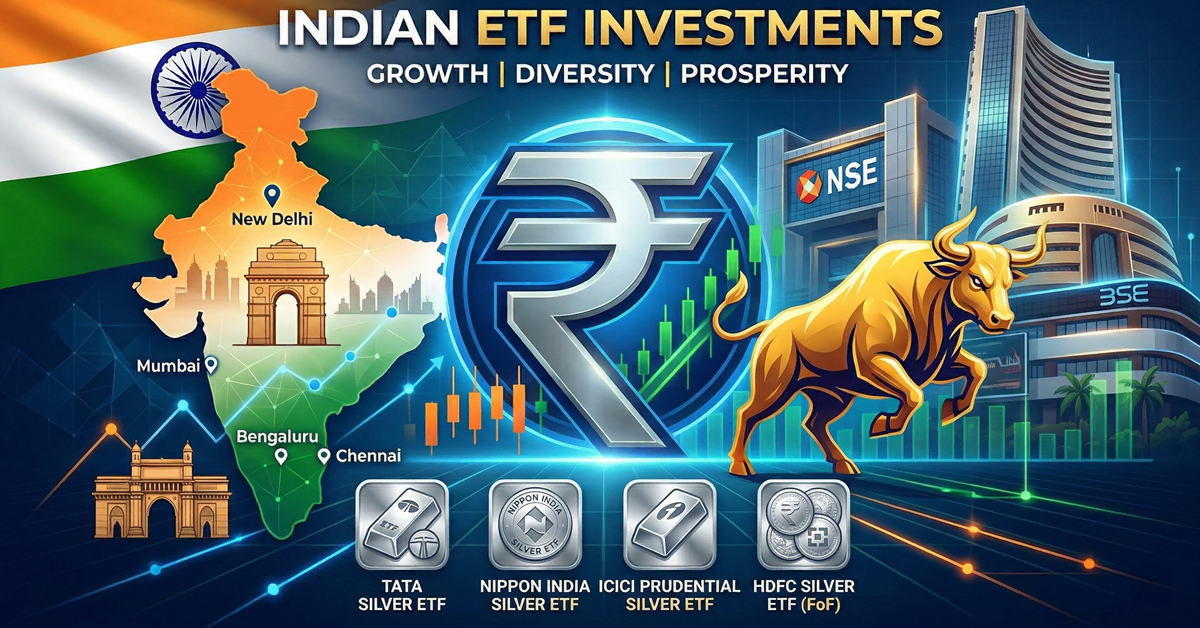
Based on 1-year trailing returns (as of early 2026), the top ETFs in India are overwhelmingly silver-oriented commodity funds. For example, Tata Silver ETF delivered +175.77%, Nippon India Silver ETF +174.28%, ICICI Prudential Silver ETF +175.58%, HDFC Silver ETF (FoF) +176.5%, SBI Silver ETF +174.24%, Kotak Silver ETF +170.52%, Axis Silver ETF +174.38%, Mirae Asset Silver ETF +174.49%, DSP Silver ETF +175.39% and Edelweiss Silver ETF +173.81%.
- Tata Silver ETF – Expense ratio 0.44%; holdings: physical silver bullion (≈100%) in a silver commodity index; 1‑year return +175.8%. Targeted at investors seeking high-risk exposure to silver prices as a commodity hedge.
- Nippon India Silver ETF – Expense ratio 0.56%; invests in physical silver (tracks domestic silver price); 1‑year +174.3%. Suits investors wanting regulated, liquid silver exposure without holding bullion.
- ICICI Prudential Silver ETF – Expense 0.40%; silver holdings ~100%; 1‑year +175.6%. Appropriate for risk-tolerant investors as a diversification play in precious metals.
- HDFC Silver ETF (FoF) – Expense 0.23%; fund‑of‑fund that invests ~101% in HDFC Silver ETF; 1‑year +176.5%. Targets investors looking for efficient silver commodity exposure; carries exit load on short-term redemption.
- SBI Silver ETF – Expense 0.40%; physical silver holdings; 1‑year +174.2%. Best for those seeking liquid silver exposure in their portfolio.
- Kotak Silver ETF – Expense 0.45%; holds physical silver; 1‑year +170.5%. Fits commodity‑focused investors.
- Axis Silver ETF – Expense 0.40%; physical silver; 1‑year +174.4%. For investors wanting to ride silver price uptrend.
- Mirae Asset Silver ETF – Expense 0.33%; physical silver; 1‑year +174.5%. Appeals to those aiming to hedge inflation or geopolitical risk via silver.
- DSP Silver ETF – Expense 0.40%; physical silver; 1‑year +175.4%. Suited for investors comfortable with volatile commodity ETFs.
- Edelweiss Silver ETF – Expense 0.47%; physical silver; 1‑year +173.8%. Targets similar high-risk commodity investors.
Each of these ETFs holds almost exclusively silver bullion (one of India’s “precious metal” commodities) rather than stocks, so their sector allocation is essentially “precious metals/commodity” only. Investor style is aggressive/commodity-oriented: silver ETFs “offer a cost-efficient, regulated way to access silver’s upside without handling physical metal”, and are generally used as a high-risk hedge component (often recommended to be only ~10–15% of a diversified portfolio).
Recent Indian Economic Trends
India’s economy in 2025–26 has been marked by robust growth and very low inflation. GDP growth is running near 7–8% (e.g. 8.2% YoY in Q2 FY2025/26) fueled by strong private consumption and rising incomes. Inflation averaged only ~1.7–1.8% in FY25, due in part to stable food prices and GST reforms. Government capex has accelerated (capex growth ~51.8% usage in H1 FY26), and manufacturing and services are expanding rapidly. Externally, India faced higher US tariffs on some exports, but projected to benefit from new trade deals. The IMF also notes that India’s economy “continued to perform well” – FY24/25 growth ~6.5%, Q1 FY25/26 at +7.8%, with “headline inflation [markedly] declined” on subdued food prices. The INR has seen pressure from global volatility (causing some currency depreciation), but foreign reserves remain sizable (around USD 560B as of Jan 2026).
Impact of Macroeconomics on ETF Performance
These macro factors influenced ETF returns, especially the silver ETFs. In particular, India’s Equity markets and broad ETFs have benefited from economic resilience (strong consumption, capex and investment). However, the silver ETFs’ extraordinary returns are driven largely by global and domestic commodity factors: as noted in India’s Economic Survey, gold and silver “touched lifetime highs in 2025” due to a weakening US dollar, persistently negative real interest rates, and safe-haven demand amid global uncertainty. In other words, global geopolitics and monetary trends (external to India) have propelled silver prices, which in turn drove the ETF gains. Locally, India has even become the world’s largest silver importer (2025 imports jumped ~44% to $9.2 billion), reflecting surging industrial demand (e.g. solar power, electronics use of silver) and investor hoarding. The GTRI report highlights that beyond safe-haven buying, “more than half of global silver consumption is now industrial, with high demand in electronics, solar power, electric vehicles…15% from solar alone”. Simultaneously, global supply deficits of silver and supply-chain constraints (e.g. China export curbs) have tightened markets.
In summary, while India’s domestic growth and low inflation have supported broad market ETFs (and suggest continued economic strength), the silver ETFs’ performance owes largely to global commodity pressures. The Reserve Bank’s relatively accommodative stance (borne out by benign inflation) also kept real interest rates low, which historically boosts precious metal investments. A weaker rupee (driven by capital flows and trade factors) further magnified silver returns in INR terms. Thus Indian ETF investors saw outsized gains from commodities ETFs underpinned by both internal liquidity conditions and external safe-haven/industrial demand factors.
Investor Strategy (India ETFs Outlook)
Given this analysis, an investor strategy might involve balanced allocation aligned with India’s economic outlook. On one hand, India’s strong GDP growth, rising consumption and investment (with inflation under control) argue for maintaining significant exposure to equity/index ETFs (e.g. broad Nifty/BSE index funds or sector ETFs in finance/infrastructure). On the other hand, a modest allocation to commodity ETFs (especially the top silver ETFs) can serve as a hedge against uncertainty. However, the silver rally may have peaked: the Economic Survey cautions the 2025 metals surge may not fully persist. Thus investors might book some profits in silver funds, using them as a tactical hedge (e.g. 10–15% of portfolio as suggested), while rotating new funds into fundamentally driven areas of the economy. In sum, continue to participate in India’s growth story via diversified equity/index ETFs, but keep a controlled exposure to high-performing silver ETFs for diversification – consistent with one’s risk appetite.