
Table of Contents
Executive Summary
Trane Technologies (NYSE: TT) is undergoing a fundamental valuation and operational paradigm shift. No longer strictly classified as a traditional industrial manufacturer of heating, ventilation, and air conditioning (HVAC) equipment, Trane is rapidly repositioning itself as a premier provider of mission-critical thermal infrastructure. As the proliferation of generative artificial intelligence (AI) drives unprecedented power densities in data centers, thermal management has transitioned from a facility afterthought to a primary rate-limiting factor for global compute capacity.
This comprehensive investor report evaluates Trane Technologies’ strategic trajectory, focusing on three core pillars of its growth narrative. First, we analyze the “Chip-to-Chiller” integration strategy, highlighted by the strategic acquisitions of LiquidStack and Stellar Energy in early 2026, which bridges the gap between traditional central plant cooling and high-density, on-chip thermal management. Second, we investigate the macroeconomic insulation provided by the company’s record $7.8 billion backlog, examining how a pivot toward complex, long-cycle applied solutions offers unparalleled revenue visibility into 2027. Finally, we evaluate the structural outperformance of Trane’s Americas Commercial HVAC division, specifically analyzing how its direct sales model captures disproportionate market share in specialized, high-margin verticals such as healthcare, higher education, and high-tech manufacturing.
The Thermal Bottleneck: Macroeconomic and Technological Context
The global data center footprint is undergoing a massive architectural overhaul. Historically, enterprise and hyperscale data centers operated at rack power densities of 5 to 15 kilowatts (kW). Traditional computer room air handler (CRAH) units, raised floors, and cold-aisle containment systems—areas where Trane has historically dominated—were more than sufficient to reject the heat generated by these general-purpose compute loads.
However, the deployment of advanced AI accelerators and next-generation graphics processing units (GPUs) has fundamentally altered the thermal equation. Modern AI clusters routinely demand rack densities exceeding 50 kW, with next-generation architectures projected to surpass 100 kW to 120 kW per rack. At these extreme densities, traditional air cooling is constrained by the laws of thermodynamics; air simply lacks the thermal mass to absorb and transport heat away from the silicon fast enough to prevent thermal throttling or catastrophic hardware failure. Consequently, hyperscalers, colocation providers, and enterprise operators are being forced to adopt hybrid and fully liquid-cooled infrastructures. Trane Technologies recognized this inflection point early, pivoting its capital allocation strategy to capture the entirety of the cooling value chain.
The “Chip-to-Chiller” Integration: Strategic M&A Accelerating High-Density Cooling
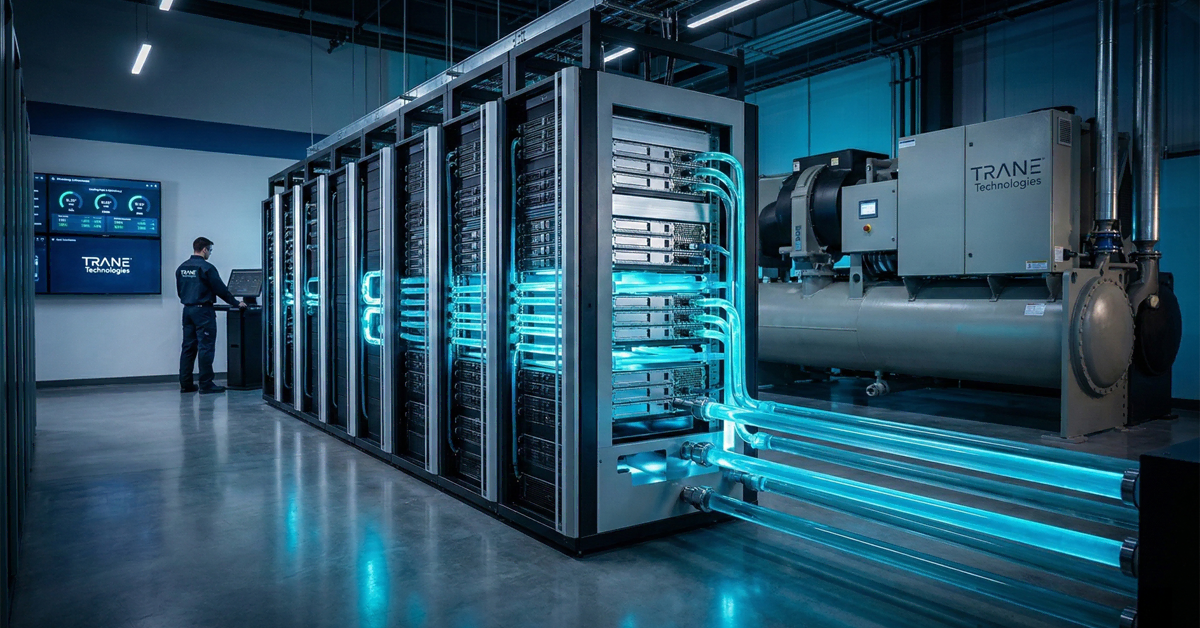
The first quarter of 2026 marked a watershed moment for Trane Technologies’ inorganic growth strategy. By finalizing the acquisitions of Stellar Energy in February 2026 and LiquidStack in March 2026, Trane executed a vertical integration maneuver that firmly establishes a “Chip-to-Chiller” ecosystem. This capability allows Trane to service the entire thermal loop of an AI data center, creating a wide competitive moat against peers who only provide fragmented components of the cooling stack.
The Physics of AI Compute and the Necessity of Liquid Cooling
To understand the strategic imperative behind Trane’s recent acquisitions, one must look at the underlying physics of heat rejection in mission-critical environments. The fundamental equation governing thermal management is expressed as:
Where represents the total heat transfer rate (the thermal load of the IT equipment), is the mass flow rate of the cooling medium, is the specific heat capacity of the fluid, and is the temperature differential between the supply and return states.
Because the specific heat capacity () of engineered dielectric fluids and treated water is orders of magnitude higher than that of air, liquid mediums can remove exponentially more heat per unit of volume. Furthermore, liquid cooling drastically reduces the parasitic energy load of facility fans, thereby improving the data center’s Power Usage Effectiveness (PUE)—a critical metric for sustainability and operational expenditure. Trane’s legacy business optimized the macro-level of the facility; its new acquisitions allow it to optimize the micro-level directly at the silicon level.
LiquidStack: Capturing the Direct-to-Chip and Immersion Imperative
On March 3, 2026, Trane Technologies announced the completion of its acquisition of LiquidStack, a recognized global leader in liquid cooling technology. Originally rooted in the extreme high-density requirements of cryptocurrency mining, LiquidStack evolved to engineer sophisticated direct-to-chip coolant distribution units (CDUs) and single-phase/two-phase immersion cooling systems tailored for generative AI and hyperscale workloads.
The strategic rationale for this acquisition is multifold:
- Total Addressable Market (TAM) Expansion: By integrating LiquidStack’s DataTank™ and direct-to-chip CDUs, Trane immediately captures wallet share inside the white space of the data center, moving beyond the mechanical yard.
- Systemic Optimization: Customers no longer need to triangulate between a chip-cooling vendor, a piping contractor, and a chiller manufacturer. Trane can now guarantee end-to-end thermal performance, ensuring that the fluid temperatures leaving the LiquidStack CDUs are perfectly synchronized with the return water temperatures expected by Trane’s centrifugal chillers.
- Talent and Intellectual Property: The acquisition brings a specialized global engineering team operating out of Texas and Hong Kong into the Trane ecosystem, bypassing the years of R&D required to build high-performance liquid systems natively.
Stellar Energy: Modular Infrastructure and Speed-to-Market
Just weeks prior to the LiquidStack close, Trane completed the acquisition of Stellar Energy in February 2026. Stellar Energy specializes in turnkey, modular data center cooling solutions. In the current AI arms race, speed-to-market is the ultimate currency for hyperscalers. Traditional stick-built cooling plants require extensive on-site construction, complex labor scheduling, and exposure to supply chain delays.
Stellar Energy’s pre-fabricated modular thermal systems allow entire cooling plants to be built, tested, and commissioned in a controlled factory environment before being shipped to the data center site. When combined with Trane’s operational excellence and vast manufacturing footprint, the Stellar Energy acquisition allows Trane to offer “cooling-as-a-product” at a massive scale. This reduces deployment timelines by months, a value proposition that gives Trane significant pricing power and preferred vendor status among top-tier cloud providers.
Synergistic Financial Impact of the End-to-End Stack
The financial implications of the “Chip-to-Chiller” integration are profound. Data center cooling is evolving from a capital expenditure (CapEx) line item to a critical enabler of revenue generation for cloud providers. By offering an integrated suite—from the LiquidStack CDU on the server rack, through the Stellar Energy modular distribution loop, out to the Trane central chiller plant—Trane secures a higher initial ticket size and embeds itself deeply into the facility’s control systems. This embedded nature drastically increases the likelihood of capturing the lucrative, high-margin, multi-decade service contracts that follow the initial equipment installation.
Backlog Resilience as a Leading Indicator of De-Risked Growth
In the Q4 2025 earnings report (released in late January 2026), Trane Technologies reported a record-breaking backlog of $7.8 billion, representing a 15% year-over-year increase. For institutional investors evaluating industrial equities, absolute backlog size and the composition of that backlog are premier leading indicators of future revenue realization and margin durability.
Deconstructing the Record $7.8 Billion Backlog
The magnitude of the $7.8 billion backlog cannot be overstated. It provides Trane with exceptional visibility into its revenue stream through 2026 and well into 2027. However, it is the composition of this backlog that forms the strongest element of the bull thesis. The backlog is heavily skewed toward Commercial HVAC, specifically in the Americas, which saw its segment backlog increase by 25% compared to the end of 2024. The EMEA segment backlog grew by an even more impressive 40%.
Applied Solutions and the Long-Cycle Buffer
A critical driver of this backlog growth is the outperformance of “Applied Solutions.” Applied systems are highly engineered, custom-configured HVAC systems designed for large-scale commercial and industrial applications. In Q4 2025, Trane reported that applied bookings surged by more than 120%, achieving an astronomical book-to-bill ratio of 200%. This marks the second consecutive quarter where applied bookings growth exceeded 100%.
Applied solutions are inherently long-cycle. The time from initial consultation to booking, manufacturing, delivery, and final commissioning can span 12 to 24 months. By securing a massive pipeline of these complex projects, Trane is effectively building a revenue shock absorber. Furthermore, applied systems boast the highest service attachment rates in the portfolio. Once a custom Trane centrifugal chiller is integrated into a hospital or data center, the facility is highly likely to sign a long-term service agreement with Trane to maintain it, generating a recurring, high-margin revenue tail that lasts for the 20- to 30-year lifespan of the equipment.
Mitigating Short-Cycle Volatility
The strategic value of this long-cycle backlog was distinctly demonstrated in late 2025. Trane faced significant headwinds in its shorter-cycle businesses. The residential HVAC market experienced a mid-teens revenue decline in Q4 2025 as the company intentionally restricted production to normalize channel inventory and maintain pricing discipline. Similarly, the transport refrigeration segment (Thermo King) navigated cyclical softness, outperforming a broader market that declined more than 20%, but still posting low-single-digit revenue drops.
In a traditional industrial conglomerate, concurrent declines in residential and transport markets would severely compress enterprise margins and derail earnings. However, because of the overwhelming strength of the long-cycle commercial backlog, Trane still achieved a 4% organic enterprise revenue growth and a 10% increase in adjusted EPS. The commercial HVAC backlog functionally de-risks the company against consumer-driven macroeconomic volatility.
Vertical Specialization and Direct Sales Outperformance in the Americas
Trane’s Americas Commercial HVAC segment is the primary growth engine of the enterprise, delivering a staggering 35% organic bookings growth in Q4 2025. While secular tailwinds like data center expansion contribute to this, a significant portion of this outperformance is structural, rooted in Trane’s go-to-market strategy and vertical specialization.
The Structural Advantage of a Direct Sales Force
Unlike many of its competitors who rely heavily on independent wholesale distributors to push equipment into the commercial market, Trane utilizes a direct sales force for its applied and complex commercial systems. Trane’s sales representatives are typically degreed engineers who act as consultative partners rather than mere equipment vendors.
This direct model is a massive competitive advantage. Trane engineers engage with facility owners, architects, and specifying engineers years before a building’s foundation is poured. By consulting on the thermodynamic design and energy efficiency modeling of the facility, Trane embeds its proprietary equipment specifications directly into the blueprints. This “spec-in” advantage drastically increases win rates, protects pricing power, and prevents value engineering by general contractors later in the construction cycle.
High-Tech Manufacturing and Mission-Critical Facilities
Trane’s direct sales model is tailor-made for the most complex and demanding verticals. Beyond data centers, Trane is heavily capitalizing on the renaissance of high-tech manufacturing in North America. Spurred by supply chain nearshoring, the CHIPS and Science Act, and the Inflation Reduction Act (IRA), billions of dollars are flowing into the construction of semiconductor fabrication plants (fabs) and electric vehicle (EV) battery gigafactories.
These facilities require absolute precision in environmental control. Semiconductor lithography processes can be ruined by microscopic fluctuations in temperature, humidity, or particulate matter. Trane’s ability to deliver customized applied air handling units, paired with advanced building automation controls, makes it the vendor of choice for these high-stakes manufacturing environments where HVAC failure equates to millions of dollars in scrapped product.
Healthcare and Higher Education: Decarbonization as a Catalyst
In the healthcare and higher education verticals, the growth thesis is driven by regulatory pressures, decarbonization mandates, and deferred maintenance. Hospitals require stringent air changes per hour (ACH) to maintain sterile environments and prevent hospital-acquired infections (HAIs). Higher education campuses operate aging district cooling plants that are highly inefficient and rely on fossil fuels.
Trane’s energy services division thrives in these environments by offering comprehensive energy retrofits. Through Energy Savings Performance Contracts (ESPCs), Trane can upgrade a university’s central plant to electrified, highly efficient chillers and heat pumps, guaranteeing that the energy savings will cover the cost of the capital equipment over time. This consultative, outcome-based selling is impossible to execute through a traditional distribution channel, further validating Trane’s direct-to-market architecture.
Financial Outlook, Margins, and Valuation Perspectives
The operational successes detailed above are translating cleanly into robust financial guidance and shareholder returns. The visibility provided by the $7.8 billion backlog allowed management to issue highly confident initial guidance for 2026 during their late January earnings call.
2026 Guidance and Margin Expansion
Trane initiated 2026 guidance forecasting 6% to 7% organic revenue growth, with total reported revenue growth expected to reach 8.5% to 9.5% (factoring in the closed M&A of LiquidStack and Stellar Energy, alongside minor FX tailwinds). More importantly, the company guided to an adjusted EPS of $14.65 to $14.85, representing a 12% to 14% year-over-year increase.
Management is targeting organic incremental margins of 25% or better across all segments in 2026. Despite integrating acquisitions and navigating lingering supply chain inflation, Trane’s pricing power remains exceptionally strong. The company expects pricing to contribute approximately 1.5 points to growth, demonstrating its ability to pass costs through to customers without sacrificing volume—a hallmark of a high-quality industrial compounder.
Capital Allocation and Free Cash Flow Yield
Trane Technologies operates as a highly efficient cash-generation machine. In 2025, the company reported a free cash flow conversion rate of 98% of adjusted net earnings, generating roughly $2.9 billion in FCF. This liquidity allows Trane to play a dominant game in capital allocation.
In 2025, Trane deployed or committed $3.2 billion across dividends, strategic M&A, and share repurchases, and it anticipates deploying an additional $2.8 to $3.3 billion in 2026. The company recently increased its quarterly dividend by 12% to $1.05 per share. With $4.7 billion remaining under its current share repurchase authorization, Trane possesses the flexibility to aggressively buy back stock if the broader market experiences a multiple compression, effectively setting a floor on the equity valuation.
Conclusion
Trane Technologies has successfully transcended its legacy industrial roots to become an indispensable partner in the global expansion of high-performance computing, advanced manufacturing, and sustainable infrastructure. The strategic acquisitions of LiquidStack and Stellar Energy complete a highly defensible “Chip-to-Chiller” ecosystem, perfectly positioning the company to capture outsized value from the generative AI boom.
Supported by a record $7.8 billion backlog that heavily indexes toward long-cycle, high-margin applied systems, Trane has insulated its commercial growth from short-term consumer volatility. Its consultative, direct sales force continues to win disproportionate market share in the Americas, transforming equipment sales into multi-decade, recurring revenue service relationships. For investors seeking exposure to the AI infrastructure super-cycle paired with the downside protection of a world-class industrial compounder, Trane Technologies represents a highly compelling, de-risked growth asset.