
Table of Contents
Executive Summary
As of early 2026, Rheinmetall AG has completed its metamorphosis from a diversified industrial conglomerate into a “Global Defense Champion.” This transition, articulated through a rigorous “pure-play” strategy, has fundamentally altered the company’s risk profile, valuation multiples, and strategic importance within the European security architecture.
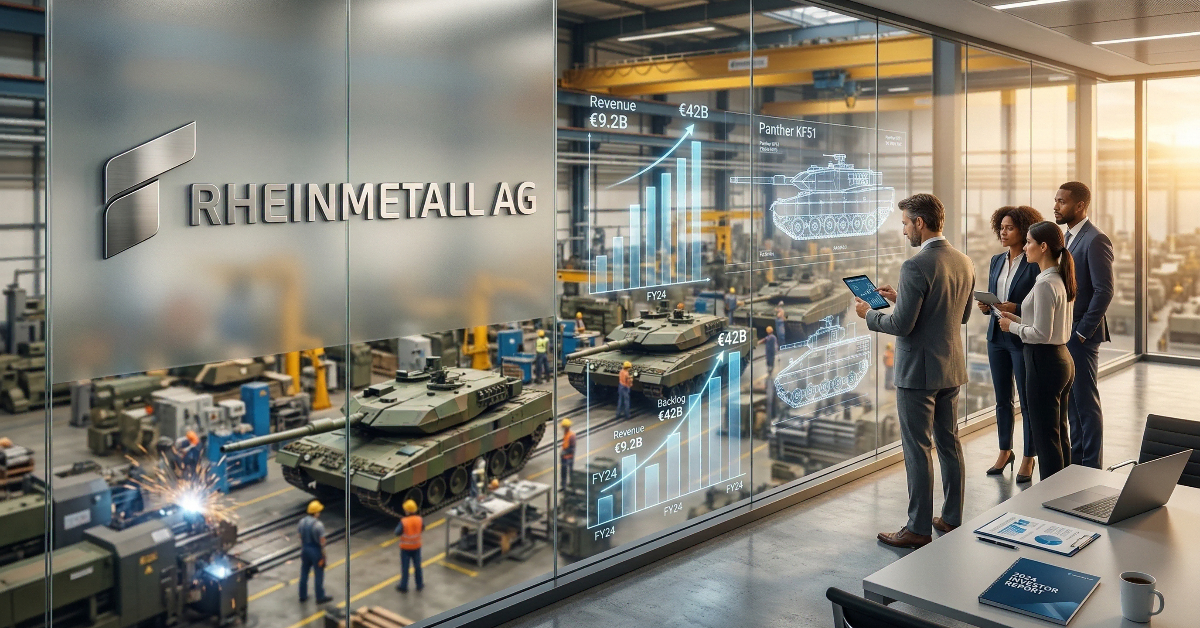
By aggressively divesting its legacy internal combustion engine (ICE) components businesses—most notably the final preparations for the sale of its Power Systems division in February 2026—Rheinmetall has decoupled itself from the cyclical and structural headwinds of the automotive sector. In its place, the company has erected a defense powerhouse with a record-breaking backlog of over €64 billion and a “Vision 2030” roadmap targeting €50 billion in annual sales.
For investors, this shift represents a “re-rating” event. Rheinmetall is no longer valued as a Tier-1 auto supplier; it is now priced as a “geopolitical utility” and a “volume moat” play. However, this high-growth trajectory comes with unique challenges: a paradoxical relationship between record profits and negative free cash flow (FCF) driven by massive working capital requirements, and an unprecedented reliance on the sustained “Zeitenwende” (turning point) in European defense spending.
The “Pure-Play” Pivot: Shedding the Civilian Skin
The cornerstone of Rheinmetall’s strategy has been the systematic elimination of “conglomerate discounts” by exiting the civilian automotive market. Management recognized early that the transition to electric vehicles (EVs) made their legacy piston and valve businesses a “melting ice cube.”
1. The Piston Divestment (2023–2024)
The first major steps involved the disposal of the high-margin but low-growth piston business.
- Large-Bore Pistons: Sold in January 2023.
- Small-Bore Pistons: The “Kolbenschmidt” brand, employing over 3,650 people across six countries, was sold to Comitans Capital AG, with the deal closing in April 2024. This move effectively removed Rheinmetall’s exposure to the most carbon-intensive and structurally challenged part of the automotive supply chain.
2. The Final Frontier: Power Systems Sale (2026)
As of February 2026, Rheinmetall has advanced preparations for the sale of its remaining Power Systems division. This division, which produces sensors, actuators, and pumps, was the final bridge to the civilian world. By exiting this segment, Rheinmetall becomes a 100% focused defense and security entity.
Investor Takeaway: This pure-play status allows for “clean” valuation. Analysts no longer need to apply blended multiples. Instead, the focus is entirely on defense margins, which—at 15-18%—are significantly superior to the low single digits seen in the automotive components sector.
The Defense Powerhouse: Vision 2030 and Strategic M&A
Rheinmetall is not just shrinking to grow; it is expanding its defense footprint through aggressive capital deployment. The “Pure-Play” strategy is fueled by three core pillars: Ammunition Dominance, Land Systems Scalability, and Digital Integration.
1. The “Volume Moat” in Ammunition
While U.S. defense primes like Lockheed Martin focus on high-cost, low-volume systems integration, Rheinmetall has cornered the market on “industrial mass.” Through the acquisition of Expal Systems (Spain) and the construction of 13 new plants across Europe (including Lithuania, Hungary, and Germany), Rheinmetall has scaled its 155mm artillery ammunition production capacity to approximately 1.1 million rounds annually.
In a world defined by a return to high-intensity conventional warfare, this capacity is a monopoly-like asset. Rheinmetall is currently the only European player capable of meeting NATO’s attrition-rate demands, giving it immense pricing power and securing multi-decade framework agreements.
2. Strategic M&A: Buying the Capacity
Management has used its surging share price and improved credit rating to acquire “ready-made” capacity:
- Loc Performance (USA): Acquired to facilitate entry into the lucrative U.S. Army XM30 Infantry Fighting Vehicle program.
- NVL (Planned): The acquisition of Lürssen’s naval division expands Rheinmetall’s reach into the maritime domain, ensuring it is a “full-spectrum” provider across Land, Air, Sea, and Space.
3. Vision 2030 Targets
CEO Armin Papperger’s Vision 2030 is arguably the most ambitious in the sector:
- Sales: ~€50 billion (up from ~€7.5 billion in 2024).
- Operating Margin: >20% (driven by economies of scale in ammunition and vehicle platforms).
- Cash Conversion: >50% (targeted for the end of the decade as factory builds conclude).
Operational Scaling: From Blueprint to Battlefield
The “Pure-Play” strategy is only as good as its execution. In 2025 and 2026, Rheinmetall moved from “booking orders” to “building factories.”
The “Rheinmetall Speed” Doctrine
The company has pioneered a new model of industrial mobilization. Instead of waiting for government funding, Rheinmetall has front-loaded investments (often referred to as “Success Capital”).
- The Ukraine Joint Venture: By building armored vehicle production and repair facilities directly within Ukraine, Rheinmetall has secured its position as the primary industrial partner for Eastern European defense.
- The Lynx and Panther Platforms: The KF41 Lynx (Infantry Fighting Vehicle) and the KF51 Panther (Main Battle Tank) are being positioned as the future standard for NATO. Orders from Italy and Hungary have validated these platforms, creating a “locked-in” ecosystem for decades of maintenance and upgrades.
What the Pure-Play Strategy Means for Investors
The transformation of Rheinmetall has created a unique investment case that requires a departure from traditional industrial analysis.
1. Valuation Re-rating: The Multiple Expansion
Historically, Rheinmetall traded at a P/E ratio of 12x to 15x, consistent with the German “Mittelstand” automotive suppliers. In 2026, the stock (RHM) is trading at multiples exceeding 80x trailing earnings and 23x forward EBITDA.
Investors are now capitalizing the €64 billion backlog as if it were risk-free sovereign debt. The market is pricing in the “mathematical inevitability” of this backlog converting into revenue. Rheinmetall is no longer a cyclical stock; it is a structural growth play on European re-armament.
2. The Cash Flow Paradox: “The Growth Tax”
A critical point of concern for investors in late 2025 and early 2026 has been negative operating free cash flow. Despite record profits, the company is “burning” cash.
- Why? To fulfill massive NATO orders, Rheinmetall must build inventory (raw materials, explosives, steel) and expand factories.
- The Risk: The company is effectively acting as a bank for NATO. While the P&L looks elite, the balance sheet is heavy with working capital. Investors must distinguish between “distress burn” and “success burn.” At Rheinmetall, it is definitively the latter, but it leaves the company sensitive to any delays in government payments.
3. The “Geopolitical Utility” Status
Rheinmetall has become “Too Big to Fail” for the European Union. Its survival and scaling are now matters of national security for Germany and its allies. This provides a “floor” to the valuation, as the risk of contract cancellation is near zero in the current geopolitical climate.
Key Investment Risks
While the bull case is strong, the “Pure-Play” strategy carries concentrated risks:
- The “Peace Dividend” Risk: Should a sudden de-escalation occur in Ukraine or a major geopolitical shift lead to a freezing of defense budgets, the “scarcity premium” currently supporting Rheinmetall’s stock price would likely evaporate. The inventory build-up could transition from an asset to a liability.
- Execution and Supply Chain: Scaling from €10bn to €50bn in revenue requires flawless execution. Any delays in the 13 new production sites or bottlenecks in specialized steel/energetics could lead to missed targets.
- Constitutional Hurdles: In Germany, defense spending remains a sensitive political issue. Shifts in the German federal budget or failures to amend debt brake rules could slow the pace of order placement.
Conclusion
Rheinmetall AG’s pursuit of a pure-play defense strategy is more than just a corporate restructuring; it is a strategic bet on the permanence of a new, more dangerous global order. By divesting its automotive roots, Rheinmetall has unlocked a valuation premium that was previously impossible.
For the investor, the “new” Rheinmetall offers unprecedented visibility into future revenue via its gargantuan backlog. However, it also demands a higher tolerance for cash flow volatility and a belief that the current “super-cycle” in defense spending is a long-term structural shift rather than a temporary spike. In 2026, Rheinmetall stands not just as a company, but as the industrial backbone of European sovereignty.