
Table of Contents
Executive Summary
Seagate Technology Holdings plc (NASDAQ: STX) has reached a definitive inflection point in the storage industry. While the broader semiconductor market focuses on AI compute, Seagate is positioning itself as the indispensable provider of the AI “memory bank.” Through its Mozaic 4+ platform, Seagate is the first and only manufacturer to achieve volume production of Hard Disk Drives (HDDs) utilizing Heat-Assisted Magnetic Recording (HAMR).
This report explores Seagate’s technological moat, specifically its vertical integration of photonics and plasmonic transducers, and assesses whether its first-mover advantage in HAMR can translate into a sustained gross margin expansion toward its 40% target. As the industry moves from Energy-Assisted Perpendicular Magnetic Recording (ePMR) to HAMR, Seagate’s lead in areal density—targeting 10TB per platter by the end of the decade—represents a fundamental shift in data center TCO (Total Cost of Ownership) dynamics.
The Areal Density Arms Race: HAMR vs. ePMR/MAMR
To understand Seagate’s position, one must understand the “Superparamagnetic Limit.” In traditional Perpendicular Magnetic Recording (PMR), as bits are packed closer together to increase capacity (areal density), the magnetic grains become so small that thermal energy can flip their magnetic orientation, leading to data corruption.
The Technological Divergence
For the past five years, the industry has split into two camps:
- Western Digital (WD): Opted for an incrementalist approach with ePMR (Energy-Assisted PMR) and OptiNAND. This allowed for stability but is rapidly approaching a density ceiling.
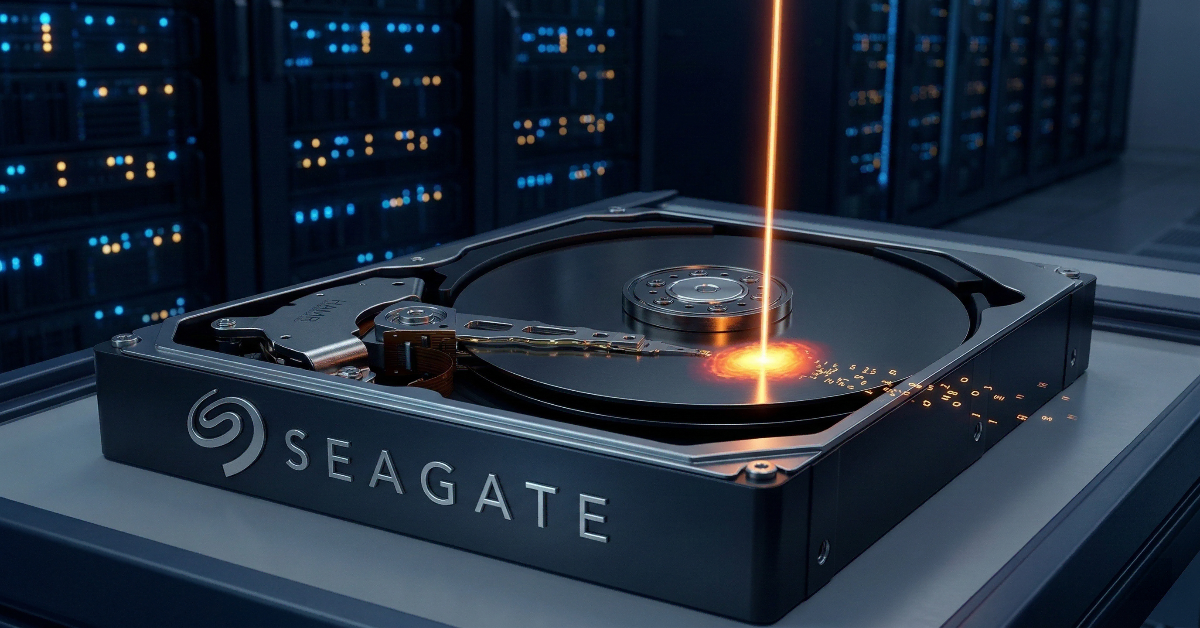
- Seagate (STX): Committed to HAMR, a high-stakes transition that requires heating the disk platter to 450°C using a laser for a fraction of a nanosecond to write data on high-coercivity media.
Mozaic 4+: The HAMR Vanguard
The Mozaic 4+ platform represents the commercialization of this ambition. By achieving 3TB+ per platter today, Seagate is delivering 30TB+ drives to cloud service providers (CSPs) like Microsoft and Google. The roadmap to 4TB (Mozaic 4), 5TB (Mozaic 5), and eventually 10TB per platter is no longer theoretical—it is an engineering trajectory supported by Seagate’s proprietary “nanolaser” and “plasmonic transducer” technology.
Vertical Integration: The Cost-per-Terabyte Advantage
A primary pillar of our bullish thesis on Seagate is its vertical integration. Unlike previous transitions where components were sourced from third parties, Seagate manufactures the critical HAMR components in-house.
The Photonics Moat
The Mozaic 4+ platform relies on a tiny laser diode integrated into the recording head. Seagate’s Derry, Northern Ireland facility is the world’s leading hub for these specialized photonics. By controlling the yield and quality of these lasers, Seagate achieves:
- Cost Efficiency: Eliminating the “middleman” margin on the most expensive component of the drive.
- R&D Speed: Rapid iteration of the plasmonic transducer (the component that focuses the laser light onto the disk).
- Supply Chain Resiliency: In a high-demand AI environment, Seagate is not beholden to external semiconductor foundries for its core differentiator.
Manufacturing Yields and the Learning Curve
The bear case against Seagate has long been “HAMR yield risk.” Skeptics argued that the complexity of heating a disk would result in high failure rates. However, Seagate’s management confirmed in recent earnings cycles that HAMR reliability (MTBF – Mean Time Between Failures) is now on par with traditional PMR drives. As yields climb toward “mature” status, the fixed costs of the Derry and Springtown facilities will be spread over millions of units, driving the cost-per-terabyte significantly lower than Western Digital’s multi-platter ePMR solutions.
Financial Analysis: The Path to 40% Gross Margins
Seagate has set an ambitious target of >40% gross margins. Historically, HDD margins have hovered in the 25-30% range. The transition to HAMR is the primary engine for this expansion.
Capacity Scarcity and Pricing Power
As AI-generated data (video, logs, training sets) explodes, the demand for “Mass Capacity” storage is outstripping the industry’s ability to add new manufacturing lines. Seagate is not building more factories; it is building denser drives.
- The TCO Proposition: A data center customer would rather buy one 30TB HAMR drive than two 15TB PMR drives. It saves on rack space, power, and cooling.
- Value-Based Pricing: Seagate can price its HAMR drives at a premium while still offering the customer a lower TCO. This “split the difference” pricing is what will drive the margin toward 40%.
Capital Expenditure (CapEx) Efficiency
Because HAMR increases capacity without necessarily increasing the number of disks and heads (the “bill of materials” or BOM), Seagate can increase its “exabytes shipped” without a linear increase in CapEx. This decoupling of capacity growth from capital spend is a classic hallmark of a high-margin technology leader.
Competitive Landscape: Can WD Close the Gap?
Western Digital is currently in the process of spinning off its Flash (NAND) business, which will leave a “Pure Play” HDD company to compete with Seagate. While WD has been successful with its 24TB-28TB ePMR drives, it is hitting the physical limits of that technology.
WD has announced its own HAMR-like transition, but Seagate holds a 2-3 year lead in volume production. This “First-Mover” window is critical. During this time, Seagate will:
- Lock in CSP Contracts: Cloud providers do not switch storage architectures lightly due to the rigorous qualification processes.
- Refine Yields: By the time WD scales HAMR, Seagate will be on its second or third generation (Mozaic 5+), maintaining a cost-per-platter advantage.
Risks to the Thesis
- Cannibalization by SSDs: While QLC NAND (Quad-Level Cell) is pushing into the data center, the price delta between HDD and SSD remains 5:1. For the “Cold Storage” and “Warm Storage” layers where AI data lives, HDDs remain the only economically viable option.
- Execution Risk: Any setback in the transition to 4TB per platter could allow competitors to catch up.
- Cyclicality: Cloud spending is lumpy. If a major CSP pauses a data center build-out, Seagate’s inventory levels could rise, temporarily hurting margins.
Conclusion: The Strategic Outlook
Seagate is no longer just a “disk drive company”; it is a precision engineering firm specializing in heat-assisted data density. The Mozaic 4+ platform is the realization of a decade of R&D.
With volume production underway, the financial story for STX over the next 12-24 months is one of margin expansion and market share consolidation. As they march toward the 10TB per platter milestone, Seagate’s vertical integration and intellectual property in photonics create a barrier to entry that is increasingly difficult for competitors to breach. For investors, the “HAMR Hegemony” represents a rare opportunity to capture the growth of the AI era through a disciplined, high-margin hardware leader.