
Table of Contents
Executive Summary
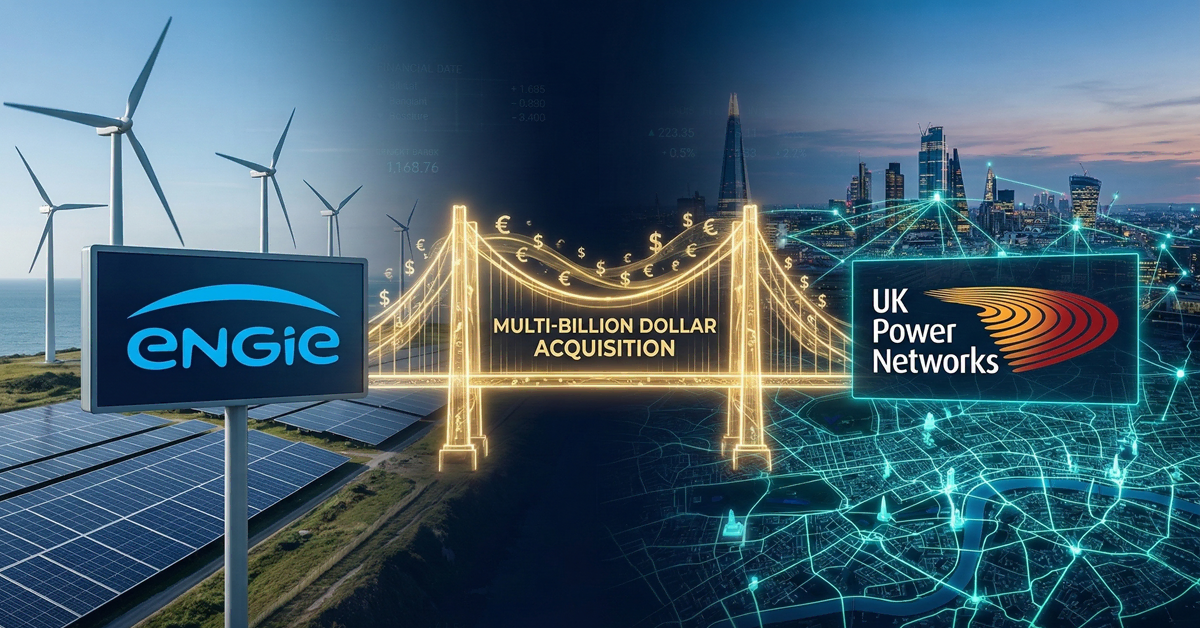
In February 2026, Engie (ENGI.PA) fundamentally reshaped its corporate identity and risk profile by announcing the acquisition of UK Power Networks (UKPN) for £15.8 billion ($21.4 billion). This transaction represents the largest acquisition in Engie’s history and marks a decisive pivot away from the volatility of merchant power markets toward the stability of regulated infrastructure.
By integrating the UK’s largest electricity distribution network operator (DNO), Engie is not merely expanding its geographic footprint; it is re-engineering its earnings quality. The deal targets a massive increase in Regulated Asset Value (RAV) and provides a predictable, inflation-linked cash flow stream that supports Engie’s ambitious dividend policy and energy transition investments. This report examines the strategic rationale, the financial implications for shareholders, and the long-term operational synergies of this landmark deal.
The Strategic Rationale: Stability in a Volatile Era
For the past decade, Engie has undergone a rigorous transformation, shedding non-core service assets and narrowing its focus to renewables and energy infrastructure. The UKPN acquisition is the culmination of this “Simplify to Grow” strategy.
De-Risking the Portfolio
The primary driver behind the £15.8 billion price tag is the desire to reduce “merchant exposure.” Merchant power prices—driven by the inherent volatility of natural gas and wholesale electricity markets—have historically led to unpredictable earnings for Engie. By shifting the portfolio weight toward regulated networks, Engie gains a “bond-like” revenue stream. UKPN operates under the RIIO (Revenue = Incentives + Innovation + Outputs) framework set by Ofgem, the UK regulator, which ensures a set rate of return on capital invested.
Capitalizing on the Electrification of London
UK Power Networks is the crown jewel of British infrastructure. It serves approximately 8.5 million customers across London, the East of England, and the Southeast. As the UK pushes toward its Net Zero 2050 targets, the demand for electricity in these regions is projected to surge. The proliferation of Electric Vehicles (EVs) and the transition from gas boilers to heat pumps require massive upgrades to the distribution grid. Engie is positioning itself at the center of this structural growth trend.
Market Analysis: UK Power Networks (UKPN)
UKPN is not just any utility; it is a high-performing operator with a formidable asset base. Its footprint covers the most densely populated and economically productive regions of the United Kingdom.
Regulated Asset Value (RAV) Growth
At the time of the announcement, UKPN’s Regulated Asset Value is a primary metric for valuation. Engie’s projections suggest that UKPN’s RAV will grow at a compound annual growth rate (CAGR) of 5% through 2028. This growth is driven by pre-approved capital expenditure (CAPEX) programs aimed at reinforcing the grid to handle renewable energy inputs and increased localized demand.
Operational Excellence
UKPN has consistently ranked as one of the most reliable and efficient DNOs in the UK. For Engie, this means acquiring a “plug-and-play” asset with a sophisticated management team already optimized for the RIIO-ED2 price control period. This minimizes integration risk—a critical factor for a deal of this magnitude.
Financial Impact and Valuation
The £15.8 billion acquisition is a bold financial move, requiring a sophisticated funding mix and a clear path to shareholder value creation.
Earnings Per Share (EPS) Accretion
Engie has provided clear guidance on the financial benefits of the deal. While the transaction is expected to close in mid-2026, the full integration benefits will materialize over the following 24 months.
- 2027 Impact: Neutral to slightly positive as integration costs are absorbed.
- 2028 Impact: Expected to be 3% to 6% accretive to EPS.
This accretion is significant because it is backed by regulated, high-visibility earnings, which typically command a higher valuation multiple (P/E) than merchant earnings.
Funding and Balance Sheet Strength
Engie intends to fund the $21.4 billion purchase through a combination of:
- Existing Cash Reserves: Bolstered by recent disposals of non-core assets.
- New Debt Issuance: Utilizing Engie’s strong credit rating to secure competitive interest rates, specifically targeting “Green Bonds.”
- Hybrid Securities: To protect credit ratings and maintain a healthy Net Debt/EBITDA ratio.
The company has reaffirmed its commitment to maintaining a “Solid Investment Grade” rating, reassuring bondholders that the increased leverage is offset by the quality of the acquired cash flows.
Dividend Policy
The stability provided by UKPN’s regulated returns provides a safety net for Engie’s dividend policy. Investors can expect more consistent payout growth, as the “regulated” portion of Engie’s EBITDA is set to increase from approximately 40% to over 50% post-acquisition.
The Regulatory Landscape: Ofgem and RIIO-ED2
A critical component of this deal is the relationship with the UK’s Office of Gas and Electricity Markets (Ofgem). UKPN is currently operating under the RIIO-ED2 price control framework, which runs until March 2028.
- Allowed Returns: Ofgem sets the baseline return on equity that DNOs can earn.
- Incentives: UKPN has historically outperformed these baselines by meeting “incentive” targets related to customer service and network reliability.
- Future Controls: Engie’s valuation of UKPN assumes a fair transition to RIIO-ED3 in 2028. There is a regulatory risk that Ofgem could tighten allowed returns in the next period, but Engie’s 3-6% EPS accretion forecast likely includes a conservative buffer for such changes.
Integration Challenges and Risks
No acquisition of this scale is without risk. Investors must monitor several key areas:
- Macroeconomic Variables: While UKPN’s revenues are inflation-linked (providing a hedge), sustained high interest rates could increase the cost of refinancing the debt used to fund the acquisition.
- Political Risk: The UK energy market is subject to intense political scrutiny. Potential changes in government policy regarding grid ownership or “windfall” regulations could impact the long-term return on investment.
- Currency Risk: Engie reports in Euros (EUR) while UKPN generates revenue in British Pounds (GBP). Significant fluctuations in the EUR/GBP exchange rate could impact the consolidated earnings reported to Engie shareholders.
- Operational Integration: While UKPN is a standalone entity, aligning its ESG reporting, digital infrastructure, and corporate culture with Engie’s global standards will require significant management bandwidth.
ESG and the Energy Transition
Engie’s acquisition of UKPN is a massive “Green” statement. To achieve Net Zero, the world needs more than just wind turbines and solar panels; it needs a grid capable of carrying that power.
- Facilitating Decentralization: UKPN is a leader in managing “Flexible Power,” allowing local businesses and homes to sell battery storage capacity back to the grid.
- Modernizing Infrastructure: Engie plans to accelerate UKPN’s investment in digital twin technology and AI-driven grid management, reducing energy waste and improving the efficiency of the London power corridor.
By owning the network, Engie becomes an indispensable partner to the UK government in its decarbonization journey, potentially opening doors for further renewable energy development contracts.
Investment Verdict
The acquisition of UK Power Networks is a transformative masterstroke for Engie. It successfully addresses the primary criticism leveled against the company in the past: its vulnerability to cyclical energy prices.
By paying a premium for UKPN, Engie is essentially buying certainty. The 5% projected RAV growth and the 3-6% EPS accretion by 2028 offer a compelling narrative for long-term institutional investors and income-focused retail shareholders alike. While the debt load will increase, the quality of the underlying assets justifies the leverage.
Engie is no longer just a utility caught in the winds of the commodity market; it is now one of Europe’s premier infrastructure giants, uniquely positioned to profit from the total electrification of the UK’s economic engine.