
Table of Contents
Executive Summary
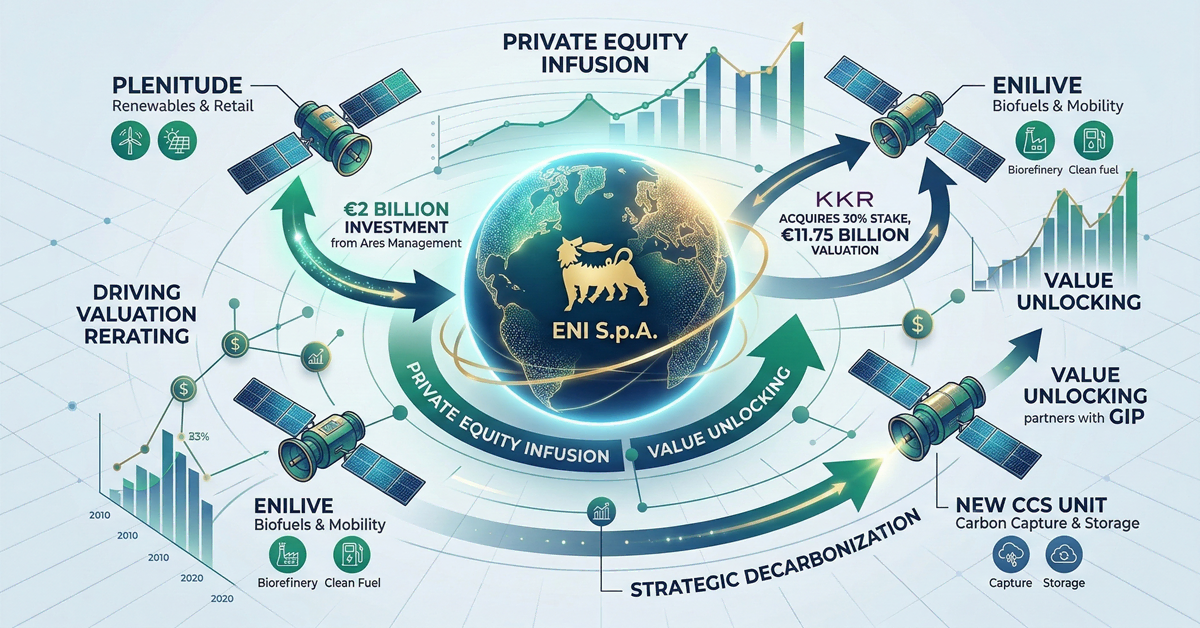
As the global energy sector navigates the complex trilemma of energy security, affordability, and sustainability, European integrated oil and gas majors have struggled to balance the capital-intensive demands of the energy transition with shareholder demands for high yields and robust free cash flow. While peers have vacillated between aggressive green pivots and abrupt retreats to core hydrocarbon strategies, Eni S.p.A. (BIT: ENI, NYSE: E) has engineered a structurally distinct approach: the “Satellite Model.”
This strategy involves incubating high-growth, low-carbon business units within the parent company, scaling them to operational maturity, and subsequently carving them out as independent “satellites.” By selling minority stakes in these entities to premier private equity and infrastructure funds, Eni achieves three critical objectives: it establishes an independent, market-based valuation for its transition assets; it secures external, aligned capital to fund aggressive growth without over-leveraging its own balance sheet; and it retains majority control to consolidate the financial upside.
This paper provides a deep dive into Eni’s satellite architecture, evaluating the financial and strategic implications of its three primary growth engines: Plenitude (Renewables & Retail), Enilive (Biofuels & Mobility), and the newly formed Carbon Capture and Storage (CCS) Satellite. Through recent private equity infusions from Ares Management, KKR, and Global Infrastructure Partners (GIP), Eni is systematically unlocking hidden value, catalyzing a profound Sum-of-the-Parts (SOTP) valuation rerating, and redefining the modern energy major.
1. The Strategic Context: Solving the Energy Transition Penalty
Historically, public equity markets have penalized traditional oil and gas companies attempting to transition into renewable energy. The core issue is a mismatch in the cost of capital and return expectations. Traditional upstream oil and gas projects typically target internal rates of return (IRR) of 15% to 20%+, compensating for geological and commodity price risks. In contrast, utility-scale renewable power and infrastructure projects yield highly predictable, long-duration cash flows, but at lower IRRs—typically 6% to 9%.
When an integrated major funds low-return renewable projects using cash flows generated by high-return hydrocarbon assets, public market investors often apply a “conglomerate discount.” The market struggles to value a single entity that blends volatile, high-yield cash cows with predictable, low-yield growth engines.
Eni’s Satellite Model elegantly bypasses this penalty. By legally and financially separating the transition businesses, Eni allows specialized private market investors—who have a lower cost of capital and longer investment horizons—to price these assets correctly. The private equity infusions provide explicit price discovery, forcing public markets to recognize the underlying value of the transition portfolio. Consequently, Eni can sustain its progressive shareholder remuneration policy (targeting a distribution payout range of 35-40% of annual Operating Cash Flow) derived primarily from its traditional upstream business, while the transition satellites self-fund their growth through dedicated capital structures.
2. The Mechanics of the Satellite Model
The architecture of Eni’s Satellite Model is built upon several foundational pillars designed to optimize financial efficiency and operational focus.
- Incubation and Integration: Eni leverages its legacy competencies, customer base, and technical expertise to incubate these businesses. For example, legacy retail gas customers are transitioned into green power customers, and legacy refineries are retrofitted into biorefineries.
- Operational Independence: Once viable, the unit is established as a separate corporate entity with its own dedicated management team, distinct balance sheet, and tailored strategic mandate.
- Accessing Aligned Capital: Eni sells minority stakes (typically 10% to 30%) to strategic or financial partners. This capital is often injected directly into the satellite to fund its specific CAPEX pipeline, shielding the parent company from debt accumulation.
- Value Unlocking (Price Discovery): The transaction multiples set by sophisticated private equity buyers provide a transparent benchmark for public analysts to apply to Eni’s Sum-of-the-Parts (SOTP) valuation.
- IPO Optionality: The ultimate phase of the satellite model is optionality for a public listing. Eni retains the flexibility to launch Initial Public Offerings (IPOs) for these entities when macroeconomic and equity capital market conditions are optimal, providing a clear exit strategy for its private equity partners and further liquidity for the parent.
3. Plenitude: The Integrated Renewables and Retail Engine
Plenitude represents Eni’s most mature satellite, operating as a unique hybrid that combines renewable power generation, retail energy sales, and a sprawling electric vehicle (EV) charging network (Be Charge). Operating as an Italian Benefit Corporation (Società Benefit), Plenitude integrates the entire green energy value chain.
3.1 The Synergistic Business Model
Standalone renewable energy developers often face merchant power price risk and rely heavily on government subsidies or complex Power Purchase Agreements (PPAs). Conversely, standalone retail energy providers suffer from thin margins and wholesale market volatility. Plenitude merges the two. By generating its own renewable power and selling it directly to its retail customer base of approximately 10 million clients, Plenitude creates a natural financial hedge. The retail division acts as a highly predictable cash-generating engine that partially subsidizes the capital-intensive buildout of the renewable generation portfolio.
3.2 Growth Targets and the Ares Management Infusion
Plenitude has set aggressive, highly visible growth targets. The company is on track to achieve a target of 5.5 GW of installed renewable capacity by the end of 2025, scaling rapidly toward 15 GW by 2030. Simultaneously, it aims to expand its retail base to 15 million customers and deploy over 40,000 EV charging points by the end of the decade.
To accelerate this trajectory without burdening Eni’s corporate balance sheet, Plenitude recently secured a €2 billion investment from Ares Management. This transaction is a masterclass in capital allocation. Ares, a premier global alternative investment manager, brings deep expertise in infrastructure and credit. For Ares, Plenitude offers utility-like downside protection supported by a massive retail customer base, coupled with the upside of a premier European renewable development pipeline.
For Eni, the €2 billion infusion serves multiple purposes:
- CAPEX Funding: It provides direct, non-recourse capital to fund the 2025-2030 renewable buildout.
- Valuation Anchor: The transaction establishes a robust private-market floor valuation for Plenitude, highlighting the severe undervaluation of this asset within Eni’s consolidated share price.
- Debt De-consolidation: It allows Plenitude to optimize its own capital structure and raise standalone debt, preserving Eni’s pristine corporate leverage ratio (which remains historically low in the 10-20% gearing range).
4. Enilive: Premium Valuation in Biofuels and Sustainable Mobility
While Plenitude addresses the electrification of the economy, Enilive is designed to tackle the decarbonization of hard-to-electrify transport sectors (heavy-duty trucking, aviation, and maritime) through advanced biofuels. Enilive consolidates Eni’s biorefining assets, biomethane production, and its expansive network of over 5,000 European service stations.
4.1 The KKR Partnership and Structural Valuation
In a landmark transaction spanning late 2024 and early 2025, global investment firm KKR acquired a 30% stake in Enilive. The deal was structured through a combination of capital increases and secondary share purchases, injecting vital growth capital and valuing the entire Enilive unit at over €11.75 billion (post-money equity value).
This €11.75 billion valuation is the most potent catalyst in Eni’s recent history. To put this into perspective, at the time of the transaction, Enilive’s implied value represented a massive fraction of Eni’s total corporate market capitalization, mathematically exposing the fact that public markets were valuing Eni’s legacy upstream oil and gas business—which generates billions in free cash flow—at historically distressed multiples.
4.2 The Strategic Moat of Enilive
KKR’s aggressive move to secure a 30% stake underscores the scarcity premium associated with fully integrated biofuel assets. Enilive’s competitive advantage lies in its vertical integration:
- Feedstock Independence: The bottleneck in the global biofuel industry is the procurement of sustainable feedstocks (used cooking oil, animal fats, and agri-residues). Enilive has proactively established an “agri-hub” network across Africa (e.g., Kenya, Congo, Angola) to cultivate sustainable, non-food-competing crops on degraded land. This proprietary feedstock supply chain shields Enilive from volatile global commodity markets.
- Refining Scale: Enilive operates world-class biorefineries in Venice and Gela (Italy), and is expanding capacity globally, including joint ventures in the United States and Asia. The goal is to scale biorefining capacity to over 3 million tonnes per annum by the end of the decade.
- Retail Distribution: The 5,000+ Enilive service stations are being transformed from traditional gas stations into multi-energy mobility hubs, offering Hydrotreated Vegetable Oil (HVO), biomethane, hydrogen, and ultra-fast EV charging. This direct-to-consumer access ensures Enilive captures the full margin from farm to pump.
With regulatory tailwinds such as the European Union’s ReFuelEU Aviation mandate (which enforces escalating quotas for Sustainable Aviation Fuel) and the Renewable Energy Directive (RED III), Enilive is positioned in a high-barrier, high-margin regulatory environment that perfectly aligns with KKR’s long-term infrastructure investment thesis.
5. The Next Frontier: The 2025/2026 CCS Satellite
Having successfully validated the Satellite Model with Plenitude and Enilive, Eni is deploying the exact same playbook for the next critical pillar of the energy transition: Carbon Capture and Storage (CCS). Scheduled for formal launch as a dedicated corporate entity in the 2025/2026 window, the new CCS Satellite is being developed in strategic partnership with Global Infrastructure Partners (GIP).
5.1 The Economics of Carbon Capture
For years, CCS was viewed as a costly, unviable experiment. However, surging carbon prices under the EU Emissions Trading System (ETS)—which have established a structural floor that penalizes heavy emitters—combined with aggressive state subsidies, have transformed CCS into a highly investable asset class.
Eni enjoys a unique geological and geographical advantage. The company possesses depleted offshore gas reservoirs in the Mediterranean and the North Sea (such as the HyNet project in the UK and the Ravenna CCS hub in Italy). These reservoirs are perfectly suited for permanent CO₂ sequestration. Furthermore, these offshore assets are located in close proximity to major European industrial clusters (steel, cement, chemicals, and fertilizers), which represent the “hard-to-abate” sectors desperate for decarbonization solutions.
5.2 The GIP Partnership Model
Global Infrastructure Partners (GIP) targets investments that offer monopolistic or oligopolistic market positions with long-term, contracted cash flows. The Eni CCS Satellite perfectly fits this mandate. The revenue model for the CCS unit is essentially a “toll road” for carbon. Industrial emitters sign long-term (15- to 25-year) take-or-pay contracts to pipe their captured CO₂ into Eni’s infrastructure, paying a fixed fee per tonne for transportation and storage.
By partnering with GIP at the launch phase, Eni achieves rapid scaling. GIP provides the massive upfront capital required to build the gathering pipelines, compression stations, and injection infrastructure. In return, Eni operates the assets, leverages its subsurface engineering expertise, and offloads the capital expenditure burden. This allows Eni to consolidate its leadership in European decarbonization, transforming a legacy liability (empty gas fields) into a multi-decade, high-margin infrastructure business.
6. Financial Implications and SOTP Rerating
From an equity research perspective, Eni’s corporate strategy necessitates a rigorous Sum-of-the-Parts (SOTP) valuation model. Historically, public markets have applied a blended Price-to-Earnings (P/E) or EV/EBITDA multiple to Eni, heavily weighted toward the cyclicality of Brent crude and European natural gas prices.
The Satellite Model fundamentally breaks this correlation. By establishing concrete, private-market valuations for its subsidiaries, analysts can reconstruct Eni’s Enterprise Value (EV) with greater precision.
Consider the valuation arithmetic:
- Enilive: Valued at €11.75 billion (validated by KKR).
- Plenitude: Valued in the high single-digit to low double-digit billions (validated by Ares Management and prior EIP investments).
- Vår Energi & Azule Energy: Eni also holds significant, easily monetizable stakes in traditional upstream joint ventures like Vår Energi (listed in Norway) and Azule Energy (Angola joint venture with BP).
When subtracting the validated equity values of these satellites from Eni’s total market capitalization, the implied valuation of Eni’s core, wholly-owned upstream business approaches distressed levels—often trading at an implied free cash flow yield exceeding 20%.
As Enilive, Plenitude, and the new CCS entity grow their EBITDA and approach potential future IPOs, this valuation gap becomes mathematically unsustainable. The private equity infusions force the public market to re-evaluate the stock. Furthermore, because Eni is not draining its core operational cash flow to fund these satellites, it can aggressively return capital to shareholders. Eni has committed to utilizing a significant portion of its robust operating cash flows to fund an increasing base dividend and systematic share buyback programs, providing a powerful dual-engine of capital appreciation and yield.
7. Key Risks and Investment Considerations
While the Satellite Model is theoretically elegant and practically successful to date, institutional investors must monitor several inherent risks:
- Execution Risk in Spin-offs: The separation of highly integrated assets requires complex corporate restructuring. Transferring personnel, unwinding shared IT infrastructure, and establishing standalone debt facilities can result in temporary operational friction and elevated SG&A (Selling, General, and Administrative) expenses.
- Regulatory Reliance: Both Enilive and the CCS Satellite rely heavily on regulatory frameworks (EU RED III, ReFuelEU, EU ETS pricing). Any political shift in European climate policy, or a sustained collapse in carbon credit prices, could impair the economic viability of these units and strain relationships with PE partners.
- Private Equity Exit Horizons: Financial sponsors like KKR, Ares, and GIP typically operate on 5- to 7-year investment horizons. Eni must eventually facilitate an exit for these partners, either through a public IPO, a secondary sale, or a parent company buyout. If equity capital markets are unreceptive to green IPOs at the end of this horizon, it could create liquidity friction.
- Commodity Price Volatility: Despite the growth of the satellites, Eni’s consolidated earnings and free cash flow—which fund the corporate dividend—remain heavily exposed to global oil and gas prices. A severe macroeconomic recession compressing hydrocarbon prices could impact Eni’s ability to maintain its aggressive buyback program, regardless of satellite performance.
8. Conclusion: A Blueprint for the Modern Energy Major
Eni S.p.A. has constructed one of the most intellectually rigorous and financially sound transition strategies in the global energy sector. By deploying the Satellite Model, management has effectively solved the energy transition penalty. The strategic carve-outs of Plenitude, Enilive, and the forthcoming CCS company allow Eni to aggressively capture market share in the low-carbon economy without diluting its core upstream returns.
The infusion of highly sophisticated private capital from KKR, Ares Management, and GIP serves as the ultimate validation of this strategy. These partnerships provide non-recourse growth capital, establish definitive valuation floors, and de-risk Eni’s corporate balance sheet. For the public market investor, Eni presents a unique proposition: a high-yielding traditional energy company trading at a discount, harboring a portfolio of rapidly growing, privately validated green infrastructure assets. As these satellites scale toward their 2030 targets and eventual public listings, the forced realization of their SOTP value is expected to be the primary driver of Eni’s valuation rerating throughout the remainder of the decade.