
Table of Contents
Executive Summary
As of late 2025, ASML Holding N.V. has solidified its position as the indispensable linchpin of the global semiconductor supply chain. The fiscal year 2025 has been characterized by a transition from the capacity-digestion phase of 2024 to a high-growth environment driven primarily by the artificial intelligence (AI) infrastructure boom. While geopolitical pressures, particularly regarding export controls to China, have created headwinds, the company’s technological monopoly in Extreme Ultraviolet (EUV) lithography continues to provide a wide economic moat. This report summarizes the 2025 financial performance, technological progress in High-NA EUV, and provides a multi-factor analysis for stock buy recommendations heading into 2026.
2025 Financial Performance Summary
ASML achieved significant top-line growth in 2025, aligning with its mid-term guidance. The company reported a total net sales increase of approximately 15% compared to fiscal year 2024. This growth was underpinned by a 30% surge in EUV system sales and a 20% increase in the Installed Base Management business, as chipmakers sought to optimize existing fleets for advanced packaging and AI-centric logic chips.
| Metric | 2025 Estimated Full Year | Notes |
|---|---|---|
| Total Net Sales | €32.5 Billion | ~15% Year-over-Year growth |
| Gross Margin | 52.0% | Driven by high-value upgrades and EUV efficiency |
| Net Income | €8.8 Billion | Reflecting strong operational leverage |
| Net Bookings (Avg. Quarterly) | €5.4 Billion | High demand for NXE:3800E and EXE:5200B |
The gross margin remained resilient at 52%, despite the dilutive effects of early High-NA EUV shipments. The second half of 2025 was particularly strong, with Q4 sales guidance reaching between €9.2 billion and €9.8 billion, fueled by a year-end push from Logic and DRAM customers preparing for 2nm volume production in 2026.
Technological Milestones: The Era of High-NA EUV
The defining technological achievement of 2025 was the transition of High-Numerical Aperture (High-NA) EUV from R&D to commercial acceptance. ASML successfully completed acceptance testing for the TWINSCAN EXE:5200B system with key partners including Intel and SK Hynix.
Key highlights include:
- Throughput Improvements: The EXE:5200B demonstrated a productivity rate of 175 wafers per hour, a critical metric for justifying its $350 million+ price tag in high-volume manufacturing.
- Resolution and Overlay: The system achieved 0.7nm overlay accuracy, enabling the industry to move toward the 1.4nm (Intel 14A) and sub-1nm process nodes.
- Advanced Packaging: ASML shipped its first product specifically for 3D integration, the TWINSCAN XT:260, addressing the bottleneck in AI chip assembly.
Stock Analysis and Investment Thesis
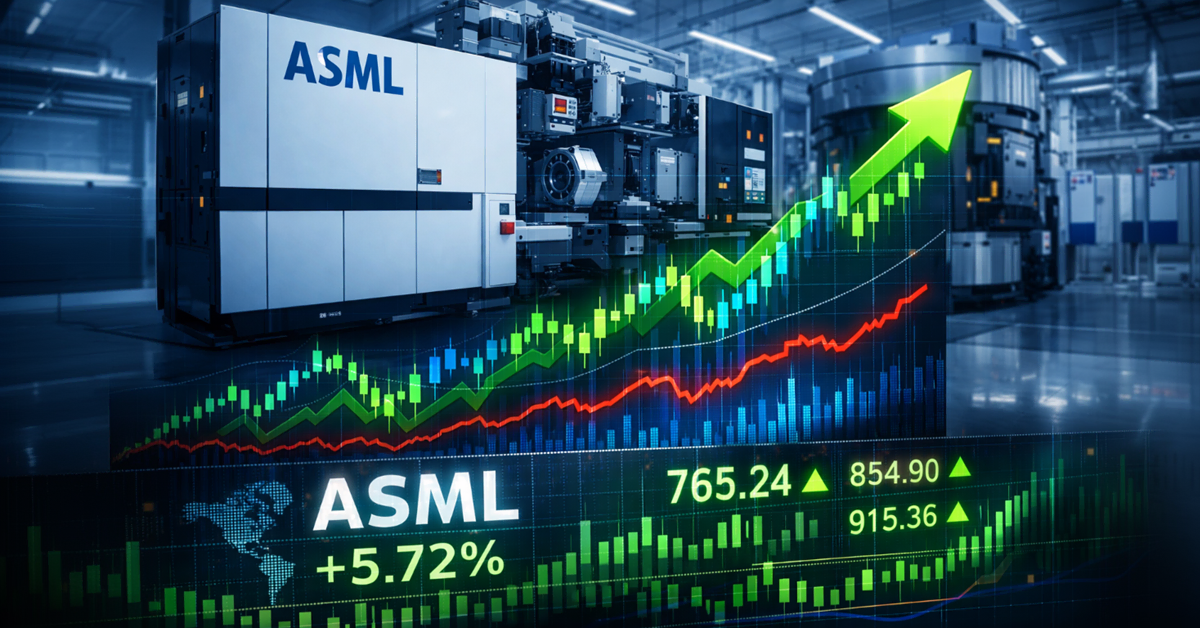
ASML stock (NASDAQ: ASML) has seen a performance increase of nearly 50% throughout 2025, outperforming the broader Nasdaq Composite. However, the valuation remains a point of intense scrutiny for institutional investors.
Valuation Metrics
As of December 2025, ASML trades at a forward Price-to-Earnings (P/E) ratio of approximately 34x. While this is a premium compared to the broader technology sector, it is consistent with ASML’s historical average during periods of technological transition. The market cap fluctuates around $420 billion, making it the most valuable technology entity in Europe.
Buy Suggestion: The Case for “Accumulate”
Analysts generally maintain a Strong Buy or Buy consensus, though with a cautious eye on 2026. The investment thesis is built on three pillars:
- AI Tailwinds: The demand for HBM (High Bandwidth Memory) and advanced GPUs requires more EUV layers per wafer. Even if unit shipments of smartphones or PCs remain flat, the “litho-intensity” per chip is increasing.
- Monopoly Power: ASML remains the sole provider of EUV tools. Competitors in Japan (Nikon, Canon) have not yet demonstrated a viable alternative to High-NA EUV for leading-edge nodes.
- Shareholder Returns: Despite not fully completing the 2022-2025 share buyback program due to strategic reinvestment, a new multi-billion euro program is anticipated in early 2026.
Risks and Headwinds
The primary risk factor remains the geopolitical landscape. In 2025, export licenses for DUV (Deep Ultraviolet) immersion systems to China became more restrictive. Management has guided that China revenue—which was abnormally high in 2024 and 2025 due to stockpiling—will likely decline significantly in 2026. This “China Reset” may lead to period-over-period revenue stagnation in early 2026, creating potential entry points for long-term investors.
Conclusion
ASML enters 2026 as a structurally stronger company than it was at the start of the decade. While the “China headwind” and a 34x P/E ratio suggest that a vertical breakout in the stock price may be limited in the immediate short term, the long-term fundamentals remain unparalleled. For investors with a 3-to-5-year horizon, ASML is a cornerstone asset that captures the growth of the entire semiconductor industry without the specific product risk of fabless designers or the capital intensity of foundries.