
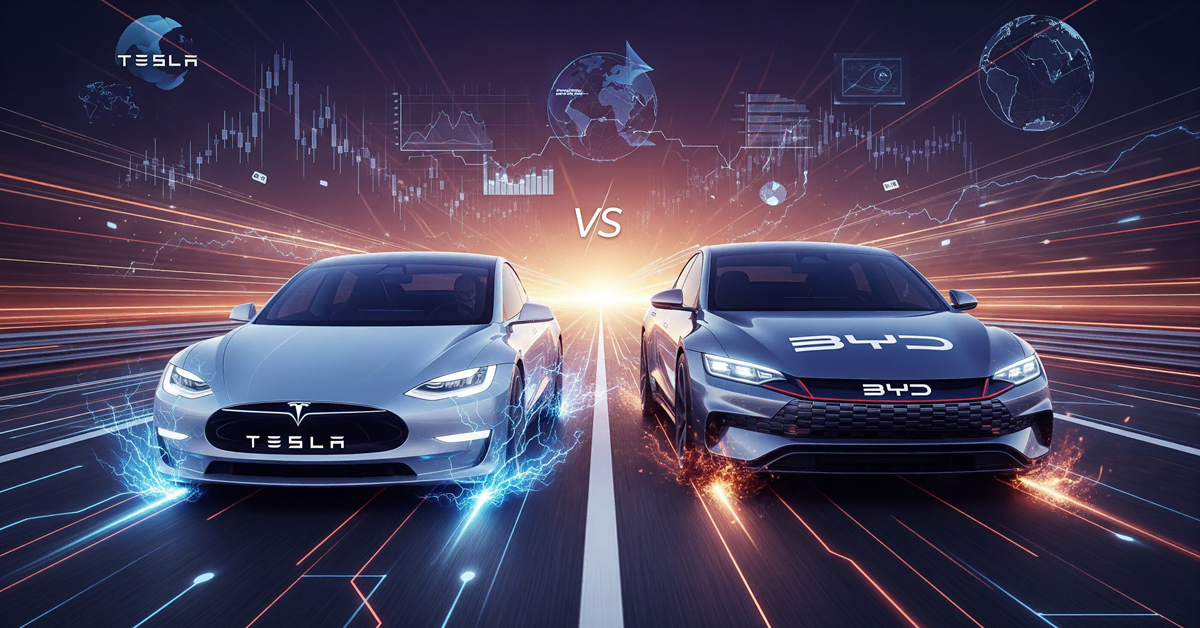
The global automotive landscape is undergoing a structural realignment as the era of early adoption transitions into mass-market saturation. At the center of this shift is the intense rivalry between Tesla, Inc. (NASDAQ: TSLA) and BYD Co. Ltd. This white paper examines the empirical data surrounding market share displacement and evaluates the investment thesis for Tesla in an increasingly fragmented global market.
Table of Contents
Market Share Dynamics: The Overtaking of 2025
For the first time in the history of the modern electric vehicle (EV) industry, Tesla has lost its title as the world’s leading seller of battery electric vehicles (BEVs) on an annual basis. While the two companies have jockeyed for quarterly leadership since late 2023, the full-year data for 2025 confirms a decisive shift in momentum.
- Sales Volume: BYD concluded 2025 with approximately 2.3 million BEV deliveries, representing a 28% year-over-year increase. In contrast, Tesla delivered roughly 1.65 million units, reflecting a year-over-year decline of approximately 7.7%.
- Global Share: Tesla’s global EV market share, which exceeded 20% in 2020, has contracted to under 10% in 2025. BYD now commands nearly 20% of the global EV market when including plug-in hybrids (PHEVs), and has officially surpassed Tesla in pure BEV volume.
- Regional Displacement: The most aggressive erosion is occurring in China, where Tesla’s market share has dwindled to approximately 9% against BYD’s dominant 35%+. Furthermore, Tesla experienced a 48% sales plunge in Europe during the latter half of 2025, while BYD’s European exports surged.
The Strategic Divergence
The loss of market share is not merely a byproduct of competition but a result of two fundamentally different corporate philosophies. BYD has achieved dominance through vertical integration and a “volume-first” strategy, manufacturing its own batteries (Blade Battery), semiconductors, and sub-systems to maintain a cost structure that Tesla’s aging platform cannot currently match.
Tesla, conversely, has pivoted its core identity. The company is transitioning from a high-volume hardware manufacturer to an AI and robotics entity. This transition has created a “growth gap” where the current vehicle lineup (Model 3 and Model Y) is facing lifecycle fatigue, while the next-generation catalysts—the Cybercab and the Optimus humanoid robot—are not expected to reach meaningful scale until 2027 or 2028.
Investment Thesis: Is Tesla Still Worth Investing?
Evaluating Tesla as an investment in 2026 requires a distinction between its automotive fundamentals and its technological optionality. The stock continues to trade at a significant premium compared to both traditional automakers and its direct Chinese rivals.
The Bear Case: Valuation and Competition
Tesla’s valuation remains decoupled from its current earnings power. Trading at a price-to-earnings (P/E) ratio exceeding 300, the market is pricing in near-perfect execution of autonomous driving. With BYD producing similar revenue at less than one-tenth of Tesla’s market capitalization, value-oriented investors see a massive dislocation. Additionally, the removal of the $7,500 federal tax credit in the United States in late 2025 has created a significant headwind for domestic demand.
The Bull Case: The Autonomous Future
Proponents of Tesla argue that market share in “dumb” hardware is a secondary metric. The true value lies in the data moat generated by billions of miles of Full Self-Driving (FSD) data. Analysts at firms like Wedbush and ARK Invest suggest that the “Robotaxi” chapter, beginning with the production of the Cybercab in April 2026, could unlock a $1 trillion to $3 trillion valuation by shifting Tesla to a high-margin software-as-a-service (SaaS) model.
Comparative Financial Metrics
| Metric (Approx. 2025-26) | Tesla (NASDAQ: TSLA) | BYD (OTC: BYDDF) |
|---|---|---|
| Annual BEV Sales | ~1.65 Million | ~2.3 Million |
| Market Capitalization | ~$1.5 Trillion | ~$140 Billion |
| Automotive Gross Margin | ~18% | ~20% |
| Primary Growth Driver | AI, FSD, Robotics | Manufacturing, Global Export |
Conclusion: A Tale of Two Realities
Tesla is undeniably losing market share to BYD in the traditional sense of vehicle deliveries. BYD has won the “manufacturing war” by providing affordable, high-quality EVs at a scale Tesla has yet to replicate for the masses. However, Tesla remains the dominant player in the “intelligence war.”
For investors, Tesla remains a high-risk, high-reward play on Artificial General Intelligence (AGI) and autonomy. It is no longer a safe “EV growth” stock; it is a speculative AI powerhouse. Those seeking exposure to the actual proliferation of electric vehicles on the road may find BYD’s valuation more grounded in reality, while those betting on a paradigm shift in transportation will continue to find Tesla’s long-term roadmap compelling despite the short-term loss in market share.