
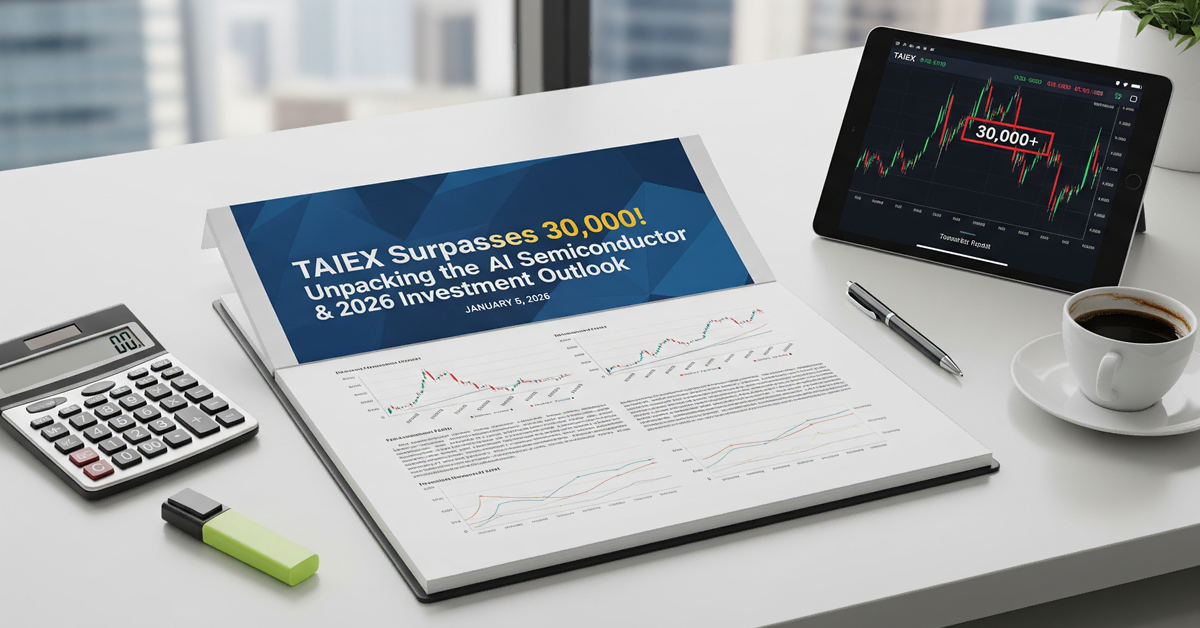
On January 5, 2026, the Taiwan Stock Exchange Capitalization Weighted Stock Index (TAIEX) achieved a historic psychological and technical milestone, closing above 30,000 points for the first time in its history. Ending the session at 30,105.04 points, the market surged by over 755 points in a single day, marking a watershed moment for the “Silicon Island.” This report analyzes the fundamental drivers, the structural significance of this level, and the risk-reward profile for contemporary investors.
Table of Contents
I. Primary Drivers of the January 5 Surge
The breach of 30,000 points was not a speculative anomaly but the result of a “perfect storm” of industrial and macroeconomic factors.
1. The 2-Nanometer Mass Production Cycle
The primary catalyst was the official commencement of volume production for 2-nanometer (2nm) chips by Taiwan Semiconductor Manufacturing Co. (TSMC). As the world’s leading foundry, TSMC’s 2nm process represents the most advanced semiconductor node globally, capturing virtually 100% of the high-performance computing (HPC) and AI accelerator market. On the day of the breach, TSMC shares surged over 5%, contributing nearly 90% of the TAIEX’s daily gains.
2. The AI Semiconductor Supercycle
Expectations for an unprecedented semiconductor supercycle reached a fever pitch. With hyperscalers (Google, Microsoft, Amazon) significantly increasing their capital expenditure for 2026 and 2027, the demand for AI hardware—from HBM (High Bandwidth Memory) provided by Nanya Technology and Winbond to advanced packaging services from ASE Technology—created a rising tide for the entire electronics sector.
3. Return of Foreign Institutional Capital
Following the New Year holiday, foreign institutional investors returned to the market with aggressive buy orders. The strengthening of the Taiwan Dollar against the U.S. Dollar incentivized capital inflows, as investors sought to benefit from both equity appreciation and currency gains. This “January Effect” was amplified by the anticipation of the upcoming semiconductor earnings season.
II. Structural Significance of 30,000 Points
The 30,000-point mark represents more than just a round number; it signifies a fundamental shift in the valuation of the Taiwanese economy.
- Lynchpin Status: It solidifies Taiwan’s position as the indispensable lynchpin of the global AI supply chain. The market now values Taiwan not as a cyclical hardware exporter, but as a structural software-enablement hub.
- Concentration of Value: The TAIEX has become increasingly “top-heavy.” The electronics sector now accounts for nearly 80% of market turnover, meaning the index is effectively a leveraged play on global AI infrastructure.
- Psychological Floor: Breaking 30,000 points converts a long-standing technical resistance level into a potential psychological support floor, attracting retail participation through AI-themed ETFs.
III. Investment Outlook: Is 30,000 Too High?
For many investors, the rapid ascent from 20,000 to 30,000 points in less than two years raises concerns of a bubble. However, a nuanced look at the data suggests a complex reality.
The Bull Case: Earnings Support
Unlike the dot-com bubble of 2000, current valuations are largely supported by robust earnings growth. Leading firms like TSMC and MediaTek are reporting record-high margins and earnings per share (EPS). Some analysts project that if TSMC’s EPS continues its current trajectory toward NT$75–$80, the TAIEX could theoretically challenge 34,000 to 35,000 points by the end of 2026.
The Bear Case: Concentration and Geopolitical Risks
The primary risk is sector concentration. Because the TAIEX is weighted by market capitalization, a slowdown in AI demand or a delay in 2nm yield rates would disproportionately impact the entire index. Furthermore, “non-tech” sectors (plastics, steel, and textiles) remain weak, creating a “two-speed” economy that may be vulnerable to broader macro downturns.
IV. Summary for Investors
The TAIEX at 30,000 points is “expensive” compared to its historical average, but it may be “fairly valued” relative to its projected earnings in the AI era. For long-term investors, the focus should remain on companies with high technological moats that are “irreplaceable” in the global supply chain. However, for short-term traders, the risk of a technical correction or profit-taking after such a rapid vertical move is high.
Strategic positioning should favor dollar-cost averaging into diversified electronics-heavy ETFs or focusing on the “upstream” suppliers that benefit from the 2nm ramp-up, while maintaining a watchful eye on global interest rate policies and AI capital expenditure guidance from Silicon Valley.