
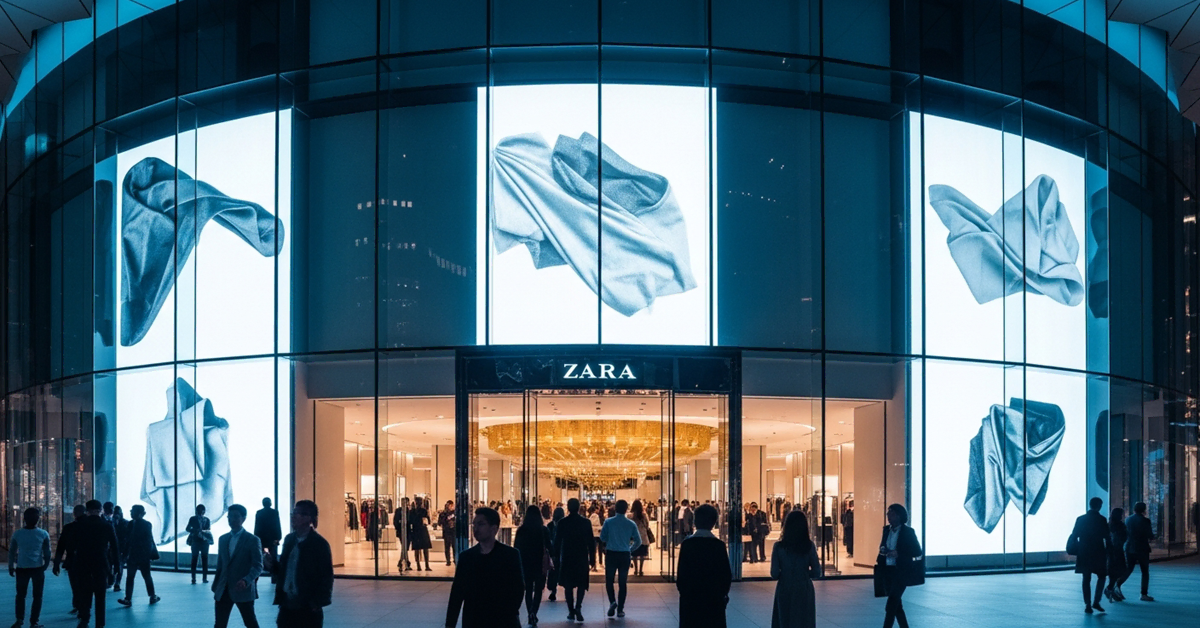
As of early 2026, Industria de Diseño Textil, S.A. (Inditex) continues to define the gold standard for global fashion retail. With its share price hovering between 55 Euro and 60 Euro, the company is trading near historic all-time highs. This white paper examines the structural drivers behind this valuation, the success of the 2024-2025 logistics expansion program, and the strategic pivot toward high-productivity flagship stores. We analyze whether the current P/E ratio represents a ceiling or if the “Inditex Premium” is justified by its peerless operational agility and a successful breakthrough into the North American market.
Table of Contents
The 2026 Landscape: Operational Excellence at Scale
Inditex has entered 2026 following a year of robust financial performance. In the fiscal year 2025, the company reported revenues approaching 40 billion Euro, driven by a 5% expansion in annual gross space and double-digit growth in online sales. The core of this success remains the Zara brand, which accounts for over 70% of group turnover, supplemented by the rapid internationalization of smaller concepts like Stradivarius and Bershka.
The company’s “integrated model”—which merges physical storefronts with a digital ecosystem—has achieved a level of synergy that competitors like H&M and Fast Retailing still struggle to replicate. In 2026, the distinction between an online sale and a store sale has effectively vanished within Inditex’s accounting, as store inventories serve as localized fulfillment centers, reducing shipping times and markdowns.
Strategic Growth Pillars
1. The North American Offensive
The most significant narrative shift in 2026 is the successful scaling of Inditex in the United States. Traditionally a “low-market-share” region for the Spanish giant, the US has become a primary growth engine. Following the expansion of Zara flagships in Los Angeles and Las Vegas in 2025, 2026 marks the physical debut of Bershka in Miami. By leveraging “excellent online performance” as a precursor to physical stores, Inditex is de-risking its capital expenditure in the Americas.
2. Flagship Optimization vs. Store Count
Inditex has completed its multi-year transition from “quantity to quality.” While the total store count has stabilized around 5,500 locations, the average square footage and productivity per meter have reached record levels. The 2026 strategy focuses on “Zara Salon” concepts—large-scale flagship stores in cities like Nanjing, Shanghai, and New York that offer immersive experiences, including dedicated styling areas and automated garment dispensers.
3. Logistics 2.0: The 1.8 Billion Euro Bet
The 900 million Euro annual investment program in logistics (2024–2025) has fully come online in 2026. The Zaragoza II distribution center is now at peak capacity, allowing Inditex to maintain its “twice-a-week” delivery schedule to every store globally, even as supply chain volatility affects rivals. This infrastructure allows the company to operate with a “pull” inventory system, where production is dictated by real-time customer demand rather than speculative forecasts.
Financial Analysis and Valuation
Current Valuation Metrics
The stock’s climb to the 60 Euro level has pushed its valuation multiples into a territory that requires flawless execution. Below is a summary of the estimated 2026 valuation landscape:
| Metric | 2026 Estimate/Actual | Historical Average |
|---|---|---|
| Price-to-Earnings (P/E) Ratio | 28x – 30x | 22x – 24x |
| Dividend Yield | 2.8% – 3.1% | 3.5% |
| EBITDA Margin | 28.2% | 26.5% |
| Net Cash Position | 11.5 Billion Euro | 9.0 Billion Euro |
Is the Stock “Priced for Perfection”?
The central debate for investors in 2026 is whether a P/E of 28x is sustainable. High-quality compounders often trade at a premium, but at 60 Euro, the market is pricing in not just steady growth, but continued margin expansion. Historically, Inditex has seen multiple compression when sales growth dips below 5%. However, with 2026 constant-currency sales growth trending above 8%, the “perfection” required by the market is currently being delivered.
Risk Factors and Competitive Headwinds
Despite its dominance, Inditex faces a bifurcated competitive threat in 2026:
- Ultra-Fast Fashion: Players like Shein continue to dominate the “disposable” segment of the market. While Zara has successfully moved upmarket to distance itself from price wars, the younger demographic remains susceptible to the ultra-low pricing of Chinese platforms.
- Regulatory Pressure: The European Union’s increased scrutiny on “throwaway culture” and the requirement for “digital product passports” by 2030 are forcing Inditex to accelerate its sustainability Capex. The company’s goal of using 100% lower-impact fibers by 2030 is ambitious and carries significant cost implications.
- Currency Volatility: With over 50% of sales generated outside the Eurozone, fluctuations in the USD and CNY continue to be a 1% to 4% headwind or tailwind on the top line.
Conclusion: The Case for the Long-Term Investor
For the new investor in 2026, the “meat on the bone” is no longer found in rapid valuation re-rating. Instead, Inditex has become a “Quality at a Reasonable Price” (QARP) play, albeit at the upper end of the “reasonable” spectrum. The stock provides a unique combination of high-single-digit growth, a fortress balance sheet with over 11 billion Euro in net cash, and a progressive dividend policy.
The verdict: While a short-term pullback to the 52 Euro range would offer a more attractive entry point, the company’s 2026 trajectory suggests that “all-time highs” are merely a milestone on the way to becoming the world’s first 250 billion Euro fashion conglomerate. Inditex is not just a retailer; it is a technology and logistics company that happens to sell clothes.