
Table of Contents
Introduction
In early 2026, Washington and New Delhi unveiled a landmark Joint Statement reframing their economic ties around “Economic Security Alignment.” This marked a strategic shift beyond India’s traditional role as an outsourcing hub, towards co-innovation in advanced technology. The interim trade framework they announced is not just about lowering tariffs – it embeds trade within a broader agenda of supply-chain resilience, investment security, and joint technology development. By prioritizing high-end tech collaboration in areas like semiconductors and AI, the US-India digital trade partnership is entering a new phase: from labor outsourcing to a silicon-powered alliance in AI and hardware innovation.
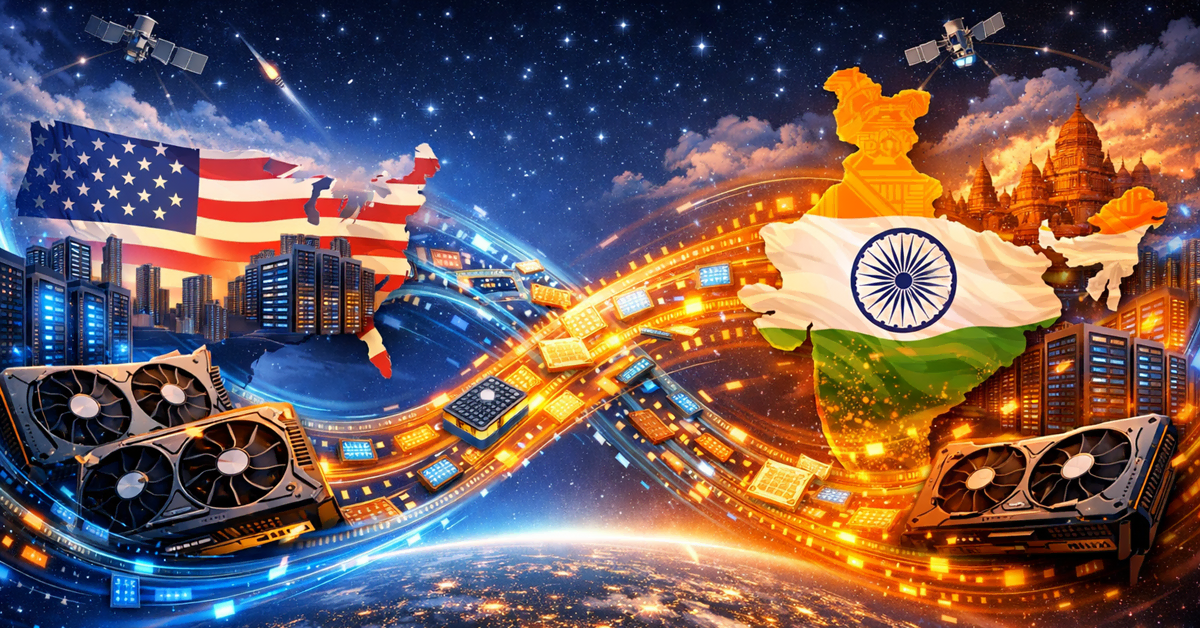
The 2026 trade framework elevates economic cooperation to a strategic level. It creates a “GPU corridor” for critical chips, establishes a roadmap for digital trade rules (balancing data flows with sovereignty), and promotes “dual-shore” production models – “Design in India, Scale in USA” – for cutting-edge manufacturing. Recent data show an explosion in trade of high-end tech (GPUs, data center hardware) between the countries, underlining this paradigm shift.
The GPU Corridor: Powering India’s AI Ecosystem
One centerpiece of the new partnership is a dedicated GPU trade corridor. The joint statement explicitly commits to “significantly increase trade in technology products, including Graphics Processing Units (GPUs) and other goods used in data centers”. This opens the door for U.S. firms – led by GPU giants like Nvidia – to export high-end chips that fuel India’s booming AI ecosystem. India currently has no domestic capacity to produce advanced GPUs, so demand is met by American suppliers. Under the government’s IndiaAI Mission, about 40,000 GPUs have been deployed so far (vastly exceeding the initial 10,000 target) to provide subsidized computing power for startups and researchers. Yet this is only a fraction of what’s needed – leading U.S. tech companies boast far larger compute clusters, and Indian industry leaders warn that insufficient GPU access could slow AI innovation.
The interim deal squarely addresses this bottleneck. It removes export uncertainty and import barriers that previously hampered GPU flows. In late 2024, the prior U.S. administration had even contemplated export controls on AI chips to India (as part of broader strategic restrictions), but the new framework sets aside those limits. “We will need these important ICT products – Nvidia chips, AI equipment, data center hardware – and it’s a big win for India that the US has agreed to provide them,” India’s Commerce Minister Piyush Goyal noted. Indeed, India’s national security and digital ambitions depend on accessible high-end semiconductors for AI and cloud computing.
On the Indian side, policies are being aligned to facilitate this tech inflow. The 2026 budget announced a sweeping tax holiday until 2047 for foreign companies setting up data centers in India, directly heeding U.S. investors’ calls for easier market access. High import duties of 20–28% on enterprise GPU servers – which had made cloud GPU services in India about 40% more expensive than in Singapore or the UAE – are slated for reduction or removal. Industry groups estimate that even a partial duty rationalization could cut data center setup costs by ~14%, “unlocking large-scale investments in AI infrastructure across the country,” according to the Bharat Digital Infrastructure Association. In fact, U.S. tech giants have already committed over $80 billion by 2030 to build new Indian hyperscale data centers (e.g. Google’s $15B AI center in Gujarat and Microsoft’s $17.5B expansion), anticipating easier access to advanced hardware.
The result is an explosion in US-India high-tech trade. New Delhi has pledged large-scale purchases as part of the deal – up to $500 billion of U.S. goods over five years, including energy, aircraft, and technology products. A significant share of this will likely be cutting-edge semiconductors and server equipment for India’s AI and cloud boom. Projections from industry experts suggest that bilateral electronics trade alone (much of it high-end ICT gear) could reach $100 billion in the near future. In short, the “GPU corridor” is poised to vastly expand exports of American silicon to India, accelerating India’s emergence as an AI powerhouse while deepening its reliance on U.S. tech. As one analysis noted, India today generates 19% of global data but hosts only 6% of data center capacity and 1.4% of enterprise GPUs – a gap this partnership aims to bridge.
Digital Trade Rules: Navigating Data Flows and ICT Barriers
Beyond tangible goods, the U.S.-India interim agreement places new emphasis on digital trade governance. Both countries committed to address discriminatory or burdensome practices in digital trade and to chart a path toward “robust, ambitious, and mutually beneficial digital trade rules” under the final Bilateral Trade Agreement (BTA). This signals intent to tackle thorny issues like cross-border data flows, data localization mandates, and licensing requirements for tech imports – areas that have caused friction in the past.
One immediate step under the framework was India’s agreement to eliminate restrictive import licensing for U.S. ICT goods. In 2023, India had introduced a contentious authorization regime for importing certain tech hardware (laptops, PCs, servers), largely aimed at Chinese suppliers. That system, which risked delaying or capping U.S. tech imports, will now be dismantled – removing a “long-standing barrier” and ensuring faster market access for American electronics. India also pledged to swiftly consider accepting U.S. and international tech standards and testing results for product approvals. Harmonizing standards will smooth compliance for U.S. exporters and cut red tape that previously hampered digital equipment trade.
Far trickier are the rules around data governance. Washington has been urging partners to allow freer cross-border data flows and prohibit forced data localization, reflecting U.S. tech industry interests. India, however, has taken a more guarded stance. Its Digital Personal Data Protection Act of 2023 and draft ecommerce policies favor keeping certain sensitive data within India’s borders as a matter of “data sovereignty.” Notably, unlike some recent U.S.–Southeast Asia deals, the India framework does not commit to unrestricted personal data transfers. Indian negotiators resisted one-sided digital clauses that could undermine domestic regulations. A Delhi-based think tank, GTRI, observed that the U.S. was “pushing for removal of barriers to digital commerce” in the BTA talks, while India sought to preserve its regulatory autonomy.
For now, the joint statement strikes an optimistic tone – both sides will work to set “clear pathways” for digital trade rules in the final agreement. But what might those rules entail? Indian stakeholders insist that any framework must balance openness with sovereignty. The Bharat Digital Infrastructure Association welcomed the trade deal’s tech focus but cautioned against compromising on digital sovereignty, security, or local value creation. They urge that India’s Trusted Source telecom policy, its data protection law, and rights to regulate data flows/platforms be upheld even as it aligns with global norms. In their words, “access to GPUs is important, but access without sovereignty risks turning India into a low-margin compute colony”.
Going forward, negotiators will have to bridge this gap. The U.S. aims to embed India in its “trusted partner” digital supply chains, which implies common standards on data and cybersecurity. Aligning with U.S. digital trade norms could unlock scale and investment for India’s tech sector, but it may constrain New Delhi’s policy flexibility on data localization, platform regulation, or digital taxes. This trade-off is acknowledged at the highest levels: the interim pact explicitly ties digital trade talks to the broader strategic cooperation agenda. In an era where data is as strategic as oil, finding a mutually acceptable equilibrium will be crucial. For now, both nations have agreed to address “barriers to digital trade” in good faith – meaning India could reconsider onerous data server localization rules, while the U.S. might accommodate India’s security concerns. The true test will come as the Interim Agreement is finalized into a full trade treaty. The intent is clear: modernize digital commerce rules so that data and tech services can flow with minimal friction between the U.S. and India, cementing a digital alliance – but without eroding the “sovereignty” that India views as non-negotiable.
Dual-Shore Production: “Design in India, Scale in USA”
Perhaps the most forward-looking aspect of this partnership is the push for dual-shore production models in advanced industries. As tariffs fall and investment barriers lift, companies are exploring ways to leverage India’s engineering talent and the U.S.’s manufacturing prowess in tandem. This is encapsulated in the mantra “Design in India, Scale in USA,” reflecting a vision of co-development rather than the old one-way outsourcing.
In practice, this means joint innovation across borders. A prime example came in February 2026 when Qualcomm announced the successful design of a 2-nanometer chip by its Indian R&D teams – one of the most advanced semiconductor designs to date. The chip will be fabricated overseas (at a cutting-edge foundry, likely in the U.S. or Taiwan), but the design work was done in Qualcomm’s Bengaluru, Chennai, and Hyderabad centers. “While the 2nm chip will not be manufactured in India, the tape-out signals that Indian engineering teams are now involved in the most advanced stages of chip design,” noted India’s Electronics Minister, hailing it as proof of India’s expanding role in global high-tech supply chains. In other words, a U.S. company’s flagship product was essentially “Designed in India” – a milestone unimaginable a decade ago – even as mass production scales up through the U.S. and its allies’ semiconductor ecosystem.
It turns out India already hosts around 20% of the world’s semiconductor design workforce, a unique competitive advantage. For years, U.S. tech firms have quietly built large engineering centers in India to design chips, software, and devices – but the new trade understanding seeks to formalize and elevate this collaboration. “Expect more ‘dual shore’ production, more design-in-India components, and more resilient supply chains serving global demand,” says Kaushik Shaparia, CEO of Deutsche Bank India, predicting a wave of co-development tie-ups as Western manufacturers tap Indian talent. This approach is seen as a “catalyst for co-innovation”: marrying, for instance, America’s advanced manufacturing and capital with India’s scale, digital infrastructure, and engineering expertise.
We can already see such models emerging. In aerospace, U.S. defense giants are working with Indian engineers on components and software for fighter jets and spacecraft (design in India) while final assembly and scaling happens in U.S. facilities. In electronics, the “India Semiconductor Mission 2.0” is encouraging foreign players to co-invest in Indian design startups and then manufacture at scale wherever it makes sense – be it a new fab in the United States or a packaging plant in India. The interim trade deal explicitly reinforces this by aligning investment screening and export control policies: both nations will cooperate to facilitate trusted tech transfers and joint production, while preventing leakage to geopolitical rivals. By coordinating on export controls, for example, Washington is more willing to share high-end tech with India (like sensitive chip IP or defense know-how), since India has agreed to uphold safeguards against diversion. This mutual trust paves the way for true co-development of next-gen technologies.
Case studies already show the potential. American and Indian engineers are co-designing new Open RAN telecom networks, with prototype systems built in India and then scaled through U.S. supply chains. General Electric and India’s HAL are collaborating on jet engine production – Indian teams contribute to design adaptations, while GE’s U.S. factories provide manufacturing at scale. In quantum computing and space tech, joint research centers are being set up under the U.S.-India Critical and Emerging Technology (iCET) initiative, aiming to create innovations that can be industrialized in both markets. Such dual-shore projects get a boost from the trade framework’s promise of preferential market access and reduced tariffs in key sectors. For instance, zero duties on certain “Make in India” electronics exported to the U.S. could encourage companies to split their production: high-value design and prototyping in India, with large-scale fabrication in the U.S. for export back to India and global markets.
Indian officials stress that embracing U.S. technology today does not mean abandoning indigenous development. “It’s not either-or: India will use US GPUs and develop its own chips,” said Abhishek Singh, CEO of the IndiaAI Mission. He emphasized that importing cutting-edge American chips and simultaneously building domestic semiconductor capabilities are complementary, not conflicting goals. Indeed, the trade partnership is structured to support this dual strategy. The U.S. is providing access to top-tier hardware now (so India’s AI surge isn’t delayed), while India invests in nurturing its own chip design and manufacturing for the long run – often with U.S. firms as collaborators. Qualcomm’s 2nm breakthrough, for example, was achieved by Indian engineers but will feed into the global supply chain, illustrating how “Designed in India” can go hand-in-hand with “Made in America (or allied countries)”. Over time, such co-created IP could be fabricated in new fabs that both nations are incentivizing (the U.S. via its CHIPS Act, and India via production-linked incentives and planned new foundries).
In summary, “Silicon and sovereignty” are being reconciled through co-innovation. The U.S.-India partnership is no longer a simple buyer-seller or client-vendor relationship; it is evolving into a joint venture in building the technologies of the future. By leveraging dual-shore production, they aim to combine India’s scale and skill with America’s advanced industries. This reduces over-reliance on any single country (notably China) in supply chains, aligning with the “friend-shoring” trend. As the two governments strengthen these channels, we are likely to see more examples of products conceived in Bengaluru or Pune, and mass-produced in Ohio or Texas – or vice versa. The 2026 trade pact lays the policy groundwork for this synergy, with both sides signaling that innovation is a shared endeavor. The rise of the US-India digital trade partnership thus represents not just a surge in tech trade volumes, but a fundamental realignment – forging a high-tech supply chain that links Silicon Valley and Bangalore as tightly as it once did Detroit and Delhi.