
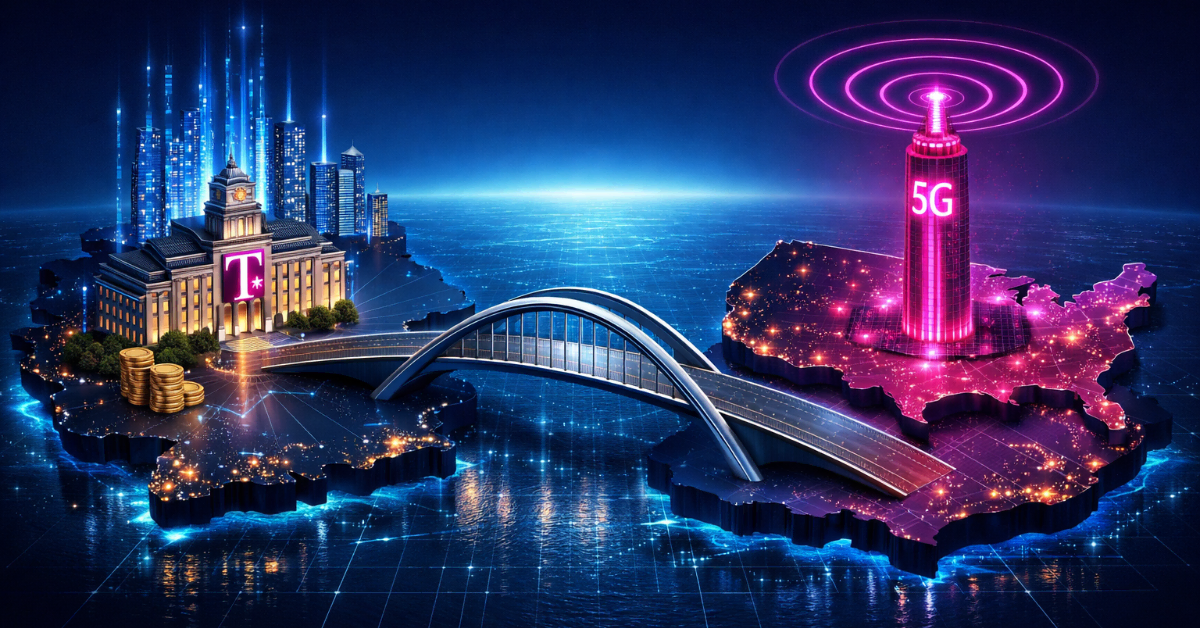
In the contemporary telecommunications landscape, Deutsche Telekom (DT) has evolved beyond its origins as a German incumbent into a strategic vehicle for capturing the growth of the American wireless market. As of early 2026, Deutsche Telekom maintains a majority stake of approximately 52.8 percent in T-Mobile US (TMUS). This structural relationship has created a unique investment thesis: DT effectively operates as a leveraged proxy for TMUS, often trading at a valuation that implies the European core operations are undervalued or, in certain market conditions, essentially free. This white paper analyzes the Sum-of-the-Parts (SOTP) valuation, the mechanics of the “tracking stock” discount, and the sensitivity of DT equity to the aggressive buyback programs and market dominance of its American subsidiary.
Table of Contents
The Structural Shift: From Domestic Utility to Global Powerhouse
For decades, Deutsche Telekom was viewed through the lens of European regulatory constraints, stagnant domestic growth, and heavy infrastructure capital expenditure. However, the 2020 merger of T-Mobile US and Sprint catalyzed a transformation. By 2026, the success of T-Mobile US in the 5G era—characterized by superior spectrum holdings and a disruptive “Un-carrier” strategy—has made the US segment the primary engine of value for the group.
The decision by DT management to hold its 52.8 percent stake without plans for divestiture in 2026 signals a commitment to consolidating the US growth within its own balance sheet. This majority control allows DT to benefit from the massive cash flow generation and shareholder return programs initiated by TMUS, while providing European investors with exposure to a high-growth US tech-telecom hybrid that would otherwise be subject to different regulatory and currency environments.
Sum-of-the-Parts (SOTP) Valuation: Europe vs. the United States
To understand the intrinsic value of Deutsche Telekom, one must dissect the company into its two primary components: the European/German operations (Ex-US) and the majority stake in T-Mobile US. The disparity in valuation multiples between these two regions is the crux of the investment case.
The T-Mobile US Contribution
T-Mobile US trades at a premium compared to its European peers. This premium is driven by higher ARPU (Average Revenue Per User), a more consolidated market structure in the United States, and a lighter regulatory touch regarding infrastructure return on investment. When calculating DT’s equity value, the market value of its 52.8 percent stake in TMUS often approaches or exceeds the entire market capitalization of Deutsche Telekom itself.
The European Core Discount
The European operations, including the domestic German business and T-Systems, face a different set of economic realities. Lower growth rates, intense competition across fragmented markets, and heavy regulatory pressure on wholesale pricing lead to lower EBITDA multiples. Historically, the European telecom sector trades at 5x to 7x EV/EBITDA, whereas TMUS has frequently commanded 9x to 11x. The SOTP analysis frequently reveals a “conglomerate discount” where the market fails to fully value the combined entity at the sum of its constituent market prices.
Is Deutsche Telekom a Discounted T-Mobile Tracking Stock?
A tracking stock is a specialized equity instrument issued by a parent company to track the financial performance of a specific segment. While DT is a full-service integrated telecom, its price action increasingly mimics a TMUS tracking stock. However, it currently trades at a persistent discount to its Net Asset Value (NAV).
The Mechanics of the Discount
Several factors contribute to why DT trades at a discount relative to the market value of its TMUS holdings:
- Holding Company Friction: Investors often apply a haircut to companies that hold large stakes in other public entities due to potential tax liabilities upon sale and general management overhead.
- Currency Risk: Since DT is denominated in Euros and TMUS in Dollars, the DT share price must absorb fluctuations in the EUR/USD exchange rate. A strengthening Euro can dampen the reflected gains of the US subsidiary.
- Governance and Capital Allocation: While DT benefits from TMUS dividends and buybacks, it also carries its own debt load and dividend obligations in Europe.
The Arbitrage Opportunity
For institutional investors, buying DT instead of TMUS can be viewed as an arbitrage play. If the discount to NAV widens beyond historical norms (often 20 percent or more), DT becomes a statistically cheaper way to own US wireless growth. By 2026, as TMUS achieves further saturation and pivots toward fiber integration, the closing of this “NAV gap” represents a significant source of potential alpha for DT shareholders.
Sensitivity to T-Mobile Growth and Buybacks
The sensitivity of DT’s share price to TMUS performance is non-linear. Because the US stake represents such a massive portion of the value, small percentage moves in TMUS have magnified effects on DT’s equity value. This is the “leverage” in the leveraged play.
The Impact of TMUS Share Buybacks
T-Mobile US has been a leader in aggressive capital return. By reducing its share count, TMUS increases the earnings per share (EPS) and the proportional value of DT’s majority stake without DT having to spend its own capital to increase its ownership percentage. This “organic” increase in ownership concentration is a powerful tailwind. In 2026, as TMUS continues to return billions to shareholders, DT is a direct beneficiary, using the cash flow to de-lever its own balance sheet and fund its own dividend growth in Germany.
Growth Sensitivity Analysis
Financial modeling suggests that for every 10 percent increase in the TMUS share price, the NAV of Deutsche Telekom increases by approximately 7 to 8 percent, depending on the current debt levels and the valuation of the European core. Conversely, because the European operations are relatively stable and defensive, they provide a “floor” for the valuation. This creates an asymmetrical risk-reward profile where the upside is driven by US tech-like growth, while the downside is mitigated by the utility-like stability of the German incumbent business.
The Role of Debt and Interest Rates
A critical component of the “leveraged play” is Deutsche Telekom’s consolidated debt. To maintain its majority stake in TMUS, DT has carried a significant debt load. The sensitivity of the stock is therefore tied to the interest rate environment in both the Eurozone and the US. As of 2026, the stabilization of rates has benefited DT by reducing the cost of refinancing its legacy debt, allowing more of the cash flow from TMUS to reach the equity holders. The synergy between TMUS’s investment-grade balance sheet and DT’s strategic positioning allows for optimized capital structures that many European competitors cannot match.
Future Outlook: 2026 and Beyond
The strategic roadmap for 2026 indicates that Deutsche Telekom will continue to integrate its global operations while keeping the US subsidiary as its “crown jewel.” The potential for TMUS to expand into fixed-wireless access (FWA) and enterprise fiber creates new growth vectors that are not yet fully priced into the DT parent stock. Furthermore, as DT reaches its desired leverage targets, the possibility of increased dividends or a special share buyback at the parent level becomes highly probable, potentially forcing a re-rating of the stock to align more closely with its NAV.
Conclusion
Deutsche Telekom (DTE) represents one of the most compelling structural plays in global telecommunications. By owning a majority of the highest-quality wireless asset in the United States while trading at a European multiple, DT offers a rare combination of growth, value, and yield. For investors seeking exposure to T-Mobile US’s dominance, Deutsche Telekom provides a discounted entry point with the added benefit of a defensive European core and the potential for significant capital appreciation as the market eventually narrows the conglomerate discount. In 2026, DT is no longer just a German phone company; it is the primary gateway to the American 5G economy.