
Table of Contents
Executive Summary
As of early 2026, Anheuser-Busch InBev (NYSE: BUD; EBR: ABI) stands at a critical juncture in its century-long history. The global beverage landscape is undergoing its most significant transformation since the craft beer revolution of the early 2010s. This report provides a comprehensive analysis of how the world’s largest brewer is navigating a period of secular decline in traditional lager volumes, particularly among younger demographics, by pivotally shifting its business model from volume-driven to value-led growth.
The fiscal year 2025 results, reported in February 2026, underscore the effectiveness of this transition. Despite a 2.3% decline in total global volumes, the company achieved an organic revenue increase of 2.0% to $59.32 billion. More significantly, EBITDA grew by 4.9% to $21.22 billion, with a margin expansion of 101 basis points to 35.8%. These figures reveal a company that is successfully decoupling profitability from raw volume, leveraging a “Megabrand” strategy and an aggressive expansion into the “Beyond Beer” category. However, the rise of the “sober curious” movement among Generation Z and a persistent shift away from alcohol-centric socialization remain the primary long-term risks to the investment thesis.
The Premiumization Pivot: Margin Expansion Through Megabrands
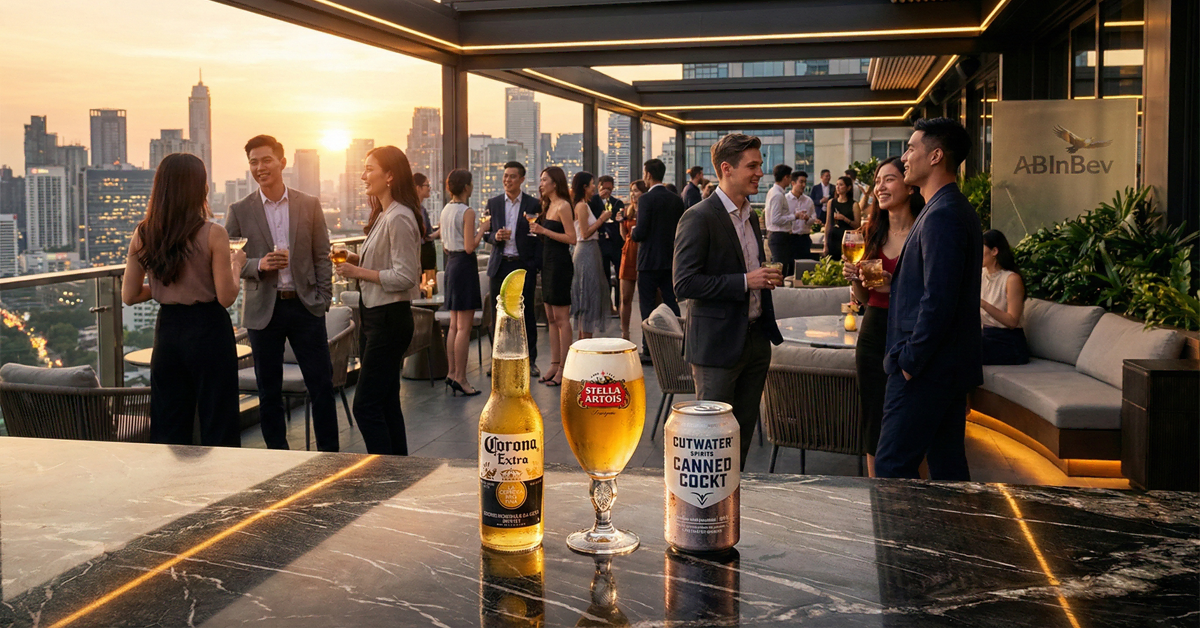
The core of AB InBev’s current strategy is the deliberate cultivation of its global brands—Corona, Stella Artois, Budweiser, and Michelob Ultra. In an era where total beer consumption is flattening in mature markets, the company has doubled down on the “premiumization” trend. This strategy assumes that while consumers may drink less frequently, they are willing to pay more for a higher-quality, branded experience.
The Outperformance of Corona and Stella Artois
Corona has emerged as the spearhead of the premium portfolio. In 2025, Corona’s revenue outside of its home market in Mexico grew by 7.6%, with double-digit growth in over 30 markets. The brand’s ability to transcend its Mexican heritage and become a global symbol of relaxation and “beach lifestyle” has allowed AB InBev to command premium pricing. Stella Artois similarly continues to serve as the company’s “super-premium” pillar, particularly effective in the on-premise (bar and restaurant) channel where its sophisticated branding and specific pouring ritual justify higher price points.
Revenue Management and Margin Drivers
The financial impact of this pivot is clear in the “Revenue per Hectoliter” (Rev/hl) metric. In 2025, Rev/hl increased by 4.4% globally. This growth was not merely the result of inflation-linked price hikes but was significantly driven by “brand mix”—the shifting of the consumer base toward more expensive products. By prioritizing marketing spend on high-margin Megabrands rather than protecting the market share of declining “value” or “mainstream” lagers, AB InBev is effectively “pruning” its consumer base to favor those with higher lifetime value.
The margin expansion of 101 basis points in 2025 is particularly impressive given the volatile commodity price environment and currency headwinds in emerging markets like Brazil and Argentina. The company’s ability to maintain a 35.8% EBITDA margin illustrates the defensive nature of a premiumized portfolio: premium consumers tend to be less price-sensitive during economic downturns than those in the value segment.
Beyond Beer: The ROI of Diversification
AB InBev’s “Beyond Beer” segment—which encompasses spirits-based Ready-to-Drink (RTD) cocktails, hard seltzers, and flavored malt beverages—has transitioned from an experimental niche to a core growth engine. In 2025, this segment delivered high-thirties revenue growth, significantly outperforming the broader beer category.
The RTD Explosion: Cutwater and BeatBox
The acquisition and scaling of Cutwater Spirits have been a masterclass in diversification. Cutwater reported triple-digit revenue growth in 2025, capitalizing on the consumer demand for bar-quality cocktails in a convenient can format. Unlike the hard seltzer boom, which relied on malt-based bases, spirits-based RTDs offer a higher perceived value and allow the company to compete directly with spirits manufacturers like Diageo and Pernod Ricard.
The late 2025 acquisition of a majority stake in BeatBox, a rapidly growing RTD brand popular at music festivals and convenience stores, further signals AB InBev’s intent to dominate the “flavor” category. BeatBox, with its high ABV and vibrant packaging, addresses a specific “party” occasion that traditional lagers are losing to spirits and cocktails. The ROI in this segment is historically higher due to the premium pricing of RTDs, though marketing costs are also elevated as the company builds new distribution networks outside of traditional beer aisles.
Hard Seltzers: Market Stabilization and Rationalization
While the meteoric growth of hard seltzers has slowed from the 2019-2021 peak, the category has stabilized as a permanent fixture of the beverage market. AB InBev’s NÜTRL Vodka Seltzer has shown resilience, particularly by leaning into the “clean label” trend (simple ingredients, no sugar). The company has successfully rationalized its seltzer portfolio, moving away from a “shotgun” approach of dozens of SKUs to focusing on a few high-performing brands that complement rather than cannibalize its beer sales.
Gen Z and the “Sober Curious” Movement: A Systemic Risk?
The most significant headwind for AB InBev is the shifting cultural relationship with alcohol. Generation Z (born 1997–2012) is consuming approximately 20% less alcohol per capita than Millennials did at the same age. This “sober curious” movement is driven by a combination of health consciousness, “image control” in the age of social media, and a preference for alternative substances such as cannabis in legalized markets.
Assessing the “Default Drink” Decline
For decades, a light lager was the “default drink” for social occasions. Today, Gen Z is rejecting the “thoughtless consumption” of high-volume, low-flavor beer. When they do drink, they gravitate toward “intentional indulgence”—high-quality spirits, complex cocktails, or craft options. This shift poses a systemic risk to AB InBev’s high-volume manufacturing plants, which were built for the era of mass-market lagers like Bud Light.
The Budweiser Zero and Corona Cero Strategy
AB InBev’s response has been an aggressive “No-Alcohol Beer” (NAB) strategy. The company’s goal is for 20% of its global volume to come from no- or low-alcohol products. In 2025, the no-alcohol portfolio grew revenue by 34%, led by Corona Cero, which saw an astonishing 75% volume increase. Budweiser Zero has also established itself as a leader in the segment, particularly through sports partnerships (e.g., FIFA World Cup, Olympic Games).
From an investment perspective, NABs are highly attractive. They typically carry similar or higher price points than regular beer but are subject to significantly lower (or zero) excise taxes in many jurisdictions. This allows for superior margins. Furthermore, NABs allow AB InBev to participate in “new occasions”—such as weekday lunches or post-workout sessions—where alcohol was previously socially unacceptable. However, the risk remains: can NAB growth fully offset the structural decline of the “mainstream” alcoholic beer segment? Current data suggests that while NABs are growing fast, they are starting from a much smaller base.
Operational Efficiency and the Digital Ecosystem
Beyond its liquid assets, AB InBev has transformed into a technology-driven logistics powerhouse. The BEES B2B platform is now active in 29 markets, capturing 72% of the company’s total revenue through digital channels. In 2025, BEES generated $52.5 billion in Gross Merchandise Value (GMV).
BEES Marketplace: Moving Beyond Beverages
The BEES Marketplace allows AB InBev to sell third-party products (such as snacks, cleaning supplies, and other consumer goods) to the millions of small retailers it already serves with beer. This “platform play” diversifies revenue and increases the “stickiness” of the retailer relationship. Marketplace GMV reached $3.5 billion in 2025, growing 61% year-over-year. This high-margin service revenue acts as a buffer against the volatility of the beer market.
Investment Thesis and Financial Health
For the long-term investor, AB InBev’s balance sheet is the healthiest it has been since the 2016 acquisition of SABMiller. The Net Debt-to-EBITDA ratio has been reduced to 2.87x as of December 31, 2025, down from over 5.0x at the peak of its leverage. This deleveraging has allowed the company to return more cash to shareholders, evidenced by the proposed 2025 final dividend of €1.00 per share and a continued $6 billion share buyback program.
Risk Factors
- Demographic Cliff: If Gen Z’s lower alcohol consumption habits persist as they age, the total addressable market for alcohol may contract permanently.
- Commodity Volatility: Aluminum, barley, and energy costs remain susceptible to geopolitical shocks, potentially squeezing margins if premiumization cannot keep pace.
- Regulatory Headwinds: Increasing global scrutiny on alcohol health impacts could lead to stricter labeling requirements or higher taxes, similar to the “sugar tax” on soft drinks.
Comparative Analysis: AB InBev vs. Peer Group
| Metric (FY2025) | AB InBev (BUD) | Heineken (HEINY) | Molson Coors (TAP) |
|---|---|---|---|
| Revenue Growth (Organic) | +2.0% | +1.8% | -0.5% |
| EBITDA Margin | 35.8% | 22.4% | 18.2% |
| Net Debt / EBITDA | 2.87x | 2.4x | 2.1x |
| No-Alcohol Revenue Growth | +34% | +15% | +12% |
AB InBev significantly leads its peers in EBITDA margin and no-alcohol growth. While its debt levels remain slightly higher than Heineken or Molson Coors, the superior cash flow generation ($11.3 billion free cash flow in 2025) makes this debt easily serviceable.
Conclusion: A Value Play in a Changing World
AB InBev is no longer just a “beer company.” It is a global beverage and technology platform. By leveraging its unrivaled scale to drive efficiencies through BEES and its brand equity to command higher prices through premiumization, it has successfully navigated a period of declining volumes. The transition to “Beyond Beer” and “No-Alcohol” is not merely a defensive crouch but an offensive expansion into higher-margin categories.
The investment case for 2026 rests on the company’s ability to maintain its margin expansion through brand mix and cost discipline. While Gen Z’s sober-curious habits represent a genuine structural threat, AB InBev’s portfolio is now more diversified than ever to meet these consumers where they are—whether that is with a Cutwater margarita, a Corona Cero at a beach club, or a Michelob Ultra at a fitness event. For investors looking for a high-margin, cash-generative staple with a clear path to debt reduction and increasing dividends, AB InBev remains a compelling long-term hold.
Looking ahead to 2026, management guidance of 4-8% EBITDA growth appears achievable, supported by major sporting events such as the 2026 FIFA World Cup, where AB InBev brands will enjoy unprecedented global visibility. The “reset” is over; the era of “Value over Volume” is in full swing.