
Table of Contents
Executive Summary: The Dawn of the “New Class”
As of early 2026, Bayerische Motoren Werke AG (BMW) stands at its most significant strategic crossroads since the 1960s. The “Neue Klasse” (New Class) represents more than just a model refresh; it is a total architectural reset designed to redefine the brand’s profitability, technological leadership, and manufacturing efficiency for the electric age.
With the first production units of the BMW iX3 rolling off the line in Debrecen, Hungary, and the global debut of the BMW i3 Sedan scheduled for March 18, 2026, investors are evaluating whether BMW can successfully navigate the “Valley of Death” in EV transition costs. Unlike its primary peers, BMW’s strategy is distinguished by “technology neutrality”—a refusal to abandon internal combustion engines (ICE) prematurely while simultaneously co-developing a series-production hydrogen fuel cell vehicle for 2028.
This report analyzes the four pillars of BMW’s value proposition: the Neue Klasse rollout, Gen 6 battery economics, the strategic hedge of hydrogen, and the continued cash-flow strength of its high-margin ICE and hybrid portfolio.
I. The Neue Klasse Roadmap (2025–2027)
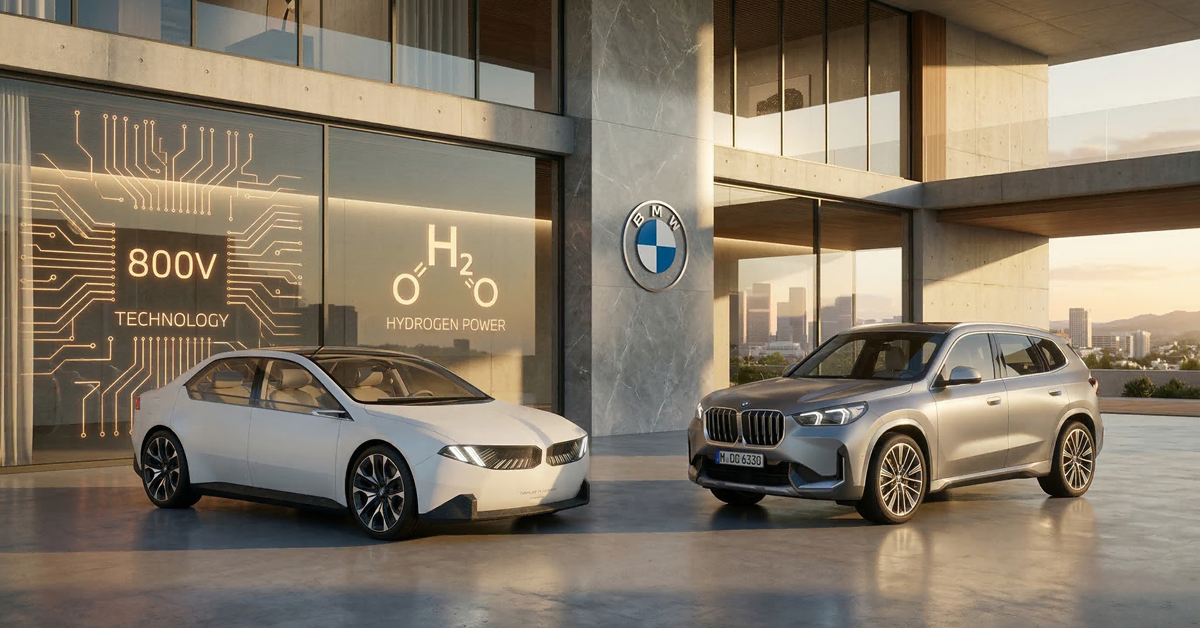
The “Neue Klasse” is a dedicated 800-volt architecture that serves as the foundation for at least six new model launches between late 2025 and 2027. This cycle is critical because it replaces the “CLAR” (Cluster Architecture), which was a flexible but compromise-heavy platform that supported ICE, PHEV, and BEV variants simultaneously.
1. The BMW iX3 (NA5): The Volume Vanguard
The iX3, an SAV (Sports Activity Vehicle), is the first to utilize the new platform. Production began in late 2025 at the Debrecen plant—BMW’s first factory to operate entirely without fossil fuels (iFactory).
- Market Launch: Spring 2026 (Europe), Summer 2026 (USA/China).
- Strategic Role: It targets the high-margin SUV segment to offset the massive R&D expenditure incurred during the 2023–2025 “Peak Capex” period.
- Investor Insight: Early pre-production feedback indicates a range of up to 805 km (WLTP), putting BMW ahead of the current Audi Q6 e-tron and Mercedes EQE SUV in pure efficiency metrics.
2. The BMW i3 Sedan (NA0): Reclaiming the Core
Debuting in March 2026, the new i3 (not to be confused with the discontinued hatchback) is the electric spiritual successor to the 3 Series.
- Production: H2 2026 at the Munich home plant.
- Significance: The 3 Series has historically been BMW’s profit anchor. The i3’s success is the ultimate litmus test for whether BMW’s traditional enthusiast base will migrate to high-voltage digital architectures.
II. Technological Quantum Leap: Gen 6 Batteries & Cost Reduction
The primary driver of the Neue Klasse’s financial viability is the Gen 6 battery technology. For years, BMW lagged behind Tesla in battery-cell-to-pack efficiency. Gen 6 changes this trajectory by moving from prismatic cells to cylindrical cells (46mm diameter, varying heights).
Battery Performance Metrics
| Metric | Gen 5 (Current) | Gen 6 (Neue Klasse) | Improvement |
| Energy Density | ~550 Wh/L | ~660 Wh/L | +20% |
| Charging Speed | 400V (max 200kW) | 800V (max 400kW) | +30% |
| Range | 500–600 km | 800+ km | +30% |
| Production Cost | Baseline | -50% | -50% |
The Path to Margin Parity
BMW management has explicitly stated that by 2026, the Neue Klasse aims to achieve margin parity with its ICE counterparts. This is a bold claim, given the historic 15–20% margin gap between combustion and electric vehicles. The 50% reduction in battery production costs is the primary lever. By utilizing Lithium Iron Phosphate (LFP) for entry-level models and high-nickel cylindrical cells for performance models, BMW is optimizing its bill of materials (BOM) to survive a low-subsidy environment.
III. Technology-Neutral Strategy: The Strategic Hedge
While competitors like Volvo and Mercedes-Benz have faced setbacks after aggressive 100% BEV pledges, BMW’s “Power of Choice” philosophy is proving resilient.
1. Hydrogen Fuel Cells (FCEV): The 2028 Series Production
BMW is the only major European premium OEM currently committed to a mass-production hydrogen passenger car. In partnership with Toyota, BMW is developing a 3rd-generation fuel cell system.
- The Logic: BMW views hydrogen as a necessary pillar for customers who cannot rely on DC fast charging (multi-unit dwellers) or for heavy towing applications.
- Industrialization: Series production is confirmed for 2028. The system is designed to be “plug-and-play” within the Neue Klasse architecture, replacing the large battery pack with hydrogen tanks and a fuel cell stack.
- Risk/Reward: While infrastructure remains a hurdle, BMW’s ability to “zero-emissions-proof” its heavy SUV lineup without the weight penalty of 150kWh batteries provides a significant long-term competitive moat.
2. Highly Efficient ICE: The Cash Engine
The launch of the G50 3 Series (ICE/Hybrid) alongside the electric i3 in 2026 is a masterclass in risk management.
- Refining the “Efficient Dynamics”: BMW continues to invest in Euro 7 compliant inline-six and four-cylinder engines.
- Financial Impact: These models benefit from fully amortized R&D and existing production lines, generating the free cash flow (FCF) required to fund the ~€9 billion annual R&D spend for the Neue Klasse.
IV. Financial Performance and Investor Outlook
1. Revenue and Earnings Analysis
In FY 2025, BMW maintained an Automotive EBIT margin in the 5% to 7% range, despite significant headwinds in the Chinese market and peak investment in the Debrecen and Munich plant conversions. For 2026, the outlook is cautiously optimistic, with a target return to the 8% to 10% long-term corridor.
2. Capex and R&D Cycle
The “Peak Capex” phase (2023–2025) is subsiding.
- 2024/2025: R&D and Capex ratios were at historic highs (approx. 6.4% each).
- 2026/2027 Projection: As Neue Klasse models move from development to sales, the R&D ratio is expected to normalize toward 5%, boosting net income margins.
3. Shareholder Returns
BMW remains a favorite for value-oriented investors due to its disciplined capital allocation.
- Dividend: A payout ratio of 30% to 40% of net income is consistently maintained.
- Buybacks: BMW’s multi-billion euro share buyback programs signal management’s confidence that the stock is undervalued relative to its technological assets.
V. SWOT Analysis for Investors
Strengths:
- Manufacturing Flexibility: The ability to produce BEV, PHEV, and ICE on the same lines (iFactory) allows BMW to respond instantly to shifts in consumer demand.
- Brand Equity: High retention rates in the M-Performance segment, which is currently seeing record sales.
Weaknesses:
- Complexity: Managing three distinct powertrain types (ICE, BEV, FCEV) increases supply chain complexity and inventory risk.
- Software Dependency: The “Heart of Joy” superbrain and iDrive X must perform flawlessly; any software-related launch delays (similar to VW’s CARIAD issues) would be catastrophic.
Opportunities:
- Gen 6 Battery Licensing: Potential to monetize internal battery IP or supply components to smaller luxury manufacturers.
- Hydrogen Leadership: First-mover advantage in the premium FCEV space if European and Chinese refueling infrastructure scales.
Threats:
- Chinese Competition: Domestic Chinese brands (BYD, Zeekr) are moving up-market, threatening BMW’s dominant position in the “Executive” segment in Asia.
- Regulatory Volatility: Potential shifts in EU/US emission targets could render some ICE investments less profitable than anticipated.
VI. Conclusion: The “Buy” Case for BMW
The 2025–2027 period is not merely a product launch; it is an industrial metamorphosis. BMW’s stock (XETRA: BMW) currently trades at a valuation that reflects the uncertainties of the EV transition, yet its underlying fundamentals suggest a company that has successfully de-risked the move.
By refusing to pick a single winner between BEV, ICE, and Hydrogen, BMW has built a “future-proof” portfolio. The Neue Klasse provides the high-tech, high-efficiency BEV required to compete with Tesla, while the 2028 Hydrogen roadmap and sustained ICE excellence provide the safety net. For the patient investor, the normalization of capital expenditure in 2026, combined with the launch of the margin-accretive iX3 and i3, presents a compelling entry point into a premium titan that is finally closing the “efficiency gap.”