John Templeton Investment Philosophy

Sir John Templeton’s Contrarian Paradigm: Historical Analysis and Modern Applications for Global Value Investing

The evolution of modern global asset management is inextricably linked to the methodological frameworks pioneered by Sir John Marks Templeton. Over a career spanning more than five decades, Templeton established a record of sustained outperformance that fundamentally reshaped the institutional investment industry, transforming the localized, theoretical constructs of early value investing into a globally applied, empirically robust discipline. His flagship […]


Algorithmic Trading vs. Human During Crashes

Algorithmic vs Discretionary Trading in Black Swan Events: Microstructure, Liquidity, and Systemic Fragility

Executive Overview The architecture of global capital markets has undergone a radical transformation over the past two decades, transitioning from human-dominated trading floors to heavily fragmented, electronic ecosystems governed by complex computational algorithms. Algorithmic execution now intermediates the vast majority of daily trading volume across equity, fixed income, and derivative markets. However, the true efficacy, resilience, and systemic impact of

ESG Mutual Funds vs. Traditional Index Funds

The “Greenium” Myth vs. Reality

Introduction: The Maturation of Sustainable Finance and the “Greenium” Hypothesis Over the past century, the integration of ethical considerations into financial markets has undergone a profound structural evolution. Environmental, Social, and Governance (ESG) investing has metamorphosed from a highly niche, values-driven exclusionary strategy into a mainstream, value-driven pillar of modern institutional portfolio management. Early iterations of socially responsible investing (SRI)

Behavioral Finance and the Architecture of Long-Term Wealth Generation

Behavioral Finance and the Architecture of Long-Term Wealth Generation

The Intersection of Human Psychology and Capital Markets The architecture of sustained wealth generation within global capital markets is fundamentally predicated on the intersection of rigorous quantitative discipline and the mastery of human psychology. Traditional financial theory and classical economics have long operated under the assumption of the homo economicus—a perfectly rational, utility-maximizing agent who processes all available information to

The Macro Cost of the Energy Transition

The Macro Cost of the Energy Transition: Quantifying the Green Premium and Global Inflationary Dynamics (2026–2046)

Introduction: The Economic Paradigm of the Global Energy Transition As the global economy advances into the latter half of the 2020s, the paradigm surrounding the energy transition has firmly shifted from theoretical climate pledges to the rigorous, capital-intensive realities of execution. The global energy system entering 2026 is characterized by a growing divergence between easing traditional commodity markets and rising

Nonlinear Dynamics of Interest Rate Transmission

2026 Market Outlook: Interest Rates & AI Equity Duration

Nonlinear Dynamics of Interest Rate Transmission: Equity Duration, Convexity, and the 2026 Market Split The global financial ecosystem of 2026 is navigating a watershed moment in the relationship between monetary policy and asset valuation. After a decade defined by the persistence of the Zero Interest Rate Policy (ZIRP) and subsequent aggressive tightening cycles, the transmission mechanism of interest rates onto

Investment Wisdom from Kostolany

The Art of Thinking, Not Calculating: Investment Wisdom from André Kostolany

The modern financial landscape is often characterized by an obsession with quantification, where high-frequency trading, algorithmic modeling, and the relentless pursuit of Big Data suggest that the markets are a machine to be solved. However, the legacy of André Kostolany, frequently referred to as the “Grand Master of the Bourse,” offers a profound counter-narrative. Kostolany’s philosophy posits that speculation is

One Up on Wall Street and PEG Ratio

Peter Lynch Stock Picking Strategy: PEG Ratio and Stock Categories

The Philosophical Genesis of the Lynch Methodology The architecture of modern growth-at-a-reasonable-price (GARP) investing finds its most influential proponent in Peter Lynch, whose stewardship of the Fidelity Magellan Fund from 1977 to 1990 yielded an unprecedented 29.2% average annual return. This performance, which nearly doubled the S&P 500’s 15.8% return over the same period, was not merely a product of

Fibonacci Ratios in Global Equity Markets

How Reliable is Fibonacci in Stock Investing?

The integration of mathematical sequences into financial forecasting represents a significant endeavor to find order within the perceived stochasticity of price movements. Among the various tools utilized by market technicians, the Fibonacci sequence and the derived “Golden Ratio” occupy a central role. Originally documented by Leonardo of Pisa in his 1202 treatise Liber Abaci, these mathematical principles have evolved from

Jim Simon Hedge Fund Philosophy

The Quantitative Architect: Analysis of Jim Simons, Renaissance Technologies, and the Evolution of Algorithmic Finance

The evolution of global financial markets has been punctuated by shifts in dominant paradigms, but few have been as disruptive as the rise of quantitative investing, a movement spearheaded by James Harris Simons. Known widely as the “Quant King,” Simons did not merely participate in the financial markets; he fundamentally re-engineered the process of capital allocation by replacing human intuition

Taiwan’s Economic Powerhouse in the AI Era

Taiwan’s Economic Powerhouse in the AI Era: Investment Opportunities and Risks Ahead

Introduction Taiwan has emerged as a tech-powered economic powerhouse in Asia, characterized by robust growth, low inflation, and a dominant high-tech export sector. Fueled by booming demand for advanced semiconductors and electronics, Taiwan’s economy saw its fastest expansion in 15 years in 2025. This report provides a comprehensive analysis of Taiwan’s macroeconomic conditions, key industry strengths (especially in semiconductors, electronics,

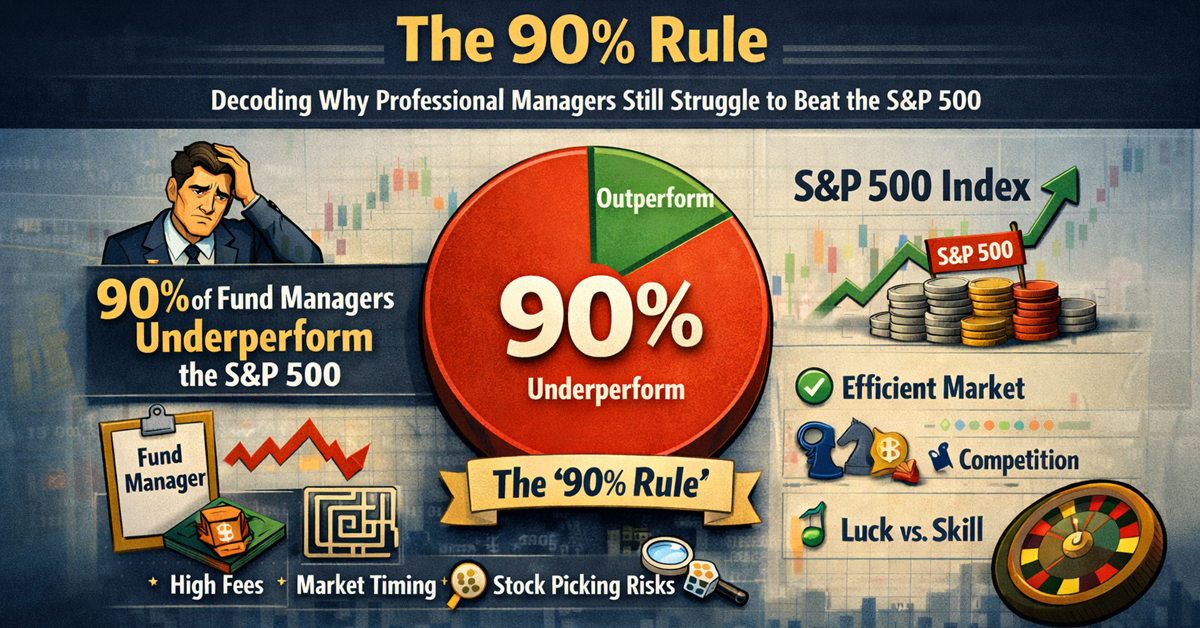
The 90% Rule, Professional Managers Still Struggle to Beat the S&P 500

The 90% Rule: Decoding Why Professional Managers Still Struggle to Beat the S&P 500

Executive Summary Professional fund managers are often presumed to have the skill and resources to outperform market indices. Yet decades of evidence reveal a persistent truth: the vast majority of active investment managers underperform broad market benchmarks like the S&P 500. This phenomenon – colloquially referred to here as “the 90% rule” – reflects findings that roughly 80–90% of active

Scroll to Top