
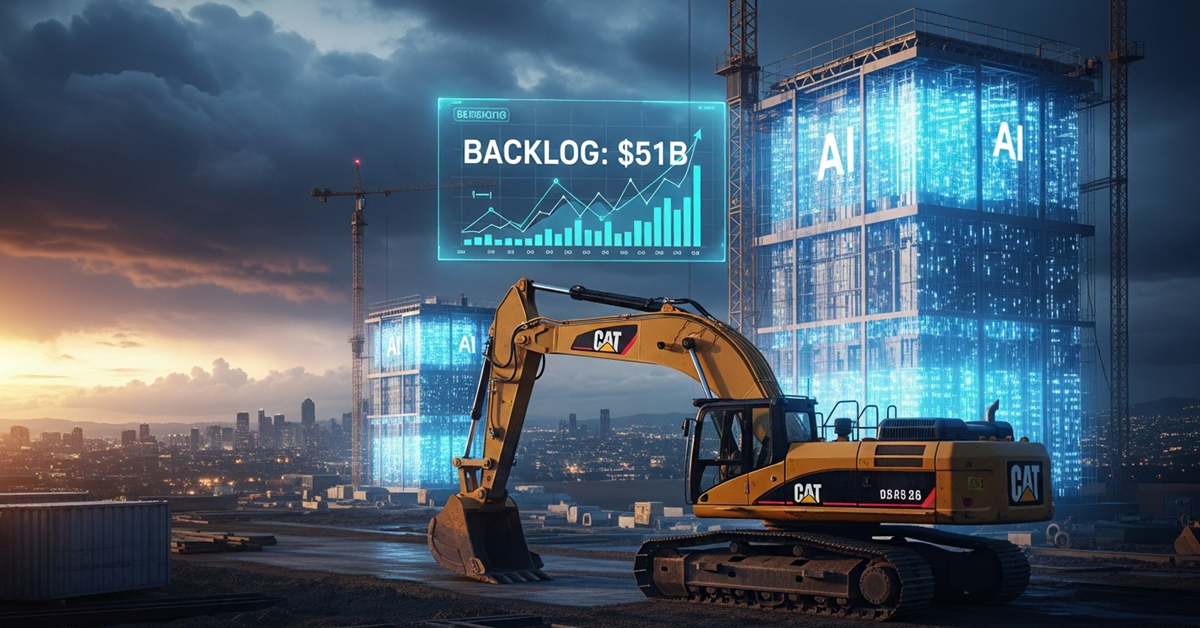
Caterpillar Inc. (NYSE: CAT) entered 2026 having achieved a historic milestone: a record-breaking $51 billion order backlog. As the global leader in construction and mining equipment, diesel and natural gas engines, and industrial gas turbines, Caterpillar’s performance serves as a primary barometer for global industrial health. However, the sheer scale of this backlog—a 70% increase compared to the previous year-end—comes at a time of significant macroeconomic volatility, shifting geopolitical landscapes, and a paradigm shift in energy demand driven by the Artificial Intelligence (AI) boom.
Table of Contents
Backlog Composition: Beyond the Bulldozer
While Caterpillar is traditionally associated with heavy earthmoving machinery, the current backlog reflects a fundamental shift toward the Energy & Transportation (E&T) segment. The surge is increasingly defined by “power, not just piles of dirt.”
- Energy & Transportation: This segment is the primary engine of growth. The rise of AI and hyperscale data centers has created a massive bottleneck in the global power grid. Caterpillar’s prime power generators are being deployed as on-site solutions, with the company booking multiple orders exceeding 1 gigawatt in capacity.
- Construction Industries: Despite high interest rates, North American infrastructure projects and a return to normal seasonal ordering patterns have kept this segment robust. The backlog here reflects long-term commitments rather than short-cycle retail demand.
- Resource Industries: Mining activity, particularly in copper and lithium for the energy transition, has supported a strong order run rate, with notable strength in South American mining operations.
The AI Power Play: A Structural Shift
The record $51 billion backlog signifies that Caterpillar is no longer just a cyclical machinery play; it is becoming a structural infrastructure play for the digital age. As data center power usage is projected to surge significantly through 2030, Caterpillar’s ability to provide rapid-deployment power solutions has positioned it as a “picks and shovels” provider for the AI revolution. Management has indicated that approximately 62% of this backlog is slated for realization within the 2026 fiscal year, providing unprecedented earnings visibility but also placing immense pressure on production capacity.
Volatility and Risks: The Margin Squeeze
Despite the record demand, the path to converting this backlog into profit is fraught with “volatile” variables. The company faces a delicate balancing act in a high-cost environment.
| Risk Factor | Projected Impact for 2026 |
|---|---|
| Tariff Headwinds | Estimated $2.6 billion in incremental costs, pressuring operating margins toward the bottom of target ranges. |
| Capacity Constraints | The inability to ramp supply quickly enough in segments like Power Generation could lead to market share loss to competitors. |
| Conversion Delays | Large-scale data center and mining projects are subject to permitting and grid-hookup delays, potentially stalling backlog realization. |
Financial Outlook and Market Sentiment
Caterpillar’s management projects 2026 sales growth at the top end of their 5% to 7% CAGR target, underpinned by the $51 billion cushion. Analysts remain cautiously optimistic, with many raising price targets toward the $750-$800 range, citing “above-average earnings visibility.” However, the market is also pricing in a premium valuation, with the stock trading at a P/E ratio significantly higher than its historical average.
Caterpillar has transitioned from a cyclical equipment maker to a structural growth story. The 44% surge in power generation sales is not an anomaly; it is the beginning of a multi-year buildout where energy may eventually overtake construction as the flagship business.
Strategic Execution in 2026
To successfully navigate the current market, Caterpillar is pivoting its strategy from simply capturing orders to optimizing execution. This includes:
- Dynamic Pricing: Implementing inflationary indices and escalators in long-term contracts to mitigate rising manufacturing and tariff costs.
- Services Expansion: Targeting $28 billion in services revenue to provide a stable, high-margin buffer against machine sales volatility.
- Capacity Investment: Aggressive capital expenditure to expand production in Lafayette and double turbine output to meet the data center demand.
The $51 billion backlog provides Caterpillar with a massive “shock absorber” against a potential global slowdown. However, the ultimate success of 2026 will depend not on the orders signed, but on the company’s ability to navigate the complex logistics of a tariff-heavy, capacity-constrained global market.