
Table of Contents
Executive Summary
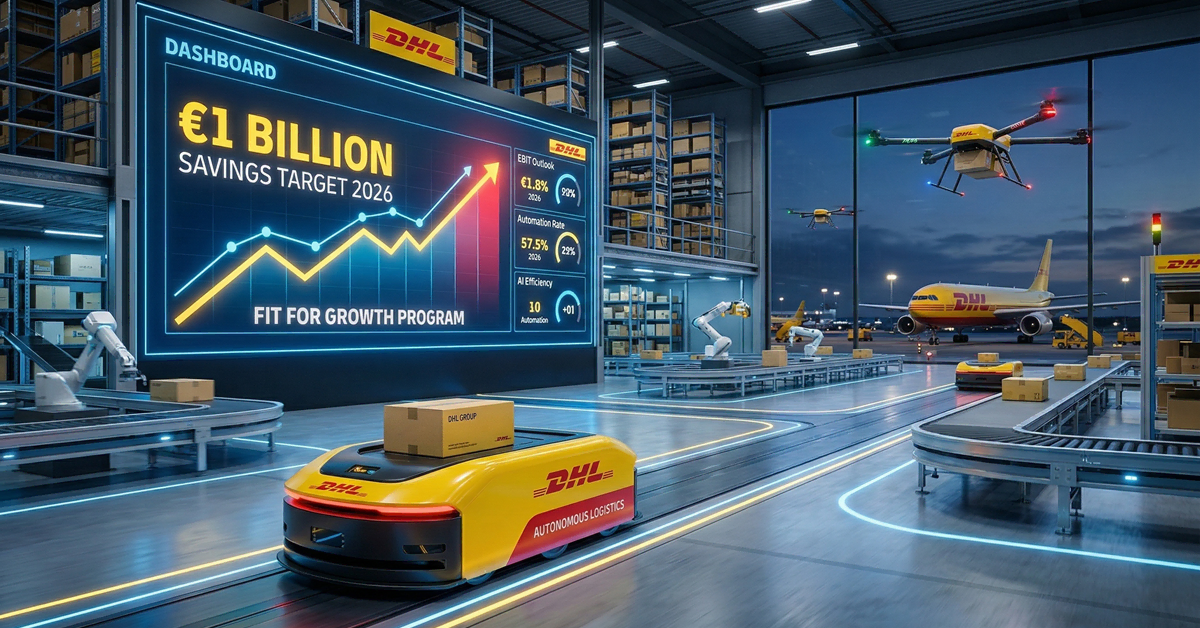
As of March 2026, DHL Group (XETRA: DHL) stands at a pivotal juncture in its “Strategy 2030” journey. Central to this strategy is the “Fit for Growth” cost program, an ambitious initiative designed to structurally improve the Group’s cost base by €1 billion annually by the end of 2026. This report provides a deep-dive analysis into the progress of this program, the technological catalysts driving it, and the resulting implications for shareholders.
Key findings indicate that DHL Group has successfully realized €600 million in gross savings during the 2025 financial year, leaving a remaining €400 million to be captured in 2026. The program is not merely a “belt-tightening” exercise but a fundamental transformation of the Group’s operational DNA, leveraging agentic AI, autonomous robotics, and a significant legal restructuring to decouple the legacy German postal business from the high-growth global logistics divisions. Despite a volatile macroeconomic environment and shifting trade patterns, the “Fit for Growth” program provides the structural floor necessary to support a 2026 EBIT guidance of over €6.2 billion.
I. Introduction: Strategy 2030 and the Fit for Growth Mandate
Launched in late 2024 as a cornerstone of the broader “Strategy 2030: Accelerate Sustainable Growth,” the Fit for Growth program was conceived to address two primary challenges: persistent inflationary pressure on labor and fuel, and the need for greater agility in a “multi-local” world where trade lanes are increasingly fragmented.
For decades, the Group—formerly known as Deutsche Post DHL—operated as a conglomerate with deep roots in domestic German mail. The 2026 target marks the culmination of a decade-long shift toward a pure-play global logistics leader. By targeting €1 billion in structural savings, management aims to expand margins independently of volume growth, ensuring that even in a stagnant GDP environment, the “Investment of Choice” bottom line remains robust.
II. Financial Progress: The Road to €1 Billion
1. 2025 Performance: Building the Foundation
In the fiscal year 2025, DHL Group demonstrated that “Fit for Growth” was more than just a boardroom concept. The company reported a gross EBIT contribution from the program exceeding €600 million (excluding cost-of-change items). This achievement was critical in offsetting a 1.3% decline in quarterly revenue during late 2025, largely caused by currency fluctuations and a normalization of ocean freight rates.
- 2025 EBIT: €6.1 billion (Reported)
- EBIT Margin: 7.4% (up from 7.0% in 2024)
- Free Cash Flow (excl. M&A): €3.2 billion
The 2025 results confirmed that the efficiency measures are gaining traction faster than initially anticipated, particularly in the Express and Post & Parcel Germany divisions.
2. The 2026 Trajectory and Guidance
As we enter the final stretch of the program, management has confirmed that approximately €400 million in savings remain to be realized in 2026. This “last mile” of the savings target is expected to be more complex, involving the completion of significant network resets and the full-scale deployment of generative AI across administrative functions.
2026 Financial Targets:
- Group EBIT: >€6.2 billion
- Free Cash Flow: ~€3.0 billion
- Gross CapEx: €3.0–3.3 billion
Investors should note that while the 2026 guidance met consensus, some analysts (e.g., Jefferies, Morgan Stanley) had hoped for a more aggressive target given the “cost-out” momentum. However, CEO Tobias Meyer’s “pragmatic” outlook reflects a cautious stance on global trade volatility, choosing to rely on internal efficiency rather than betting on an economic rebound.
III. Operational Transformation: Structural Resets & Network Optimization
The “Fit for Growth” program identifies three primary “Profitability Accelerators”: Support Functions, Ground Operations & Warehousing, and Aviation & Air Freight.
1. Express Division: The “Air-to-Truck” Pivot
DHL Express, the Group’s most profitable division, has undergone a “structural air network reset” in Europe and the USA. By redesigning routes and shifting certain short-haul volumes from air to road (air-to-truck), the division has significantly reduced its carbon footprint and fuel expenditure.
- Fleet Renewal: The final delivery of the Boeing 777 factory order in 2025 has replaced older, less efficient wide-body aircraft, reducing maintenance costs and improving fuel burn by double digits on long-haul routes.
- U.S. Network Adaptation: Following a 26% drop in U.S.-bound weight-per-day due to tariff shifts, the Group rapidly adapted its U.S. Express network, downsizing capacity to match the new volume reality without sacrificing service quality.
2. Post & Parcel Germany: Rightsizing the Legacy
In the domestic German market, the focus has been on “socially responsible” position reductions and network optimization.
- Headcount Reduction: Approximately 8,000 positions are being phased out in 2025-2026, primarily through natural attrition and early retirement, as part of the “Fit for Growth” overhead optimization.
- Automation in Sorting: New high-speed sorting technology and automated “Packstations” (which now exceed 15,000 locations) have reduced the “last mile” cost-to-serve, which is traditionally the most expensive part of the logistics chain.
IV. Technology as a Multiplier: AI, Automation, and Robotics
The most significant differentiator in the 2026 efficiency drive is the move from “Experimental AI” to “Agentic AI.” Unlike previous iterations of AI that provided suggestions, the systems currently being deployed by DHL autonomously execute tasks.
1. Agentic AI and the “HappyRobot” Partnership
DHL Supply Chain has entered a strategic partnership with the AI startup HappyRobot to deploy AI agents that manage operational communication.
- Autonomous Coordination: These agents handle phone calls and emails for appointment scheduling, driver follow-ups, and warehouse coordination. By processing millions of minutes of conversation annually, they have freed up human staff for complex exception handling.
- Efficiency Gains: In customer service and customs clearance, AI has accelerated process speeds by over 30%, a critical factor as global trade faces increasing regulatory and tariff complexity.
2. Robotics in the Warehouse
DHL has moved beyond pilot programs to a global deployment of 8,000 collaborative robots (cobots).
- Picking Efficiency: In key logistics hubs, item-picking robots have increased picking rates by 30% per hour.
- Autonomous Forklifts: These have contributed a 20% efficiency boost in pallet movement, reducing labor-intensive shifts and improving warehouse safety.
- Standardization: A key part of “Fit for Growth” is the standardization of warehouse management systems (WMS) across all regions, allowing for a “plug-and-play” approach to new robotic technology.
V. Corporate Structure Evolution: From Deutsche Post to DHL AG
A fundamental component of the efficiency program is the simplification of the legal group structure.
1. The Rename
Subject to the shareholder vote on May 5, 2026, the parent company “Deutsche Post AG” will be renamed “DHL AG.” This is more than a branding exercise; it signifies the full integration of the company under its most valuable global brand.
2. The P&P Carve-down
The Group is proceeding with the legal carve-down of Post & Parcel Germany into a dedicated subsidiary.
- Rationale: By separating the domestic mail business from the global DHL divisions, management can fully allocate corporate center costs more transparently and allow the P&P division to operate with its own dedicated efficiency mandates.
- GBS Entities: Global Business Services (GBS) will remain a central engine, providing shared services (HR, Finance, IT) to all divisions at a lower per-unit cost than decentralized models.
VI. Market Outlook and Investor Sentiment
1. Macroeconomic Headwinds vs. Internal Levers
The “Fit for Growth” program serves as a hedge against a “subdued macroeconomic environment.” CEO Tobias Meyer has stated that the Group is not “betting on an economic recovery.” Instead, the focus is on Geographic Tailwinds (growth in Asia, the Middle East, and India) and high-margin sectors like Life Sciences & Healthcare.
2. Valuation and Shareholder Returns
As of March 2026, DHL trades at approximately 14.7x earnings, representing a discount compared to its European logistics peers (averaging 15.1x) and significantly below its fair value estimate. This discount suggests that the market has yet to fully price in the long-term structural benefits of the “Fit for Growth” savings.
Shareholder Return Policy:
- Dividend: Proposed increase to €1.90 for FY 2025.
- Share Buybacks: €1.5 billion remaining to be executed in 2026 as part of the €6 billion multi-year program.
- Total Yield: DHL offers a total cash return yield above 6%, making it an attractive “Income + Growth” play for value-oriented investors.
VII. Conclusion: The Efficiency Point of No Return
The DHL Group’s “Fit for Growth” program is on track to meet its €1 billion annual savings target by year-end 2026. The transition from 2025 to 2026 marks the shift from large-scale network restructuring to granular, AI-driven productivity gains.
For investors, the primary risk remains the “operating leverage” debate: can cost savings outpace inflation if revenue growth remains stagnant? However, with €600 million already secured and the legal path cleared for a leaner “DHL AG” structure, the Group has built a resilient foundation. The integration of 8,000 robots and the deployment of Agentic AI are not merely marginal improvements; they represent a fundamental reset of the cost of doing business in global logistics. As the Group moves toward its medium-term EBIT target of over €7 billion, the “Fit for Growth” program remains the engine room of this transformation.