
Table of Contents
Executive Summary
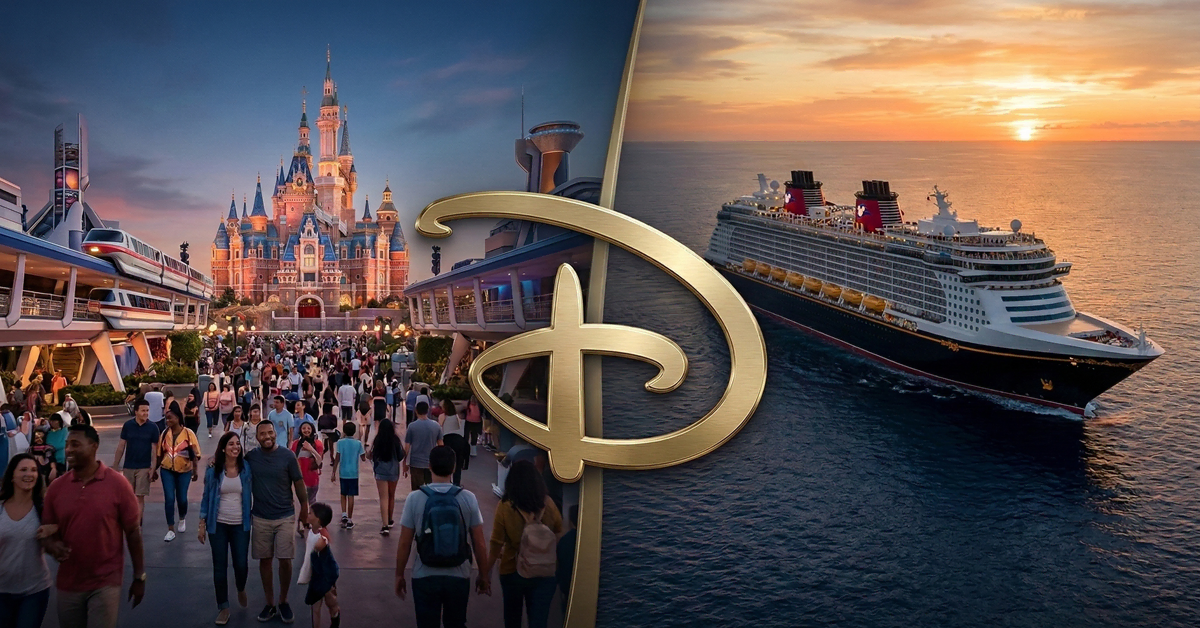
In the opening quarter of fiscal year 2026, The Walt Disney Company (NYSE: DIS) achieved a monumental financial milestone: its “Experiences” segment—comprising domestic and international theme parks, resorts, and the rapidly growing Disney Cruise Line (DCL)—surpassed $10 billion in quarterly revenue for the first time in the company’s history. This achievement is not merely a post-pandemic recovery story; it is the first tangible result of a massive, multi-year $60 billion capital expenditure (CapEx) strategy designed to turbocharge the segment’s growth over the next decade.
As the traditional linear television business faces secular decline and the Direct-to-Consumer (DTC) streaming segment transitions from a loss-leader to a margin-focused business, the Experiences segment has solidified its role as Disney’s primary engine of free cash flow and earnings stability. With the maiden voyage of the Disney Adventure in March 2026 and the recent launch of the Disney Destiny, Disney is aggressively expanding its maritime footprint to capture the high-margin, high-loyalty cruise market. This report analyzes the drivers behind the $10.01 billion revenue peak, the tactical execution of the $60 billion investment plan, and the long-term implications for shareholders.
The $10 Billion Milestone: Breaking Down the Numbers
Disney’s Q1 2026 earnings report highlighted a 6% year-over-year increase in Experiences revenue, reaching $10.01 billion. Operating income for the segment also climbed to $3.31 billion, an 8% increase in domestic operations.
| Metric | Q1 2026 (Experiences) | Q1 2025 (Experiences) | YoY Growth |
| Total Revenue | $10.01 Billion | $9.44 Billion | +6% |
| Operating Income | $3.31 Billion | $3.12 Billion | +6% |
| Domestic Revenue | $6.91 Billion | $6.46 Billion | +7% |
| International Revenue | $1.80 Billion | $1.68 Billion | +7% |
| Operating Margin | ~33% | ~33% | Stable |
Drivers of Growth
- Guest Spending and Per Capitas: Even as attendance levels showed a modest 1% increase domestically, the “per capita” spending—the average amount a guest spends on food, merchandise, and premium experiences like Lightning Lane Premier—rose by 4%.
- Cruise Line Expansion: The addition of the Disney Treasure (Dec 2024) and the Disney Destiny (Nov 2025) significantly increased the total available “passenger cruise days.”
- International Resilience: Despite global economic fluctuations, international parks in Paris, Hong Kong, and Shanghai saw a combined 7% revenue increase. The upcoming “World of Frozen” at Disneyland Paris (Spring 2026) is already driving pre-bookings.
The Maritime Offensive: Disney Destiny and Disney Adventure
The most visible component of Disney’s capital expansion is the doubling of the Disney Cruise Line fleet. The cruise industry represents a unique vertical where Disney can exert total control over the guest environment, leading to industry-leading Net Promoter Scores (NPS) and high re-booking rates.
Disney Destiny: The “Heroes and Villains” Paradigm
Launched in late 2025, the Disney Destiny is the third ship in the Wish-class. Unlike its predecessors, which focused on “Enchantment” and “Adventure,” the Destiny leans into the popular “Heroes and Villains” lore from Disney, Marvel, and Pixar.
- Monetization Strategy: By integrating more “adult-exclusive” spaces, such as the Black Panther-themed Saga lounge and Haunted Mansion parlor, Disney is successfully expanding the cruise demographic beyond families with young children, capturing a higher share of wallet from “Disney Adults.”
Disney Adventure: The Singapore Gambit
The Disney Adventure, which commenced its maiden voyage on March 10, 2026, represents Disney’s first-ever year-round homeport in Asia (Singapore).
- The Global Dream Acquisition: Acquired for a mere $40 million as a partially completed hull (formerly Global Dream), the ship underwent a $1.8 billion retrofit. While more expensive than the original $1 billion estimate, it remains a cost-effective way to enter the Southeast Asian market.
- Scale and Scope: At 208,000 gross tons, it is the largest ship in the fleet, accommodating 6,000 passengers. It serves as a floating theme park, introducing the Disney brand to millions of potential customers in a region where the physical park footprint is limited.
Decoding the $60 Billion Capital Plan
In late 2023, Disney announced it would double its investment in the Experiences segment to $60 billion over 10 years. In 2026, we are seeing the “peak construction” phase of this cycle.
Allocation of Funds
The $60 billion is roughly divided into three strategic buckets:
- 50% for New Capacity: This includes new cruise ships and major park expansions like the Villains-themed Land and Monsters, Inc. Land at Walt Disney World.
- 30% for Technology and Infrastructure: Implementation of advanced AI for guest flow management, personalized itinerary planning via the “Disney Magic” app, and the multi-billion dollar transportation hub at Disneyland Resort.
- 20% for Maintenance and Refurbishments: Ensuring the “show quality” of existing attractions, such as the 2026 reopening of a refurbished Big Thunder Mountain Railroad.
The Theory of “Flywheel Investment”
Management’s thesis is that every dollar spent in Experiences has a higher ROI than a dollar spent in linear television. By building “The Tropical Americas” at Animal Kingdom or “World of Frozen” in Paris, Disney creates “sticky” reasons for fans to visit. These physical experiences, in turn, drive subscriptions to Disney+ and sales of consumer products, creating a self-reinforcing financial loop.
Domestic vs. International: A Tale of Two Markets
Domestic: The High-Yield Core
The U.S. parks (Florida and California) remain the crown jewels. However, they face the challenge of “normalization.” Following the post-COVID travel boom, Disney has shifted focus from volume (attendance) to yield (profit per guest). The introduction of Lightning Lane Premier—a high-priced, “skip-the-line” tier—has been controversial among fans but highly accretive to margins.
International: The Growth Frontier
- Disneyland Paris: Long the “problem child” of the portfolio, the park is being renamed Disney Adventure World in 2026 to coincide with the opening of the Frozen expansion. This rebranding signals a shift from a “studio” focus to a “world-building” focus, which historically yields higher guest stay times.
- Shanghai and Hong Kong: These parks are benefiting from a surge in regional tourism. The new Spider-Man-themed land in Shanghai is part of a broader strategy to leverage Marvel IP in markets where it outperforms traditional Disney fairy tales.
Risks and Headwinds: The Challenges to the $10B Peak
While the $10 billion milestone is impressive, several factors could dampen the segment’s trajectory in the latter half of 2026:
- Capital Intensity vs. Shareholder Returns: Some institutional investors have expressed concern over the $60 billion price tag. While Disney is on track to repurchase $7 billion of stock in FY2026, the high CapEx requirement limits the potential for significant dividend increases.
- Inflation and Consumer Discretionary Spending: Although Disney guests have shown “inelastic” demand so far, persistent inflation in travel costs (airfare, hotels) may eventually force families to choose shorter stays or cheaper alternatives (like Universal’s upcoming Epic Universe).
- Operational Costs of Fleet Expansion: Launching ships like the Destiny and Adventure involves massive pre-opening expenses and staffing requirements. Q1 2026 operating margins were “held back” by these launch costs, and it will take several quarters of full occupancy for these assets to become margin-accretive.
Investor Outlook: Why the “Experiences” Peak is Just the Beginning
For long-term investors, the Experiences segment is the “moat” that protects Disney from the volatility of the box office and the uncertainty of the streaming wars.
- Valuation Multiples: Traditionally, theme park businesses trade at higher EV/EBITDA multiples than media businesses because their cash flows are more predictable. As Experiences grows as a percentage of Disney’s total EBIT, the stock may see a “re-rating” to a higher valuation.
- Intellectual Property Lifecycle: The $60 billion plan ensures that Disney’s newest and most successful IPs (Encanto, Coco, Avatar) have a physical home. This extends the lifespan of the IP far beyond its theatrical window.
Conclusion
The milestone of $10 billion in quarterly revenue in Q1 2026 is a “proof of concept” for Bob Iger’s second-term strategy. By leaning into the high-margin world of cruises and “experience-based” storytelling, Disney is successfully pivoting away from its reliance on the dying cable bundle. The $60 billion investment plan is a bold, high-stakes bet that the “Experience Economy” will continue to outpace the “Content Economy.” As the Disney Adventure sails out of Singapore and the Disney Destiny prepares for its first summer season, the company has clearly signaled that its future is not just on screens, but in the physical worlds it builds for its fans.