
Table of Contents
Executive Summary
E.ON SE has firmly established itself as the indispensable “playmaker” of the European energy transition. Following a multi-year strategic transformation that saw the divestiture of its conventional merchant generation assets, the company has emerged as a pure-play infrastructure and customer solutions behemoth. The recently unveiled 2026–2030 Industrial Plan marks a pivotal acceleration in E.ON’s capital deployment, raising cumulative capital expenditure to an unprecedented €48 billion—an 11.6% increase from its previous €43 billion plan covering 2024 to 2028.
For institutional and retail investors alike, this updated industrial plan clarifies E.ON’s long-term trajectory. By allocating roughly €40 billion strictly to its regulated energy networks, management is systematically compounding its Regulated Asset Base (RAB), thereby securing highly visible, inflation-protected cash flows well into the next decade. While near-term noise surrounding a forecasted earnings dip in 2026 and ongoing regulatory negotiations in Germany may test market patience, the underlying fundamentals remain exceptionally robust. This report deep-dives into the €48 billion industrial plan, dissects the micro and macroeconomic tailwinds propelling the business, models the financial path to the company’s 2030 targets, and evaluates the stock’s current risk-reward profile.
1. Macroeconomic and Industry Context: The Grid as the Ultimate Bottleneck
It is entirely reasonable for market participants to question the sheer magnitude of a €48 billion capital program. However, grounding our analysis in the physical reality of the European energy landscape reveals that this level of expenditure is not discretionary—it is an absolute necessity. The European power grid is currently facing a convergence of unprecedented structural demands, creating acute bottlenecks that operators like E.ON are uniquely positioned to solve.
The energy transition is fundamentally altering both the supply and demand dynamics of electricity:
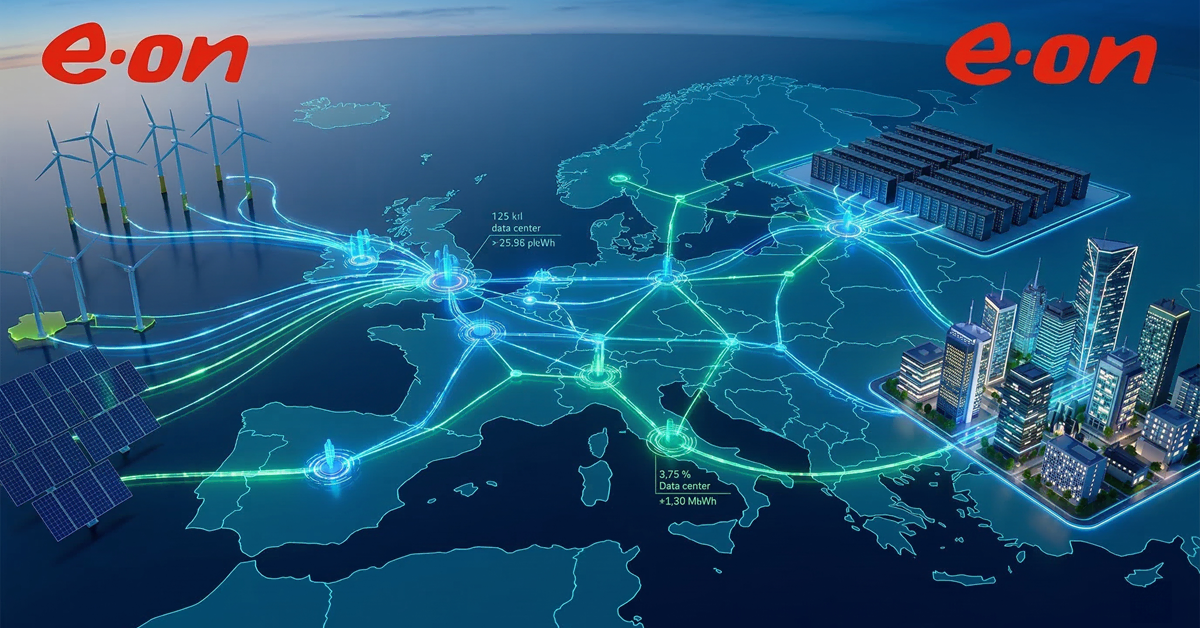
- Supply-Side Decentralization: The historical model of centralized, large-scale power plants is being replaced by a highly fragmented web of decentralized renewable assets. E.ON currently connects approximately 70% of Germany’s onshore wind capacity and nearly 50% of its solar capacity. Recently, the company connected its two-millionth renewable energy generation plant, bringing total installed capacity on its networks to roughly 110 gigawatts (GW). Integrating these intermittent energy sources requires massive physical and digital grid upgrades.
- Demand-Side Electrification: The accelerated adoption of electric vehicles (EVs) and residential heat pumps is drastically altering local load curves, necessitating thicker cables, upgraded transformers, and digitized substation monitoring.
- The AI and Data Center Supercycle: Beyond traditional electrification, the exponential growth of artificial intelligence is triggering a wave of energy-intensive data center construction across the continent. These facilities require massive, uninterrupted baseload power, directly straining distribution and transmission capacities.
In this macroeconomic environment, utility companies operating regulated networks are no longer viewed merely as defensive yield proxies. They are critical growth engines enabling the dual megatrends of decarbonization and digital infrastructure expansion.
2. Deconstructing the €48 Billion 2026–2030 Industrial Plan
The €48 billion investment program is meticulously engineered to address these macroeconomic tailwinds while maximizing risk-adjusted returns for shareholders. The capital is aggressively skewed toward regulated, low-risk infrastructure.
2.1 Energy Networks: The €40 Billion Core
Operating over 1.62 million kilometers of energy networks across Europe, E.ON possesses the largest distribution grid on the continent. The allocation of €40 billion (roughly 83% of total CapEx) to this division underscores management’s commitment to growing its Regulated Asset Base (currently valued at approximately €48 billion).
This capital will be deployed toward:
- Physical Expansion: Building out new grid connections for wind parks, solar farms, battery storage systems, and industrial consumers.
- Digitalization and Smart Grids: Adding a digital layer to distribution networks to monitor and balance load fluctuations in real-time. E.ON’s smart meter rollout in Germany has already reached a 30% penetration rate, significantly exceeding the statutory requirement of 20%. Digitalization reduces physical capital requirements over the long run by optimizing existing infrastructure capacity.
2.2 Energy Infrastructure Solutions (EIS): The €5 Billion Growth Engine
E.ON has allocated €5 billion to its Energy Infrastructure Solutions division. This segment operates around 6,000 energy infrastructure assets and 5,000 kilometers of district heating and cooling grids, supplying approximately 18 TWh of energy.
This is the company’s highest-growth vector, targeting a 12% EBITDA Compound Annual Growth Rate (CAGR) from 2025 to 2030. The capital here will fund long-term contracted B2B partnerships, focusing on industrial decarbonization, localized battery storage, and the modernization of municipal district heating systems. Because these projects are typically backed by long-term, inflation-linked off-take agreements with municipalities and large industrial clients, they offer an attractive blend of growth and revenue security.
2.3 Energy Retail: The €2.5 Billion Cash Cow
Serving 47 million customers across Europe—including top-three market share positions in Germany (23%), the UK (16%), and the Netherlands (24%)—the Energy Retail division requires relatively minimal capital intensity. The €2.5 billion allocated here will primarily fund digital customer platforms, e-mobility integrations, and flexible tariff solutions. This segment is expected to deliver a steady 4% EBITDA CAGR, acting as a highly cash-generative foundation that helps organically fund the heavy capital requirements of the Networks division.
3. Financial Performance: Analyzing the 2025 Outperformance and 2026 Normalization
To understand E.ON’s future trajectory, we must contextualize its recent historical performance. Fiscal year 2025 was a benchmark year for the company, demonstrating exceptional operational execution.
- Adjusted Group EBITDA: Reached €9.8 billion, a 9% year-over-year increase, landing at the absolute upper bound of management’s €9.6–€9.8 billion guidance.
- Adjusted Net Income: Rose 6% to €3.0 billion.
- Investments: Capital deployment scaled to a record €8.5 billion (up 13.3% YoY), proving management’s ability to efficiently allocate capital at scale.
The 2026 Guidance Reality Check:
We must candidly address the optical friction in E.ON’s 2026 guidance, which forecasts Adjusted Group EBITDA to contract slightly to €9.4–€9.6 billion, and Adjusted Net Income to fall to €2.7–€2.9 billion. It is natural for investors to experience momentary concern when encountering downward forward guidance after a record year.
However, we must gently correct the misconception that this represents fundamental business deterioration. The exceptional 2025 results were augmented by temporary, non-recurring regulatory catch-up effects—most notably, delayed compensations for network losses in Hungary that were retroactively recognized. Beginning in 2026, E.ON’s management is proactively stripping out these volatile regulatory distortions to provide a cleaner, more transparent baseline for normalized earnings. This is a conservative accounting adjustment, not an operational failure.
4. The Path to 2030: Earnings Projections and Financial Modeling
Looking past the 2026 normalization, E.ON’s long-term targets are highly compelling. By 2030, the company expects Adjusted Group EBITDA to reach approximately €13 billion and Adjusted Net Income to hit €3.8 billion, yielding an Adjusted EPS of approximately €1.45.
We can mathematically validate the feasibility of these targets by calculating the required Compound Annual Growth Rate (CAGR). Using the formalized formula for CAGR:
Where is the ending value (€13.0 billion), is the base year value (€9.8 billion), and is the 5-year time horizon:
This calculated ~5.8% annualized growth rate aligns perfectly with management’s blended segmental projections (Networks at 6%, EIS at 12%, Retail at 4%). Given the rigid, regulated nature of E.ON’s revenue model, a 5.8% EBITDA growth rate carries an exceptionally high degree of probabilistic certainty compared to cyclical industrial peers.
Furthermore, management has committed to an annual dividend growth target of up to 5% through 2030. Starting from the proposed 2025 base dividend of €0.57 per share, investors can project the future income stream:
An estimated dividend of €0.73 by the end of the decade provides a robust income floor that will heavily support the total return profile of the equity.
5. The Regulatory Battleground: The Withheld €5–€10 Billion Option
While the €48 billion plan is ambitious, CFO Nadia Jakobi has explicitly noted that E.ON has the balance sheet capacity to deploy an additional €5 billion to €10 billion in discretionary capital starting in 2027. Yet, management is deliberately withholding these funds.
This standoff represents the central battleground for the stock’s valuation. The core issue lies with the German Federal Network Agency (BNetzA) and the parameters governing allowed returns. In corporate finance, capital should only be deployed if the return on that capital exceeds the company’s Weighted Average Cost of Capital (WACC), defined formally as:
Due to the global shift to a “higher for longer” interest rate environment, E.ON’s cost of debt () and cost of equity () have structurally increased. Management argues—correctly, in our view—that the current regulatory return parameters proposed by BNetzA are insufficient to refinance existing assets at market conditions.
By withholding the €5–€10 billion, CEO Leonhard Birnbaum is exercising prudent capital discipline. The company is actively signaling to regulators that without an adequate framework that appropriately adjusts allowed Return on Equity (ROE) to reflect current macroeconomic realities, vital infrastructure build-outs will be stalled. We view this not as a weakness, but as a demonstration of excellent corporate governance. When regulatory clarity is eventually achieved (likely via the final gas regulation decision due in late 2026, which will have a read-across to electricity), this withheld capital represents a massive, coiled spring for future earnings upgrades.
6. Balance Sheet Health, Debt Profile, and Shareholder Returns
Executing a €48 billion capital program requires an ironclad balance sheet. At the close of 2025, E.ON’s Economic Net Debt stood at €43.2 billion, representing a €200 million decrease from the prior year. This deleveraging, achieved simultaneously with record capital investments, was driven by robust operating cash flows totaling €3.6 billion.
E.ON continues to demonstrate exceptional access to capital markets, heavily leveraging sustainable financing. In January 2026, the company successfully secured its near-term funding needs by issuing €1.6 billion in bonds. Notably, this included an €850 million green bond featuring a 12-year maturity and a highly competitive coupon of 3.895%. As the first issuance under E.ON’s updated Green Financing Framework launched in November 2025, it highlights the strong institutional appetite for ESG-aligned infrastructure debt, effectively lowering E.ON’s blended cost of capital.
For equity holders, the proposition is clear: management proposed a €0.57 per share dividend for fiscal 2025 (a 4% YoY increase). Combined with the up to 5% annual growth mandate through 2030, E.ON offers a highly secure, compounding yield that compensates investors while the multi-year CapEx cycle is executed.
7. Valuation and Peer Group Analysis
Based on current trading metrics, E.ON presents a compelling valuation asymmetry. The stock trades at a normalized Price-to-Earnings (P/E) ratio of approximately 18.8x and a Price-to-Book (P/B) ratio of 2.79. While the P/E may appear fully valued at first glance for a utility, it must be contextualized by the company’s growth profile.
Crucially, E.ON boasts a Price/Earnings-to-Growth (PEG) ratio of approximately 0.24. In financial modeling, a PEG ratio below 1.0 traditionally indicates that a stock is heavily undervalued relative to its forward earnings growth trajectory.
When compared to European peers like Iberdrola (IBE) and Centrica (CNA), E.ON offers a fundamentally different risk profile. Integrated utilities carry merchant risk—their margins fluctuate wildly based on wholesale power generation prices. E.ON, having completely spun off its conventional generation assets, is insulated from commodity price volatility. Its earnings are determined by regulatory asset bases and contracted infrastructure services, deserving a premium multiple for its superior earnings visibility.
8. Environmental, Social, and Governance (ESG) Leadership
Beyond pure financial metrics, E.ON’s industrial plan is intrinsically linked to its aggressive sustainability mandates. As the “playmaker” of the energy transition, the company’s ESG targets are deeply embedded into executive remuneration structures (both Short-Term and Long-Term Incentives).
- Environmental: E.ON targets a 50% reduction in Scope 1 and 2 emissions by 2030, accelerating to a 100% reduction by 2040. Furthermore, the company aims for complete Net Zero (including Scope 3 emissions) by 2050.
- Social: The company is dedicated to improving workplace safety, targeting a Serious Incident Frequency (SIF) of less than 0.07% by 2030. On the diversity front, management has committed to ensuring that at least 32% of executive management positions are held by women by 2031.
- Governance: E.ON mandates that at least 30% of its Supervisory Board must be female, ensuring diverse oversight of its long-term strategic execution.
9. Risk Factors and Bear Case Considerations
No investment report is complete without a rigorous assessment of downside risks. Investors allocating capital to E.ON must monitor the following variables:
- Regulatory Lag: The primary bear case centers on the pace of regulatory reform in Germany. If the Federal Network Agency fails to increase allowed returns to match the higher WACC environment, E.ON’s Return on Invested Capital (ROIC)—currently resting at a healthy 6.84%—could compress, destroying shareholder value in the outer years of the plan.
- Supply Chain and Execution Bottlenecks: A €48 billion physical infrastructure build-out is subject to severe execution risk. Global shortages of high-voltage cables, specialized transformers, and skilled engineering labor could lead to project delays and cost overruns, hindering RAB expansion.
- Interest Rate Sensitivity: Utilities traditionally trade as bond proxies. Should macroeconomic conditions force central banks to reverse rate cuts and adopt a sustained “higher for longer” posture, the relative attractiveness of E.ON’s dividend yield could diminish, placing downward pressure on equity multiples.
10. Conclusion and Final Investment Thesis
E.ON SE’s 2026–2030 Industrial Plan is a masterclass in strategic focus. By expanding its capital expenditure to €48 billion, management is aggressively capitalizing on the structural bottlenecks defining the European energy transition—specifically, the urgent need for grid modernization to support renewables, electric vehicles, and AI data centers.
While the forecasted normalization of earnings in 2026 and the ongoing regulatory standoff regarding the additional €5–€10 billion in discretionary CapEx may introduce short-term volatility, the long-term thesis is undeniable. E.ON provides investors with a rare combination of deeply defensive, regulated cash flows and highly visible, mid-single-digit organic growth. Supported by an expanding Regulated Asset Base, strict capital discipline, and a progressive dividend policy, E.ON stands out as a premier infrastructure asset for the coming decade.