
Table of Contents
The Multi-Dimensional Architecture of Monetary Transmission: Federal Reserve Policy, Asset Correlation Dynamics, and Strategic Portfolio Calibration in the 2026 Macro Environment
The Federal Reserve occupies the pivotal role of the global monetary fulcrum, where its manipulation of the federal funds rate serves as the primary mechanism for moderating the velocity of economic activity. As the central bank of the United States, the Fed is legally mandated to pursue the dual objectives of maximum employment and price stability. The execution of this mandate through the federal funds rate—the interest rate at which commercial banks lend to each other overnight—triggers a complex sequence of transmission mechanisms that permeate every layer of the global financial system. In the contemporary landscape of 2026, these traditional mechanisms are increasingly intersected by structural transformations, including the integration of generative artificial intelligence and the shifting liquidity paradigms of digital assets.
The Institutional Framework of Federal Reserve Monetary Policy
The operational core of the Federal Reserve’s influence lies in its ability to adjust the cost of liquidity. By raising or lowering the federal funds rate, the Fed influences the “price” of money, which subsequently filters through the economy via the prime rate and the Secured Overnight Financing Rate (SOFR). These benchmarks dictate the interest rates on a vast array of financial products, from the revolving credit lines of multinational corporations to the adjustable-rate mortgages of individual households.
During periods of economic deceleration or deflationary pressure, the Federal Reserve typically adopts an accommodative stance, lowering interest rates to near-zero levels to incentivize borrowing and stimulate aggregate demand. This reduction in the cost of capital allows businesses to finance expansion and capital expenditures more cheaply, while simultaneously reducing the debt-servicing burden on consumers, thereby freeing up discretionary income for spending. Conversely, when the economy exhibits signs of overheating or when inflation deviates significantly from the 2% long-term target, the Fed implements restrictive policy by raising rates to dampen spending and cool the labor market.
Quantitative Dimensions of the Fed’s 2026 Economic Outlook
The macroeconomic environment of 2026 is characterized by a “stabilization” phase following the aggressive tightening cycles of 2022-2023. Current projections indicate that the Fed is approaching a “neutral” interest rate environment, where policy neither stimulates nor constrains growth.
| Macroeconomic Indicator | 2026 Forecasted Status | Strategic Significance |
| Real GDP Growth | 1.8% Expansion | Indicates a return to long-term trend growth post-volatility. |
| Federal Funds Rate | 3.25% – 3.50% (Target) | Represents the expected “hold” level for the neutral rate regime. |
| PCE Inflation | Upper-2% Range (approx. 2.7%) | Sticky inflation persists due to tariff passthroughs and wage growth. |
| Unemployment Rate | 4.6% (November peak) | Reflects “low hiring, low firing” conditions and labor market slack. |
| Tech Capex (AI) | 33% Growth | Continued institutional investment in productivity-enhancing technology. |
Transmission Mechanisms: From Policy Rate to Consumer Behavior
The impact of interest rate adjustments on the real economy is experienced through multiple channels, primarily the cost of credit and the incentive to save. When the Federal Reserve raises interest rates, banks adjust the yields offered on savings accounts and certificates of deposit (CDs) almost immediately, providing a greater incentive for households to defer consumption in favor of saving. Simultaneously, the cost of borrowing for “big-ticket” items—such as automobiles, appliances, and homes—increases, leading to a contraction in consumer demand.
This dynamic creates a “wealth effect” in reverse. As interest rates rise, the discount rate applied to future cash flows increases, often leading to a decline in the market value of equities and existing bonds. This perceived reduction in household wealth can lead to a further pull-back in discretionary spending, even among consumers who are not directly utilizing credit. In 2026, this effect is nuanced by the “OBBBA” tax refunds, which are expected to provide a temporary counter-cyclical boost to consumer spending in the first half of the year, even as debt-servicing costs remain elevated.
The Labor Market and Wage Growth Correlation
The Federal Reserve monitors labor market data—including the unemployment rate, labor force participation, and wage growth—as a primary indicator of economic health. A very low unemployment rate, while socially desirable, can lead to wage-push inflation if businesses must compete for a limited supply of workers by offering higher salaries. In response, the Fed may raise rates to deliberately slow the pace of hiring, thereby moderating wage growth and stabilizing prices.
By late 2025 and into 2026, the U.S. labor market has shown signs of cooling, with unemployment climbing to a four-year high of 4.6%. This increase in labor market slack is a direct consequence of sustained restrictive policy, as businesses face slower consumer demand and higher financing costs, making them more cautious about expanding their workforces.
Equity Market Dynamics: Sector Performance and Factor Regimes
Equity markets serve as a sophisticated discounting mechanism for the broader economy. Interest rates influence stock prices through two primary avenues: the direct cost of corporate borrowing and the discount rate used in valuation models. For growth-oriented companies, whose valuations are heavily weighted toward future earnings, higher interest rates are particularly detrimental, as they reduce the present value of those distant cash flows.
The Business Cycle Approach to Sector Allocation
The relative performance of various equity sectors tends to rotate as the economy moves through different phases of the business cycle. Historical analysis indicates that interest rate cycles are a critical determinant of this rotation.
- Early Cycle Phase: Characterized by falling interest rates and a sharp economic recovery. During this phase, cyclical sectors like Consumer Discretionary and Industrials tend to lead the market, as they benefit most from the initial surge in consumer demand and business expansion.
- Mid-Cycle Phase: Economic growth gathers momentum and profitability is healthy against an increasingly neutral monetary policy backdrop. Information Technology and Communication Services often perform well in this environment.
- Late Cycle Phase: Growth slows to “stall speed” as monetary policy becomes restrictive. In this phase, investors often rotate into defensive sectors such as Healthcare, Consumer Staples, and Utilities, which offer stable earnings regardless of the broader economic climate.
- Recession Phase: Characterized by negative growth and falling interest rates. Defensive assets and Treasury bonds typically experience their highest relative returns as investors prioritize capital preservation over growth.
Factor Behavior Across Interest-Rate Regimes
Beyond traditional sectors, “factors” or style-based investment approaches exhibit distinct sensitivities to interest rate changes.
| Investment Factor | Relationship with Interest Rates | Historical Performance Notes |
| Value | Positive Correlation | Tends to outperform when interest rates are moderate to rising. |
| Growth | Negative Correlation | High sensitivity to the discount rate; flourishes in low-rate environments. |
| Low Volatility | Inverse Correlation | Performs well as rates fall; sensitive to the yield-competitive nature of dividends. |
| Quality | Resilient / Inverse | Marked inverse correlation to rate changes, but provides stability in late cycles. |
| Small Cap (Low Size) | Positive to Growth | Performs strongly during rising rates if accompanied by improving economic growth. |
Analysis of data spanning 1975 to 2023 reveals that the change in interest rates often has a more pronounced impact on factor performance than the absolute level of the rate. This suggests that market participants price in expectations for future policy, making “surprise” rate movements the primary driver of volatility. In 2026, with rates expected to hold steady at a neutral level, the emphasis has shifted toward the “Quality” and “Minimum Volatility” factors as investors navigate the lingering uncertainties of the post-tightening era.
Fixed Income Analysis: Navigating the Price-Yield Relationship
Fixed income securities represent a direct contract for future cash flows, making them the most sensitive asset class to interest rate fluctuations. The fundamental maxim of bond investing is that bond prices and interest rates move in opposite directions. When interest rates rise, newly issued bonds offer higher coupons, rendering existing bonds with lower coupons less valuable and forcing their market price to decline.
Interest Rate Risk: Duration and Convexity
To manage this “interest rate risk,” investors utilize the metric of duration. Duration is a measure of a bond’s sensitivity to interest rate changes, rolling up maturity, coupon rate, and yield into a single number. A bond with a duration of five years is expected to lose approximately 5% of its value for every 1% increase in interest rates.
However, the price-yield relationship is not linear; it exhibits “convexity.” A bond with positive convexity will see its price increase more when rates fall than it will decrease when rates rise by an equal amount. This mathematical property works in the investor’s favor, providing a buffer against rising yields while amplifying gains in a falling-rate environment.
The Yield Curve and Investor Sentiment
The yield curve, representing the relationship between yields and maturities for U.S. Treasuries, is a critical barometer of economic sentiment. Under normal conditions, the curve is upward-sloping, as investors demand higher yields (a “term premium”) to compensate for the greater uncertainty of the distant future.
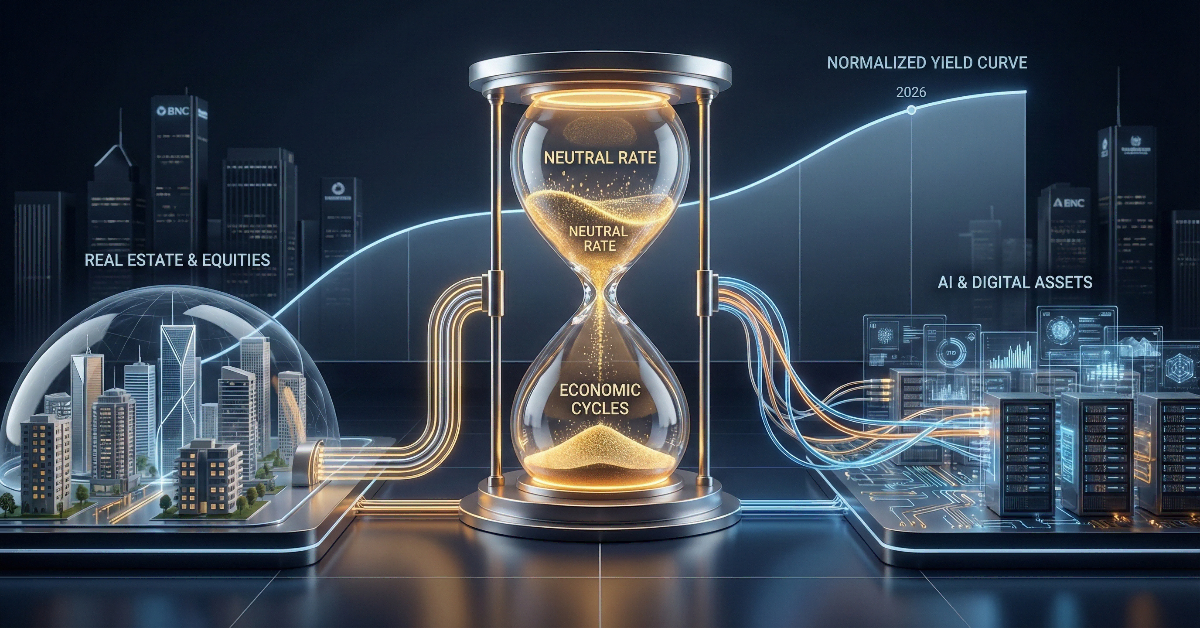
The curve inverted from mid-2022 through 2024—a state where short-term yields exceeded long-term yields—signaling a market expectation of future economic contraction and eventual rate cuts. By early 2026, the curve has normalized, with the 10-year Treasury yielding roughly 0.70% more than the 2-year Treasury. This normalization indicates that the market has transitioned from recession-fearing to a “neutral” outlook, though investors must remain wary of the “term premium” logic when deciding whether to stay in short-duration or move to intermediate-duration assets.
Real Estate and REITs: Leveraging the Cost of Capital
The real estate industry is profoundly influenced by interest rates, as the majority of property transactions are financed through debt. Higher rates increase the cost of capital for developers and the monthly mortgage payments for buyers, creating a direct dampening effect on property values and demand.
Residential Housing and the Mortgage Lock-In Effect
In the residential sector, rising interest rates lead to decreased affordability, particularly for first-time buyers. This shift can lead to a stabilization or even a decline in home prices as demand wanes. In 2026, the market is characterized by a “mortgage lock-in” effect, where homeowners who secured 3% or 4% mortgages during the low-rate era of 2020-2021 are unwilling to sell their homes and move into a new property at a 6% or 7% rate. This has created a persistent supply shortage, keeping housing activity in “low gear” despite moderating price increases.
Real Estate Investment Trusts (REITs) and Operational Leverage
REITs offer a way for investors to access real estate markets through a publicly traded security. However, they are sensitive to interest rates in two specific ways:
- Financing Costs: REITs rely heavily on debt to acquire and develop properties. Rising interest rates increase their cost of capital, potentially reducing profit margins and funds from operations (FFO).
- Dividend Yield Competition: Because REITs must distribute 90% of their income as dividends, they often compete with bonds for yield-seeking investors. When bond yields rise, REIT prices often fall as investors rotate into the perceived safety of fixed income.
| REIT Sector | Interest Rate Sensitivity | 2026 Performance Outlook |
| Mortgage REITs | Extreme (Highly leveraged) | Sensitive to the spread between short-term borrowing and long-term asset yields; benefit from rate stabilization. |
| Residential REITs | Moderate (Inflation hedge) | Strong resilience; ability to adjust rents annually allows them to offset higher borrowing costs. |
| Industrial REITs | Low to Moderate (Demand-driven) | Benefiting from structural shifts like the e-commerce and data center boom. |
| Healthcare REITs | Low (Defensive) | Essential services provide consistent occupancy regardless of the interest rate cycle. |
Alternative Assets: Gold, Commodities, and Digital Assets
Traditional and digital alternative assets react differently to Federal Reserve policy, often serving as hedges against specific monetary outcomes.
Gold as the Classic Monetary Hedge
Gold has historically shared an inverse relationship with real (inflation-adjusted) interest rates. When the Federal Reserve raises rates and inflation is brought under control, the real return on cash and bonds increases, making non-yielding gold less attractive. However, gold maintains its role as a “safe haven” during periods of geopolitical instability or when the dollar’s status as a reserve currency is questioned. In 2026, gold serves as a critical diversifying agent, particularly for emerging market central banks looking to reduce their reliance on the U.S. dollar.
The Digital Asset Liquidity Cycle: Bitcoin and the Fed
A compelling body of research suggests that Bitcoin and other major cryptocurrencies have become intrinsically tied to the Federal Reserve’s liquidity cycle. Specifically, Bitcoin exhibits a high correlation (0.76 to 0.78) with annual changes in banking liquidity, as measured by bank reserves.
When the Fed engages in Quantitative Easing (QE)—the purchase of securities to inject cash into the banking system—liquidity expands, and capital often flows into risk-on assets like Bitcoin. Conversely, during periods of Quantitative Tightening (QT), liquidity is drained from the system, often leading to a correction in digital asset prices. By 2026, the market is closely watching for the transition toward “Reserve Management Purchases” (RMP), which is effectively a form of “QE-lite” designed to maintain ample reserves.
The institutionalization of Bitcoin in 2025 and 2026 has further matured the asset class. With the scaling of spot ETFs and the adoption of Bitcoin by corporate treasuries, Bitcoin is increasingly viewed not as a speculative fringe asset, but as a “high-beta digital gold” that serves as an extension of the macro trade.
Global Macro Spillovers: The Dollar and Emerging Markets
Federal Reserve policy is the single most significant external factor affecting Emerging Market Economies (EMEs). Because the U.S. dollar is the primary currency for international trade and debt, changes in U.S. interest rates create cascading effects across global financial systems.
The Financial Channel and Capital Flows
When the Fed raises interest rates, capital typically flows toward the U.S. as investors seek higher risk-adjusted returns. This “capital flight” can significantly weaken the currencies of emerging markets, forcing their central banks to raise domestic rates to prevent a collapse of their currency, even if their domestic economies are already struggling.
U.S. monetary tightening significantly reduces net capital inflows to EMEs, undermining the stable financing conditions necessary for long-term development. For nations with high levels of dollar-denominated debt, a hawkish Fed and a stronger dollar create a “double whammy”: the cost of servicing their debt increases in dollar terms, and the value of their local currency (which they use to pay that debt) decreases.
The Trade and Output Channel
A stronger U.S. dollar makes U.S. imports cheaper and exports more expensive. For the global economy, this can reshuffle supply chains. For example, during high-rate periods, some countries—notably Mexico and Vietnam—have seen their share of U.S. imports increase as trade flows adjust to the higher cost of capital and changing tariff regimes. By 2026, these shifts have become more permanent features of the global trade landscape, with countries like Brazil gaining market share in agricultural exports to China after retaliatory tariffs were placed on U.S. products.
The 2026 Context: Artificial Intelligence and the Neutral Rate
As we evaluate the Federal Reserve’s path in 2026, we must account for the transformative impact of artificial intelligence. AI is projected to impact 56% of professional work in the next five years, particularly in law, tax, and accounting.
The Productivity-Inflation Nexus
If AI adoption leads to a significant surge in productivity, it could create a “Goldilocks” scenario for the Fed. High productivity allows for faster economic growth without triggering wage-pull inflation, as workers produce more output with less labor. This development would imply a higher “neutral interest rate” (), as the return on capital has fundamentally risen.
However, the transition is fraught with risk. If the Fed misjudges the neutral rate and keeps policy too restrictive for too long, it risks inducing unnecessary labor market pain. Conversely, if it cuts rates too aggressively in anticipation of productivity gains that have not yet materialized, it could reignite inflation.
| 2026 Trend | Macroeconomic Impact | Investment Implication |
| AI Integration | Boosts productivity; potential for disinflationary growth. | Focus on tech capex and firms with high “AI ROI”. |
| Trade Policy | Tariffs keep inflation sticky in the upper-2% range. | Inflation-sensitive assets (Gold, Real Estate) remain relevant. |
| Labor Slack | Unemployment peaks at 4.6%; wage growth moderates to 3.5%. | Shift toward Quality and Defensive equities. |
| Monetary Pivot | Fed shifts from QT to “Reserve Management” ($40B/mo). | Liquidity-sensitive assets (BTC, Growth Stocks) may see a tailwind. |
Tactical Investment Strategies for 2026
Given the complex interplay between interest rates and the various asset classes, a sophisticated approach to portfolio management is required.
Fixed Income: Laddering and Duration Management
In a neutral-rate environment where the yield curve has normalized, the strategy of bond laddering remains a primary tool for mitigating interest rate and reinvestment risk. By staggering maturities, investors can capture current yields while maintaining the flexibility to reinvest at higher rates if the Fed is forced to tighten again.
For those with a more aggressive outlook, the barbell strategy—concentrating on very short-term and very long-term maturities—allows for the capture of high long-term yields while maintaining liquidity at the short end to capitalize on any sudden rate fluctuations.
Equities: Factor Tilt and Sector Rotation
Investors should consider a strategic tilt toward the Value and Quality factors in the first half of 2026. Value stocks, particularly in the Financials sector, have historically performed well when yields are moderate to high and stable. Financials benefit from the spread between the interest they pay on deposits and the rates they charge on loans, provided the yield curve is not inverted.
As economic growth trends stabilize around 1.8%, investors should monitor the “stall speed” of the economy. If growth dips below this level, a rotation into defensive sectors like Healthcare and Utilities—which are less sensitive to the business cycle—would be warranted.
Digital Assets: Liquidity and Scarcity
The 2026 macro backdrop, characterized by the end of QT and the start of a rate-cutting or neutral cycle, creates a favorable environment for Bitcoin as a “scarcity asset”. Institutional and retail investors should consider Bitcoin as a store-of-value diversifier. Research suggests that Bitcoin’s low correlation with other assets like bonds and REITs can improve the risk-adjusted returns of a diversified portfolio. Position sizing is critical, as volatility remains higher than traditional assets, though drawdowns have historically diminished as the market matures.
Conclusions and Strategic Synthesis
The Federal Reserve’s influence on the economy is neither linear nor immediate; it is a complex, lagged process that operates through the psychological expectations of investors and the mechanical cost of capital. In 2026, the traditional relationship between interest rates and the economy is being rewritten by the structural forces of AI and the institutionalization of digital assets.
Strategic success in this environment requires a transition from the “passive beta” approach of the low-interest-rate decade (2010-2020) to a more “active alpha” framework. This involves:
- Duration Awareness: Recognizing that intermediate-term bonds now offer attractive carry opportunities as the yield curve normalizes.
- Factor Selectivity: Prioritizing Quality and Value over speculative Growth as the discount rate remains above historical lows.
- Liquidity Monitoring: Tracking the Fed’s balance sheet and reserve management as a lead indicator for digital asset and tech equity performance.
- Global Diversification: Accounting for the dollar’s resilience while seeking high-yielding opportunities in emerging markets that have demonstrated monetary independence.
As the Federal Reserve navigates the “sticky” inflation of the mid-2020s, the “neutral rate” will serve as the north star for investors. Those who can correctly anticipate the Fed’s proximity to this target while accounting for the productivity shifts induced by AI will be best positioned to preserve and grow capital in the years ahead.