
Table of Contents
Executive Summary
In an era characterized by macroeconomic volatility, persistent inflationary pressures, and shifting interest rate regimes, institutional investors are increasingly scrutinizing the underlying contract structures of real assets. While traditional infrastructure is broadly marketed as an “inflation hedge,” the reality is highly nuanced. Assets constrained by rigid, retroactive Consumer Price Index (CPI) caps often suffer from margin compression when input costs (labor, materials, maintenance) rise faster than allowable tariff adjustments.
Ferrovial SE (NASDAQ: FER), a premier global infrastructure operator, presents a highly differentiated investment thesis. Through its toll road division, Cintra, Ferrovial has deliberately cultivated a portfolio of “concession jewels” that bypass traditional regulatory price caps. By leveraging unconstrained tolling agreements—most notably the 407 ETR in Toronto—and pioneering dynamically priced “Managed Lanes” in the United States, Ferrovial has detached its revenue generation from backward-looking inflation metrics. Instead, the company has pegged its top-line growth to real-time economic demand, traffic congestion, and the marginal value of commuter time. This report provides a comprehensive analysis of how Ferrovial’s specific contractual mechanisms act not merely as a hedge against inflation, but as an engine for margin expansion in an inflationary environment.
1. The Macroeconomic Context: Infrastructure as an Asset Class in an Inflationary Regime
To understand the premium valuation assigned to Ferrovial’s toll road assets, one must first dissect the mechanics of how inflation impacts infrastructure investments. Historically, investors flocked to infrastructure for its “bond proxy” characteristics: stable, predictable cash flows generated by monopolistic assets. However, not all infrastructure cash flows react equally to inflation.
The Vulnerability of Traditional Concessions
In traditional Public-Private Partnerships (P3s), operators often rely on “Availability Payments”—fixed payments from a government entity based on the asset being available for use, regardless of traffic volume. In an inflationary environment, the operator’s Operations and Maintenance (O&M) costs rise, but the availability payment remains fixed, directly eroding EBITDA margins.
Alternatively, many toll roads operate under strictly regulated “CPI-linked” contracts. In these scenarios, the concessionaire is permitted to raise tolls annually based on the previous year’s CPI. While better than fixed payments, this model introduces a dangerous lag. If O&M and capital expenditure costs spike rapidly, the operator must wait a full year to adjust prices. Furthermore, true underlying costs in construction and maintenance frequently outpace the blended, smoothed government CPI figures.
The Ferrovial Paradigm Shift
Ferrovial has systematically rotated its portfolio away from availability-payment assets and rigid CPI-capped concessions. Instead, the company focuses on highly complex, greenfield transportation projects situated in high-growth demographic corridors (such as Texas, Virginia, North Carolina, and Ontario). The core strategy is to accept traffic volume risk in exchange for absolute pricing freedom. By controlling the toll rate independently of government CPI mandates, Ferrovial ensures that its revenue can capture both nominal inflation and real economic growth.
2. Concession Typology: The Mechanics of Pricing Power
Ferrovial’s inflation-beating capability is rooted in two distinct contractual frameworks within its portfolio. Understanding the legal and operational nuances of these frameworks is essential for evaluating the company’s forward-looking earnings power.
Type A: The Unconstrained Volume-Dependent Threshold (e.g., 407 ETR)
Under this framework, the concessionaire is granted the legal right to set toll prices at their sole discretion, without requiring political or regulatory approval. The only constraint is a volume-based penalty system. As long as traffic on the highway remains above a contractually defined baseline (ensuring the road serves its public utility purpose and relieves surrounding congestion), the operator can raise prices infinitely. This captures the economic value of the asset rather than an arbitrary inflation metric.
Type B: Algorithmic Dynamic Pricing (e.g., US Managed Lanes)
Under this framework, toll prices are not set on an annual or monthly schedule. Instead, they fluctuate in real-time—often updating every three to five minutes. The concession contract mandates that the operator must maintain a minimum average speed on the toll lanes (typically around 50 to 55 mph). As traffic volume increases and threatens to drop speeds below this threshold, an algorithm automatically increases the toll price to deter entry and manage demand. This mechanism perfectly captures nominal wage inflation; as wages rise, a commuter’s willingness to pay to save 30 minutes of time increases concurrently.
3. Deep Dive: The 407 ETR (Toronto) – The Crown Jewel of Unconstrained Pricing
The 407 Express Toll Route (ETR) in Ontario, Canada, is widely considered one of the most lucrative and strategically sound infrastructure assets globally. Ferrovial currently holds a 48.29% stake in the asset, operating it alongside consortium partners including the Canada Pension Plan Investment Board (CPP Investments).
The 1999 Privatization Masterstroke
In 1999, the consortium acquired a 99-year lease for the 407 ETR from the provincial government for approximately $3.1 billion CAD. The length of the concession—expiring in 2098—is extraordinary, granting Ferrovial multi-generational cash flow visibility. However, the true genius of the acquisition lies in the specific language of the Concession and Ground Lease Agreement.
The Schedule 22 Tolling Mechanism
Unlike almost every other toll road in North America, the 407 ETR is not subject to a government-mandated price cap. The operator has the unilateral right to set toll rates, subject only to a traffic volume mechanism known as “Schedule 22.”
Schedule 22 dictates a theoretical Traffic Threshold. If the operator raises tolls so high that traffic volume falls below this established threshold, they are required to pay a financial penalty to the government. The purpose of this mechanism was to prevent the consortium from turning the 407 ETR into a purely empty, hyper-expensive “luxury” road that provides no congestion relief to the parallel public Highway 401.
However, the Greater Toronto Area (GTA) has experienced explosive demographic and economic growth since 1999. The resulting severe congestion on public alternatives has generated massive, highly inelastic demand for the 407 ETR. Because baseline demand is so high, Ferrovial can aggressively raise tolls without pushing traffic volumes below the Schedule 22 threshold.
Recent Evidence of Inflation-Busting Pricing Power
The true test of an inflation hedge is the ability to enact pricing actions that dwarf the prevailing inflation rate without destroying demand. The 407 ETR recently provided a masterclass in this dynamic. In late 2025, the 407 ETR announced its tariff grid for 2026, revealing a staggering base price increase of 23% per mile before discounts.
Breaking down the 2026 tariff adjustments reveals the surgical nature of Ferrovial’s pricing strategy:
- Peak Travel Periods (7:00-9:30 AM and 3:30-6:00 PM): Average increases of approximately 27%.
- Hyper-Congested Sections: Targeted hikes ranging from 33% to 44% to aggressively manage demand.
- Off-Peak Hours: Rates jumping by 40%.
With Canadian CPI running in the low single digits, a 23% to 44% price increase highlights an asset that is completely untethered from standard inflation tracking. The toll increases are driven by the scarcity of road space and the economic cost of congestion, acting as an ultimate buffer against any underlying increases in operational or financing costs.
4. Deep Dive: US Managed Lanes – The Algorithmic Inflation Hedge
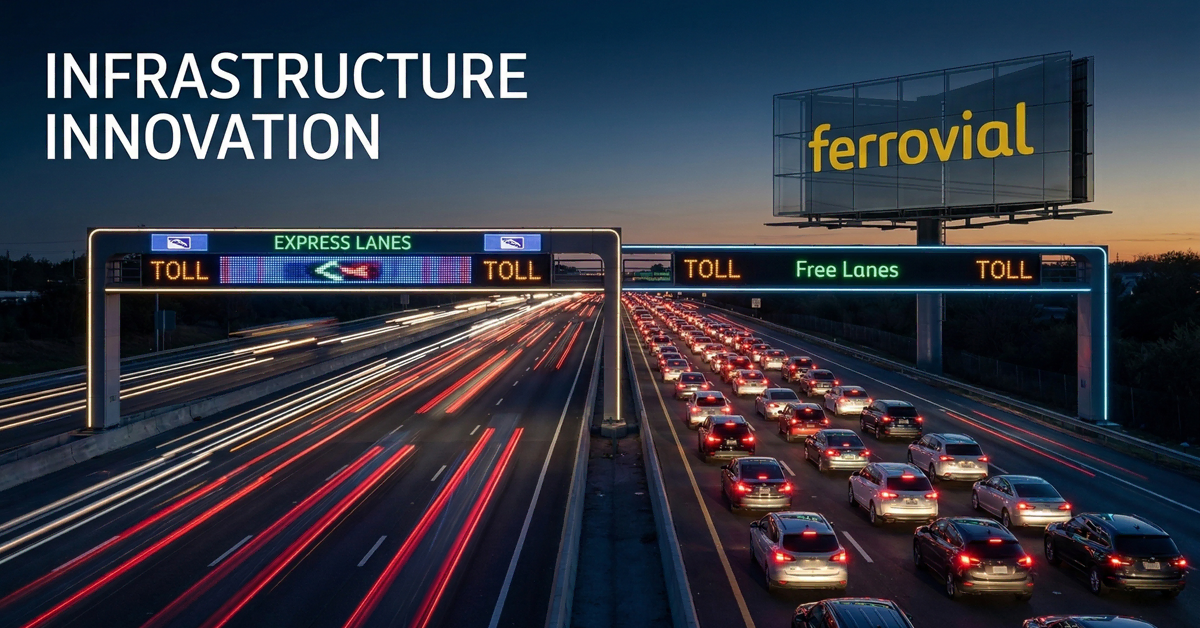
While the 407 ETR operates on an annual tariff grid, Ferrovial’s growth engine in the United States relies on a completely different, highly technological approach: Managed Lanes, also known as High-Occupancy Toll (HOT) lanes or Express Lanes. Ferrovial operates a network of these assets, including the NTE (North Tarrant Express), LBJ, and NTE 35W in Texas, the I-66 in Virginia, and the I-77 in North Carolina.
The Anatomy of a Managed Lane
Managed Lanes are constructed adjacent to existing, free general-purpose lanes on heavily congested urban interstates. They are physically separated, utilizing a free-flow, barrier-less electronic tolling system. The fundamental value proposition to the user is reliability: the guarantee of a fast, predictable trip in exchange for a variable fee.
Machine Learning and Dynamic Pricing
The contracts governing these assets mandate that Ferrovial must keep traffic flowing freely. If the Express Lanes become congested and slow down, Ferrovial is failing its contractual obligation. To manage this, Ferrovial employs sophisticated machine learning algorithms and big data analytics.
The system monitors traffic density, relative speeds between the free lanes and the toll lanes, the time of day, and even weather conditions in real-time. Prices are recalculated and updated on electronic gantries every few minutes. As the free lanes become gridlocked, more drivers attempt to enter the Express Lanes. To prevent the Express Lanes from also congesting, the algorithm sharply increases the toll price. This creates a supply-and-demand equilibrium at 50+ mph.
Why Dynamic Pricing is the Ultimate Inflation Hedge
Dynamic pricing acts as a superior inflation hedge compared to CPI-linking for three critical reasons:
- Zero Time Lag: If a sudden economic boom or supply-chain shock hits an area, congestion spikes immediately. The algorithm raises prices that exact same day. There is no waiting for an annual CPI adjustment.
- Capturing Wage Inflation: The core product being sold on a Managed Lane is not asphalt; it is time. A commuter’s willingness to pay $15 to save 30 minutes is directly tied to their hourly wage and the perceived value of their free time. As regional wage inflation occurs, the psychological threshold for toll acceptance rises proportionally. The algorithm naturally discovers this new, higher willingness to pay without requiring a boardroom strategy meeting.
- Uncapped Upside: On newer concessions like the I-66 and I-77, there is virtually no hard price cap. The price is allowed to float as high as necessary to maintain traffic speed.
Financial Validation from the Field
The financial results directly validate this thesis. In Ferrovial’s Q1 2025 financial disclosures, the company reported that all Managed Lanes posted robust revenue per transaction growth that significantly outpaced the US inflation rate (which was approximately 2.9%).
- NTE (Texas): +13.8% revenue per transaction growth.
- I-77 (North Carolina): +21.8% revenue per transaction growth.
- I-66 (Virginia): +25.6% revenue per transaction growth.
This demonstrates that dynamic pricing acts as a multiplier on regional economic heat, stripping away inflation risk and delivering massive top-line expansion.
5. Operating Leverage: The Mathematics of Margin Expansion
Pricing power is only half of the inflation-hedge equation; the other half is cost structure. Infrastructure assets, and toll roads specifically, benefit from massive operating leverage. This leverage ensures that when top-line revenues grow to combat inflation, the bottom-line EBITDA grows exponentially faster.
The Cost Structure of a Modern Toll Road
Toll roads are highly capital-intensive to build, but incredibly cheap to operate. The transition to all-electronic, barrier-free tolling (using transponders and license plate recognition cameras) has eliminated the need for human toll booth operators, stripping out the largest historical variable cost: labor.
Today, the O&M costs of a mature toll road consist primarily of basic road maintenance, administrative overhead, and IT system upkeep. These costs typically consume only 15% to 20% of revenues, resulting in structurally high EBITDA margins of 80% to 85%.
The Mathematical Impact of Inflation
To understand why Ferrovial’s structure is so lucrative, consider the underlying mathematics of a high-margin business in an inflationary environment where pricing power exceeds cost inflation.
| Financial Metric | Base Year | Inflation Scenario (Assuming 15% Revenue Growth and 5% Cost Inflation) | Absolute Growth |
| Gross Toll Revenue | $1,000.00 | $1,150.00 | +$150.00 |
| O&M Costs (Variable) | $150.00 | $157.50 | +$7.50 |
| EBITDA | $850.00 | $992.50 | +$142.50 |
| EBITDA Margin | 85.0% | 86.3% | +130 bps |
Note: The table above illustrates a hypothetical scenario demonstrating the operating leverage inherent in Ferrovial’s toll road assets.
Because Ferrovial’s O&M cost base is so small relative to its revenue, even if maintenance costs inflate, the absolute dollar impact is minimal. Conversely, because they apply aggressive, unconstrained price increases to a massive revenue base, the absolute dollar flow-through to EBITDA is staggering. In the scenario above, a 15% increase in top-line revenue—enabled by unconstrained contracts—results in nearly a 17% increase in EBITDA, actively expanding margins during an inflationary cycle.
6. Capital Structure Dynamics: Inflating Away Fixed Debt
The final pillar of Ferrovial’s inflation defense lies off the income statement and on the balance sheet. Large-scale infrastructure projects are financed using non-recourse, project-level debt. This means the debt is secured only by the cash flows of the specific toll road, shielding the parent company (Ferrovial) from direct liability.
Crucially, this project-level debt is predominantly fixed-rate and long-term (often spanning 15, 20, or even 30 years). In an inflationary environment, the macroeconomic reality works heavily in favor of the equity holder (Ferrovial).
As dynamic tolling and unconstrained pricing push nominal revenues rapidly higher, the principal and interest payments on the debt remain entirely fixed in nominal terms. Therefore, the real value of the debt burden is systematically “inflated away.” The cash flow available for debt service (CFADS) grows exponentially, making the debt safer, accelerating the potential for deleveraging, and maximizing the residual cash flow that can be up-streamed as dividends to Ferrovial.
In recent financial periods, this mechanism has resulted in record dividend distributions from project companies back to the Ferrovial parent, including hundreds of millions of dollars flowing from the 407 ETR, I-77, and I-66 directly into Ferrovial’s corporate liquidity pool.
7. Key Investment Risks and Mitigating Factors
While Ferrovial’s contract structures offer unparalleled inflation protection, investors must weigh several inherent risks associated with this aggressive pricing model.
1. Political and Regulatory Backlash
The most significant risk to unconstrained pricing is populist political intervention. Massive toll increases (such as the 23% hike on the 407 ETR or dynamically priced tolls hitting $40+ during rush hour in the US) frequently generate media outrage and political scrutiny. Politicians may attempt to unilaterally alter contracts, introduce windfall taxes, or threaten eminent domain.
Mitigant: Ferrovial operates in regions with strong rule of law and respect for private contracts (North America, Western Europe). Previous attempts by governments (such as the Ontario government in the early 2000s) to challenge the 407 ETR’s pricing power in court were struck down, legally validating the ironclad nature of the concession agreements.
2. Elasticity of Demand and Traffic Volume Attrition
There is a theoretical ceiling to what consumers will pay. If tolls rise too rapidly, commuters may alter their behavior—carpooling, shifting to mass transit, changing work hours, or enduring the congested free lanes. If volume drops too sharply, total revenue could decline despite higher prices per vehicle.
Mitigant: Ferrovial utilizes highly advanced big data analytics to monitor price elasticity in real-time. Their algorithms are designed to find the exact peak of the revenue maximization curve without destroying the user base. Furthermore, demographic growth in their core markets (GTA, Dallas-Fort Worth, Washington D.C. metro) ensures a constant influx of new potential users to replace any who are priced out.
3. Refinancing and Interest Rate Risk
While existing fixed debt is a benefit during inflation, eventually, debt matures and must be refinanced. If inflation causes central banks to hold interest rates at elevated levels for a prolonged period, Ferrovial will face higher cost of capital upon refinancing.
Mitigant: The extreme duration of their concessions allows Ferrovial to lock in debt for decades, smoothing out near-term interest rate volatility. Furthermore, the massive EBITDA growth generated by their pricing power typically outweighs the increased interest expense upon refinancing.
8. Conclusion
Traditional infrastructure assets often market themselves as inflation hedges, but effectively serve as delayed, lagging approximations of CPI. Ferrovial (NASDAQ: FER) has transcended this limitation by engineering a portfolio centered around absolute pricing freedom and algorithmic responsiveness. Through the unconstrained legal framework of the 407 ETR and the dynamic, congestion-based pricing of its US Managed Lanes, Ferrovial directly monetizes demographic growth and the marginal value of commuter time. Coupled with the massive operating leverage of electronic tolling and fixed-rate debt structures, Ferrovial’s contracts do not merely protect the company from inflation—they actively weaponize it to drive unprecedented margin expansion and equity value creation.