
Table of Contents
Executive Summary
As the global economy pivots toward artificial intelligence, the investment narrative has predominantly focused on the “brain” of the revolution: the semiconductor. However, as 2025 and early 2026 have demonstrated, the most sophisticated chips in the world are inert without a massive, reliable, and immediate supply of electricity. GE Vernova (NYSE: GEV), following its successful spin-off from General Electric in 2024, has rapidly positioned itself as the indispensable partner for “Big Tech” hyperscalers like Amazon Web Services (AWS) and Microsoft. This report explores GE Vernova’s transition from a traditional utility supplier to a direct infrastructure partner for the world’s largest technology companies. With data center orders tripling in 2025 and tech companies now representing approximately 25% of the company’s customer base, the thesis for GE Vernova is clear: while others trade the “gold” of AI data, GE Vernova provides the “shovels”—the gas turbines and grid switchgear required to dig the mine.
The Thesis: Power as the True Bottleneck of AI
The explosive growth of generative AI has created an unprecedented demand for compute power. Every query processed by a large language model requires significantly more energy than a traditional search engine request. This shift has turned the energy sector from a slow-growth utility market into a high-stakes race for capacity. For years, the bottleneck was thought to be GPU availability; today, the bottleneck is the grid. Hyperscalers can buy thousands of H100s, but they cannot easily find the 50 to 100 megawatts required to power a single large-scale facility in overstressed markets.
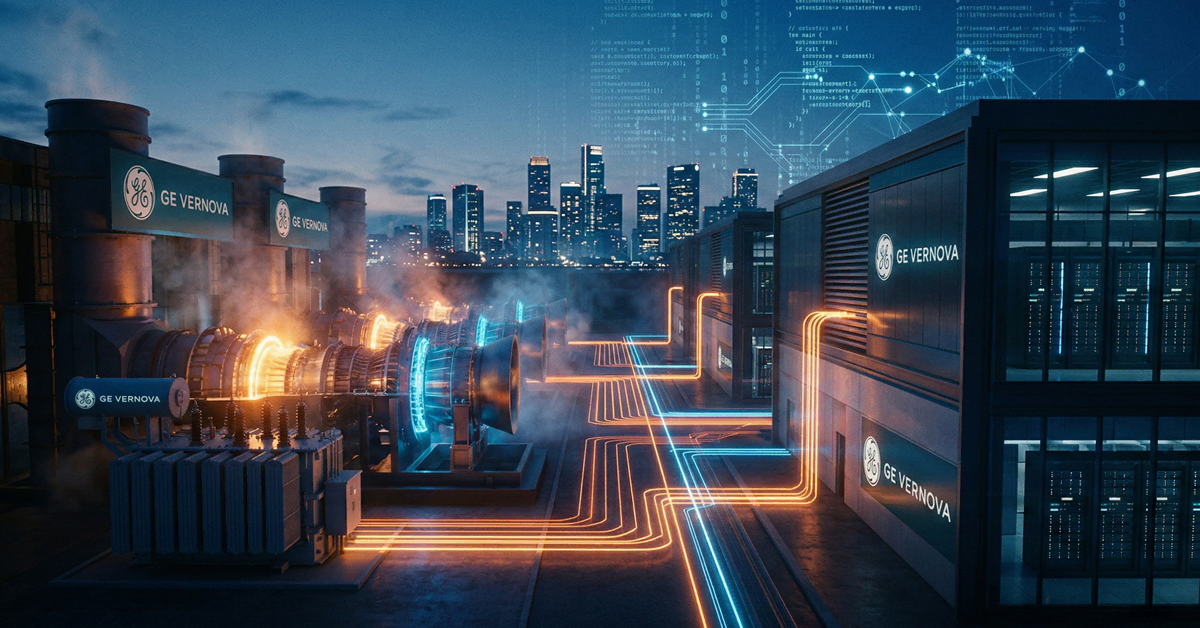
GE Vernova sits at the intersection of this crisis. The company’s gas power and electrification segments are no longer just servicing municipal utilities; they are providing the mission-critical hardware that allows tech giants to bypass grid constraints. By focusing on dispatchable, high-efficiency gas turbines and advanced grid orchestration software, GE Vernova is enabling the “self-generation” movement within the tech sector, where companies like AWS and Microsoft act as their own mini-utilities to ensure uptime and scalability.
The Strategic Shift: From Utility Supplier to Big Tech Partner
Historically, GE’s power business sold equipment to regulated utilities. These utilities would then manage the slow process of grid connection and power distribution to end-users. The AI boom has disrupted this linear model. Hyperscalers now demand “power at the speed of tech,” which traditional utility timelines—often measured in decades—cannot meet. In response, GE Vernova has pivotally transitioned into a direct partner for hyperscalers.
The AWS Strategic Framework Agreement
A landmark moment in this transition was the signing of the Strategic Framework Agreement (SFA) with Amazon Web Services. This partnership is not merely a vendor-client relationship but a deep engineering collaboration. AWS utilizes GE Vernova’s turnkey substation solutions and grid equipment to accelerate the deployment of its data centers across North America, Europe, and Asia. In return, GE Vernova leverages AWS’s cloud and generative AI capabilities to optimize its own asset performance management and grid orchestration software. This “circular” partnership reflects a new reality: the energy company needs the tech company’s software, and the tech company needs the energy company’s hardware.
Expansion of the Tech Customer Base
The data from 2025 confirms this shift. GE Vernova reported that orders specifically for data center electrification tripled over the previous year. Even more telling is the composition of the company’s revenue and backlog. Tech companies and hyperscalers now represent roughly 25% of GE Vernova’s active customer base. This is a staggering transformation for a company that, only a few years ago, dealt almost exclusively with public utilities and independent power producers. The entry of tech giants into the energy market has brought higher margins, faster decision-making, and a demand for high-spec, premium technology that favors GE Vernova’s H-Class turbine portfolio.
Product Breakdown: The Shovels in the Gold Mine
To understand the investment value of GE Vernova, one must look at the specific technologies being deployed in the data center scramble. The “shovels” in this metaphor are divided into two primary categories: Generation (The Power) and Electrification (The Grid).
High-Efficiency Gas Turbines: The 7HA and 9HA Series
While tech companies have a stated preference for renewable energy, the “always-on” nature of AI workloads requires baseload power that wind and solar cannot yet provide without massive battery storage. Natural gas has become the pragmatic solution for 24/7 reliability. GE Vernova’s HA-class gas turbines are the most efficient in the world, capable of reaching over 64% efficiency in combined cycle mode. More importantly for tech companies, these turbines are “hydrogen-ready,” providing a clear decarbonization roadmap that aligns with corporate sustainability goals. In 2025 alone, the company saw a surge in “slot reservation” agreements, where hyperscalers pay premiums just to guarantee a place in the manufacturing queue for these turbines.
Grid Switchgear and Substation Solutions
Generating power is only half the battle; moving it into the servers is the other half. The Electrification segment of GE Vernova has become the company’s fastest-growing division. This includes high-voltage switchgear, transformers, and the “GridOS” software suite. Data centers require highly complex electrical substations to step down high-voltage power for server use. GE Vernova’s ability to provide these as integrated, modular units has reduced data center construction timelines by months—a critical advantage in a market where being first to market with compute capacity is everything.
Financial Performance and Backlog Analysis
The financial results of 2025 have vindicated the spin-off strategy. As of early 2026, GE Vernova’s total backlog has swelled to approximately $150 billion. The gas turbine backlog alone reached 83 gigawatts by the end of 2025, with production capacity sold out through much of the late 2020s. This creates a high level of revenue visibility and “pricing power” that the business hasn’t seen in two decades.
Margin Expansion and Free Cash Flow
Critically, the shift toward tech customers is driving margin expansion. Hyperscalers are less price-sensitive than regulated utilities because the cost of a power delay far exceeds the premium on a turbine. GE Vernova has reported equipment margins in its backlog expanding by several hundred basis points. The company’s guidance for 2026 suggests a significant acceleration in free cash flow, as the high-priced orders booked during the 2024-2025 “power scramble” begin to ship and convert into revenue.
The “Prolec GE” Factor
The recent completion of the Prolec GE acquisition in February 2026 further strengthens the company’s grip on the electrification market. By taking full control of this transformer powerhouse, GE Vernova has verticalized its supply chain for the most critical component of the grid: the transformer. With lead times for large transformers stretching beyond two years globally, owning the production capacity is a massive competitive moat.
The Competitive Landscape
While competitors like Siemens Energy and Mitsubishi Power are also vying for the data center market, GE Vernova holds a unique advantage in its footprint. With equipment already generating roughly 25% of the world’s electricity, GE Vernova has a massive installed base that generates high-margin service revenue. This “annuity” business provides the capital necessary to reinvest in R&D for next-generation technologies like Small Modular Reactors (SMRs), which represent the next frontier of data center power.
Future Outlook: Beyond Gas to SMRs and Fusion
Looking toward 2030, GE Vernova’s role in the data center scramble will likely evolve from gas and grid to advanced nuclear. The company’s BWRX-300 Small Modular Reactor is currently the leading contender for “on-site” nuclear power for mega-data centers. Tech companies, including Microsoft, have already expressed interest in nuclear power to meet their net-zero targets while maintaining AI growth. GE Vernova’s existing relationships through gas and grid equipment make them the “default” partner for these future nuclear deployments.
Conclusion: The Structural Infrastructure Play
Investors looking for exposure to the AI revolution must look beyond the application layer and into the physical reality of the power grid. GE Vernova is no longer a legacy industrial company; it is a high-growth infrastructure firm that has successfully captured the most valuable customer segment in the world: Big Tech. The tripling of data center orders in 2025 and the massive backlog of gas and grid equipment suggest that we are only in the early innings of a multi-year investment cycle. As electricity demand continues to outpace supply, GE Vernova’s “shovels” will remain the most valuable tools in the AI gold mine.
For the long-term investor, GEV represents a unique combination of high-growth tech exposure and the defensive stability of a global energy leader. The company is effectively “sold out” of its primary products for several years, creating a floor for valuation while the AI-driven upside remains uncapped. In the data center power scramble, GE Vernova is not just a participant; it is the referee and the equipment manager.