
Table of Contents
Executive Summary
Iberdrola S.A., a global titan in the energy transition, is undergoing a profound structural metamorphosis. Traditionally celebrated as a pioneer in renewable energy generation, the company has officially pivoted toward a “Grid First” strategy. Under its 2025–2028 Strategic Plan, Iberdrola is channeling a staggering €58 billion into the electrification of the global economy, with a definitive emphasis on regulated network infrastructure over volatile generation assets. By reallocating capital toward A-rated jurisdictions—specifically the United Kingdom and the United States—Iberdrola is positioning itself as a low-risk utility proxy with a growing Regulated Asset Base (RAB) and highly predictable cash flows. This report analyzes the mechanics of this pivot, the regulatory arbitrage between its core markets, the integration of Electricity North West, and the ultimate investment case for the stock in 2026.
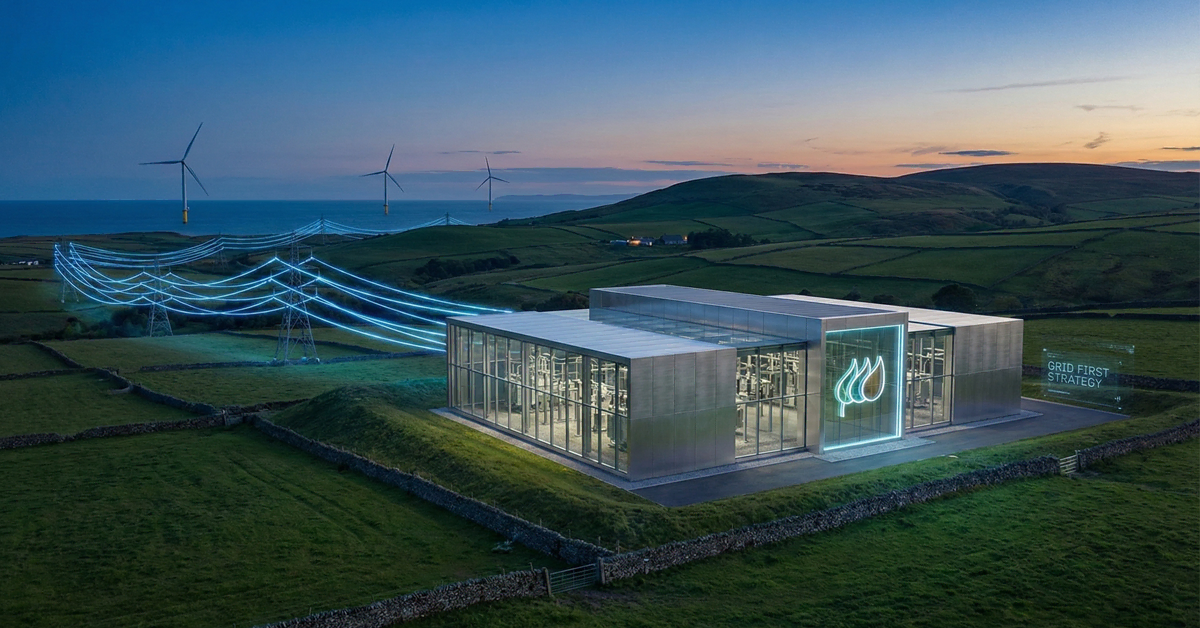
The “Grid First” Strategy: De-risking via Infrastructure
For over two decades, Iberdrola was the poster child for the renewables revolution. However, as the global energy landscape has matured, the economics of “pure-play” renewable generation have faced increasing headwinds: cannibalization effects, supply chain inflation, and extreme wholesale price volatility. In response, Iberdrola’s 2025–2028 roadmap marks a decisive shift. The company has allocated €37 billion—roughly two-thirds of its total planned investment—to electricity networks.
This “Grid First” pivot is a masterclass in corporate de-risking. Unlike renewable generation, where revenue is often tied to fluctuating market prices or competitive auctions, regulated networks operate under “cost-plus” or “incentive-based” regulatory frameworks. These frameworks guarantee a return on investment regardless of whether electricity prices are €20/MWh or €200/MWh. By 2028, Iberdrola expects networks to contribute 55% of its total EBITDA, up from approximately 40% in previous cycles. When combined with long-term contracted renewables (PPAs and Feed-in Tariffs), nearly 75% of the group’s EBITDA will be decoupled from wholesale market volatility. This shift transforms Iberdrola from a high-growth “green energy” stock into a resilient, infrastructure-heavy utility with bond-like predictability.
Geographic De-risking: The Flight to A-Rated Stability
Iberdrola is not just changing what it builds, but where it builds. A cornerstone of the current strategy is the allocation of 85% of total capital to A-rated countries. The United Kingdom has emerged as the primary investment destination (€20 billion), followed closely by the United States (€16 billion).
UK Ofgem vs. Spanish Regulatory Environment
The strategic retreat from the Iberian Peninsula as the primary growth engine is a direct response to regulatory risk. Spain’s energy policy has historically been characterized by “regulatory whiplash”—sudden tax changes, price caps, and retroactive adjustments that have frustrated long-term planning. While the 2025–2028 plan still allocates €9 billion to Iberia, the focus is on maintenance and highly selective storage projects rather than aggressive expansion.
In contrast, the UK’s Ofgem framework (specifically the RIIO-2 and upcoming RIIO-3 periods) provides a benchmark for stability. The RIIO framework (Revenue = Incentives + Innovation + Outputs) offers clear visibility on allowed returns and allows for the recovery of capital expenditure with an inflation-linked component (CPIH). This is particularly attractive in a 2026 macroeconomic environment where inflation remains a persistent concern. The UK’s commitment to “Net Zero” creates an insatiable demand for grid upgrades to handle offshore wind and EV charging, ensuring that the regulator has every incentive to keep returns attractive enough to pull in international capital.
M&A and Integration: The Electricity North West (ENW) Case Study
The acquisition of an 88% stake in Electricity North West (ENW) for an equity value of approximately €2.1 billion (roughly €5 billion enterprise value) is the crown jewel of Iberdrola’s recent M&A activity. This transaction was more than just a horizontal expansion; it was a tactical move to dominate the UK distribution landscape.
Prior to the ENW deal, Iberdrola (via its subsidiary ScottishPower) operated networks that flanked ENW’s territory to the north and south. Integrating ENW allows for significant operational synergies in maintenance, procurement, and digital grid management. More importantly, it fundamentally shifts the scale of the company’s Regulated Asset Base (RAB). With ENW integrated, the UK has surpassed the United States to become Iberdrola’s largest market by RAB, valued at approximately €14 billion. This expansion was a key factor in S&P and Moody’s maintaining the group’s BBB+ credit rating despite the massive capital outlay, as the influx of regulated, sterling-denominated cash flow significantly improves the group’s business risk profile.
Macroeconomic Context: Electrification and AI Demand
The “Researcher” view on the macro environment for 2026 identifies a secondary but vital growth driver: the data center explosion. As Artificial Intelligence (AI) matures, the demand for stable, high-capacity electrical connections has skyrocketed in the US and Europe. Iberdrola’s focus on transmission (the “highways” of the grid) positions it to benefit from this trend. High-voltage transmission projects in the US (via Avangrid) and the UK are currently seeing record demand for interconnectivity. This thematic tailwind provides an “organic growth” layer on top of the regulated returns, as network operators are often able to earn additional incentives for meeting connection deadlines and improving grid resilience.
Financial Outlook and Dividends
The financial targets for 2028 are ambitious but grounded in the reality of regulated returns. Iberdrola aims for a net profit of €7.6 billion and an EBITDA of €18 billion. For investors, the most compelling figure is the dividend floor. The company has committed to a dividend floor of €0.64 per share, with a payout ratio between 65% and 75%. In the current 2026 market, with shares trading in the €18–€20 range, this provides a solid yield that is well-covered by recurring regulated cash flows. The recent €5 billion capital increase has also fortified the balance sheet, ensuring that the debt-to-EBITDA ratio remains within manageable levels despite the €58 billion investment cycle.
Conclusion: Is It Worth Investing?
Iberdrola has successfully navigated the “Valley of Death” that many renewable energy companies fell into during the high-interest-rate environment of 2023–2024. By pivoting to a “Grid First” strategy and doubling down on the UK and US, the company has effectively floor-priced its earnings volatility.
The Bull Case: You are buying a global infrastructure giant with a €70 billion RAB (by 2028), a 4% to 5% yield, and a footprint in the most stable regulatory jurisdictions on earth. The exposure to AI-driven grid demand and offshore wind provides “optionality” for growth that exceeds the standard 6% utility average.
The Bear Case: The stock is no longer a high-growth “green tech” play. It is a mature utility. While the downside is limited by regulation, the upside is also capped by those same regulators. Furthermore, any significant appreciation of the Euro against the Sterling or the Dollar could create a drag on reported earnings.
Final Verdict: For the conservative 2026 investor seeking a defensive hedge against macroeconomic uncertainty, Iberdrola is a Strong Buy. It offers the rare combination of environmental ESG leadership and the “boring” financial stability of a regulated monopoly. It is an “all-weather” stock for the electrification era.