
Table of Contents
Is the US Stock Market Overvalued at the End of 2025?
As 2025 draws to a close, investors are debating whether the surging U.S. stock market has become overvalued. Major indexes have climbed significantly in recent years – fueled by technological innovation and an artificial intelligence (AI) boom – pushing key valuation indicators to levels well above historical norms. Below, we examine these valuation metrics (such as the P/E ratio, CAPE, and market cap-to-GDP) as of December 2025 to evaluate if the market appears overvalued. We then assess whether stocks can continue to grow in 2026, considering expert forecasts, the economic outlook, and anticipated Federal Reserve policy. The goal is to provide a balanced view, combining hard data with analyst opinions on risks and opportunities ahead.
Valuation Metrics at Historic Extremes (December 2025)
Several broad metrics suggest that U.S. equities are highly valued relative to historical benchmarks as of late 2025:
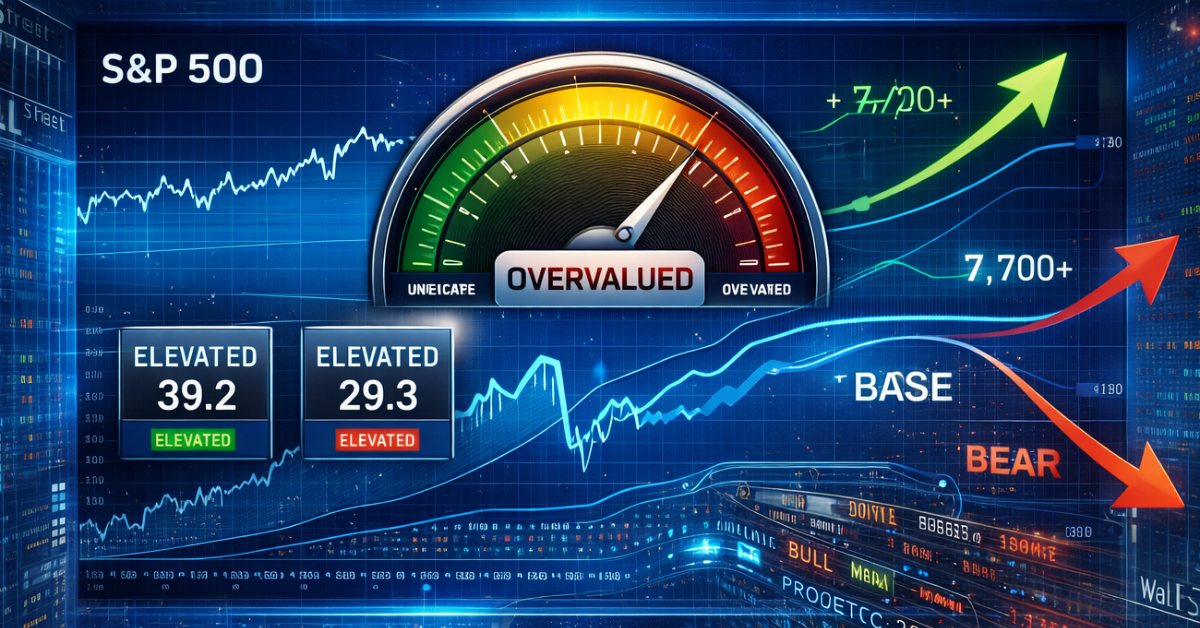
- Price-to-Earnings (P/E) Ratios: The S&P 500’s trailing P/E is around 29–30, well above its long-term average (historically closer to the mid-teens). The overall U.S. stock market (e.g. the total market index) sports a similar elevated P/E in the high 20s. Such levels indicate investors are paying almost $30 for each $1 of current earnings, compared to a more typical ~$15 in past decades.
- Cyclically Adjusted P/E (CAPE): The Shiller CAPE ratio (which uses 10-year inflation-adjusted earnings) is near 38–40. This is one of the highest readings on record, approaching the peak reached during the 2000 dot-com bubble. For context, the CAPE’s long-run median is about 16, and even its 25-year average is around the high 20s – meaning current valuations are far above normal by this measure.
- Market Cap-to-GDP (Buffett Indicator): The total U.S. stock market value is roughly 220–230% of U.S. GDP. In Warren Buffett’s terms, this “Buffett indicator” is in extreme territory – substantially higher than prior market cycle peaks (for example, it was roughly 140% at the height of the 2000 bubble). A value around 100% is often considered a fair-valued market, so 230% suggests stocks are priced at over twice the size of the economy.
These metrics collectively signal that valuations are stretched. In plain terms, stocks are very expensive relative to the earnings they generate and the size of the economy. Historically, such extremes have often been followed by periods of weaker returns or corrections. For instance, when the Shiller CAPE last approached the high-30s and 40+ range (in 1999–2000), the subsequent decade saw the market deliver poor returns as valuations came back down to earth. Likewise, a sky-high market cap-to-GDP ratio has tended to precede market pullbacks in the past.
Why are valuations so high now? One reason is the extraordinary rally in a handful of mega-cap technology stocks. Companies often dubbed the “Magnificent Seven” – Apple, Microsoft, Alphabet (Google), Amazon, Meta (Facebook), Tesla, and Nvidia – have seen massive price gains, pushing their valuations to lofty levels. These giants now make up an outsized portion of the major indexes, and their rich valuations have pulled the overall market averages higher. Meanwhile, some other segments of the market are not as expensively priced. For example, smaller-cap stocks (Russell 2000) actually trade at a valuation discount relative to large caps, which is unusual (historically, small caps carried a premium). This suggests that the overvaluation issue is concentrated at the top end of the market.
Another factor is the low interest rate environment of recent years. Even after interest rates rose from their pandemic-era lows, the late-2010s and early-2020s featured historically low rates and easy monetary policy, which encouraged investors to pay more for stocks. Corporate earnings have also been strong coming out of the pandemic, which provided some fundamental support for prices – but stock prices have risen faster than earnings, hence the inflated P/E ratios. Optimism around future growth areas like AI has further boosted sentiment, with investors seemingly willing to “pay up” now in hopes of substantial earnings down the road.
All told, by traditional measures the entire market appears richly valued at end-2025. This doesn’t guarantee an imminent crash – markets can stay overvalued for long periods – but it does raise the risk of lower returns going forward. Even bullish analysts acknowledge that starting from such high valuation levels, it may be unrealistic to expect the kind of double-digit annual gains that characterized the past decade.
Will the Stock Market Continue to Grow in 2026?
Despite valuation concerns, many experts believe the market can still advance in 2026, though perhaps not without some bumps. The general consensus among major investment banks and market strategists leans optimistic for the next year. Here are some forecasts and factors influencing this outlook:
- Upbeat Analyst Forecasts: Several Wall Street firms are projecting further gains for equities in 2026. For instance, Morgan Stanley predicts the S&P 500 could rise roughly 14% over the next 12 months (they forecast the index reaching around 7,800 by the end of 2026). J.P. Morgan’s research team is also positive, expecting double-digit percentage gains across U.S. stocks, buoyed by robust earnings growth and easing interest rates. Similarly, Deutsche Bank has issued a bullish call with a year-end 2026 S&P 500 target near 8,000, implying significant upside from late-2025 levels. Other institutions – HSBC and some others – likewise anticipate continued stock market growth. In short, the prevailing view from many big strategists is that 2026 will be a positive year for stocks (with U.S. equities even outpacing international markets).
- Economic Tailwinds: The U.S. economic backdrop is expected to be reasonably favorable in 2026. Most forecasts call for moderate GDP growth (somewhere in the 2% range) while inflation gradually trends lower. Notably, the Federal Reserve’s own projections going into 2026 envision inflation cooling toward the 2% target even as growth stays solid – essentially a “soft landing” scenario. Continued healthy consumer spending and business investment (particularly in technology and infrastructure) could support corporate revenues. There are also fiscal factors like government investment in AI, green energy, and infrastructure projects that may provide an extra growth boost or at least a backstop against a downturn.
- Shifting Monetary Policy: A major reason for optimism is the anticipated change in Federal Reserve policy. After aggressively raising interest rates in 2022–2024 to fight high inflation, the Fed reversed course in late 2025 by cutting rates a few times. The benchmark federal funds rate has come down from its peak (which was above 5%) to around the mid-3% range as of December 2025. Going into 2026, the Fed has signaled a pause to assess conditions, but many market participants expect that if inflation remains under control, the Fed could implement at least one or two additional small rate cuts during 2026. Even if rate cuts are limited, simply moving from a tightening cycle to a stable or easing stance is a relief for equities. Lower interest rates reduce borrowing costs for companies and make riskier assets like stocks more attractive relative to bonds. Historically, when the Fed stops hiking and begins cutting, it often provides a tailwind for the stock market (though the timing and magnitude of gains can vary). The prospect of a more accommodative monetary policy through 2026 is thus a key pillar of the bullish case.
- Earnings and Innovation: Corporate earnings are projected to grow in 2026, which could help justify current valuations. Many companies streamlined operations and cut costs during tougher times, so they stand to benefit disproportionately as conditions improve. Moreover, the tech sector – which drives a large share of S&P 500 profits – is expected to continue robust growth. Developments in artificial intelligence, cloud computing, and other innovations are seen as potential catalysts for productivity gains and new revenue streams. If AI investments start translating into higher efficiency and profits, it could propel tech giants and broader market earnings higher. Additionally, certain legislative changes (such as corporate tax breaks or incentives that are scheduled through 2026) might boost net earnings. Analysts pointing to these factors argue that as long as earnings keep rising, stock prices have room to climb even from already-elevated levels.
In summary, the bullish camp believes that a Goldilocks combination of decent economic growth, falling inflation, and easier monetary conditions will support further stock market appreciation in 2026. Under this scenario, valuations could remain elevated or even expand slightly if investor confidence grows that the worst of inflation is over and a recession will be avoided. The fact that many investors still have cash on the sidelines or underinvested in equities (after the volatile, rate-hike-heavy period) means there is potential buying power to drive prices up on any good news. Thus, it’s quite plausible the market can grind higher or even see another year of above-average gains in 2026.
A Balanced View – Potential Risks and Rewards
While the outlook for 2026 has many positive elements, it’s important to consider the risks and contrary opinions as well. High starting valuations themselves are a double-edged sword: they reflect optimism and strong recent performance, but they also imply that future returns could be more limited. If any of the supportive factors mentioned above falter, an overvalued market can correct quickly. Here are some key risks and considerations tempering the 2026 growth story:
- Valuation Mean-Reversion: The elephant in the room is that stocks are priced for perfection. If corporate earnings in 2026 come in below expectations or if growth disappoints, richly valued shares could see their prices fall. With a CAPE near 40 and P/E near 30, even minor earnings misses or guidance cuts might trigger outsized stock declines, as there isn’t much margin for error. Some analysts caution that when valuations have been this high in the past, the following years often saw very modest returns. Essentially, some of the future gains may have been “pulled forward” into the current prices.
- Narrow Market Leadership: The current rally has been very concentrated in those handful of tech mega-caps. If the market’s leadership narrows further or one of the giants stumbles, it could drag down the indices. A lot of the 2026 bullish case assumes continued strength from big tech and successful monetization of AI initiatives. However, there’s competition and the risk of technological disruption – the dominance of today’s leaders is not guaranteed forever. If investors rotate out of these high-fliers or if a tech bubble forms and bursts, it would have a broad impact given these companies’ weight in the market.
- Economic and Geopolitical Wildcards: The base-case economic outlook is positive, but there are scenarios where 2026 could see a slowdown or recession. The delayed effects of earlier Fed rate hikes, tighter credit conditions, or an external shock could all undermine growth. For example, if consumer spending softens more than expected (perhaps due to depleted savings or higher unemployment) or if corporate investment pulls back, earnings would suffer. Globally, any resurgence of trade tensions, supply chain disruptions, or geopolitical conflicts could spook markets. Additionally, although inflation is receding, an unexpected flare-up in prices (perhaps due to oil shocks or other supply issues) could force the Fed to halt rate cuts or even raise rates again – a clear negative for stocks.
- Interest Rates and Fed Policy Uncertainty: There is some disconnect between market expectations and Fed communications. Markets are pricing in the likelihood of a couple of rate cuts in 2026, but Federal Reserve officials have voiced caution, with some indicating they don’t foresee many more cuts in the near term. If inflation remains sticky around 3% instead of falling to 2%, the Fed might choose to keep rates at an equilibrium level (or even hike if necessary). In such a scenario, investors hoping for monetary stimulus could be disappointed, which might lead to market volatility. Moreover, a change in Fed leadership is coming (as the term of the Fed Chair is set to expire) which adds policy uncertainty. How aggressively the new Fed Chair will prioritize inflation vs. growth is unknown – any shift to a more hawkish stance would be a headwind for equities.
- Lower Long-Term Return Expectations: Not all experts are forecasting huge gains. Some, like the analysts at Vanguard, project that U.S. stock returns over the next 5–10 years will be much more subdued (on the order of mid-single-digit annual returns). They argue that the outsized returns of the past were partly a product of falling interest rates and expanding valuations, trends that are unlikely to continue indefinitely. In their view, even if 2026 is positive, it might be followed by leaner years as the market works off its high valuation. Investors should be mentally prepared for the possibility that 2026 could mark a transition to a period of more modest returns, rather than a continuation of the roaring bull market. This perspective urges caution and suggests focusing on fundamentals (and perhaps tilting toward value stocks or international markets that have lower valuations) as a way to navigate an overpriced U.S. market.
The bottom line: The U.S. stock market in late 2025 undeniably looks expensive by traditional measures. This raises valid concerns about overvaluation and the sustainability of recent gains. However, a strong economy, improving inflation backdrop, and potential Fed rate cuts provide a supportive case for equities to keep rising in 2026. Many analysts foresee the market advancing further, though likely at a more moderate pace and with continued volatility. As an investor, it’s wise to balance these viewpoints. That means acknowledging the red flags (lofty valuations and possible headwinds) while also recognizing the momentum and positive factors that could extend the rally.
In practical terms, going into 2026 one might expect continued growth in stock prices but tempered by periods of consolidation or pullback. It would not be surprising to see stocks climb higher over the year if the optimistic scenarios play out – yet the magnitude of gains may be lower than in the banner years, and setbacks could occur if reality falls short of high expectations. Keeping a long-term perspective, diversifying across sectors and asset classes, and not over-committing at euphoric price levels are prudent steps. By doing so, investors can participate in any further upside the market delivers in 2026 while being resilient against potential corrections that could arise from an overvalued starting point.