
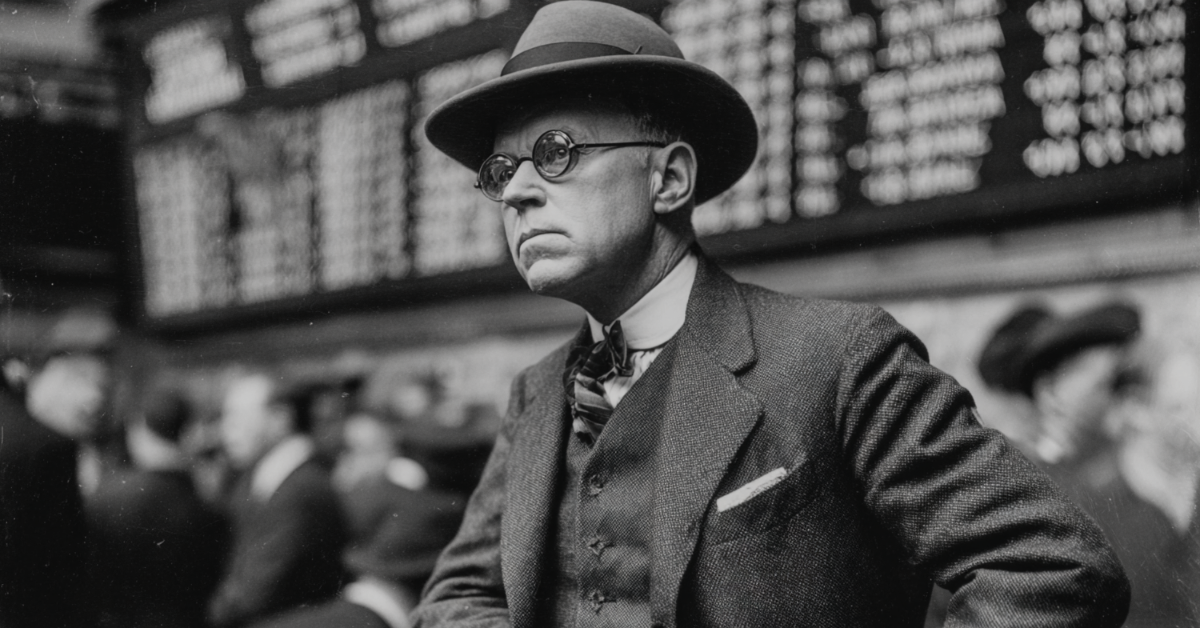
The historical development of financial speculation finds its most profound architectural expression in the career and methodologies of Jesse Lauriston Livermore. As a figure who navigated the shift from the chaotic, unregulated markets of the late 19th century to the institutionalized structures of the early 20th century, Livermore transitioned from a localized phenomenon known as the Boy Plunger to a global symbol of market foresight and technical discipline. His approach to the markets was not merely a collection of tactical maneuvers but a comprehensive philosophy rooted in the immutable laws of human psychology and the rhythmic cycles of capital flow.
Table of Contents
The Formative Era of Speculative Discovery
Jesse Livermore’s entry into the world of high finance occurred in 1891, an era devoid of modern transparency, electronic execution, or standardized accounting. At the age of fourteen, Livermore fled the agricultural limitations of his father’s farm in Massachusetts to seek opportunity in Boston, where he secured a position as a board boy at the brokerage firm Paine Webber. This role required him to manually update stock quotations on a chalkboard as they were transmitted via ticker tape. It was within this environment that Livermore’s innate talent for pattern recognition manifested; he began to perceive price movements not as random numbers but as a graphic language reflecting the psychological states of market participants.
The laboratory for his early theories was the bucket shop, a type of establishment that allowed individuals to place bets on stock price fluctuations with high degrees of leverage. Because these shops did not actually purchase the underlying securities, they were essentially gambling houses that mirrored the real exchange prices. Livermore’s success in these venues was so consistent that he was eventually banned from bucket shops throughout the Boston area, leading him to utilize aliases and disguises to continue his operations. By the age of twenty, he had amassed over $10,000 in profits, a testament to his ability to read the “tape” with uncanny accuracy.
Structural Foundations of the Livermore Trading System
Livermore’s mature trading system was built upon three fundamental pillars: market timing, money management, and emotional control. He argued that speculation is a professional endeavor requiring the same dedication as medicine or law, asserting that the “mentally lazy” or those seeking “get-rich-quick” schemes would inevitably face ruin.
The Top-Down Trading Methodology
The first step in Livermore’s execution framework was the analysis of the general market trend. He believed that no individual stock could resist the overwhelming tide of the broader market. Consequently, he focused on the “line of least resistance,” a term he used to describe the primary direction of the market’s momentum. He avoided permanent labels such as bull or bear, choosing instead to align his capital with the side that was currently proving itself correct through price action.
Once the general market direction was established, Livermore moved to industry group evaluation. He observed that stocks tend to move in groups, and he sought sectors that exhibited the strongest relative strength. Within these sectors, he identified the “leaders”—the specific stocks that were the first to break out of trading ranges and reach new highs. He maintained that if one could not make money in the leading stocks, one could not make money in the market at all.
| Step of Top-Down Analysis | Scope and Objective | Strategic Rationale |
|---|---|---|
| General Market Trend | Identification of the primary “line of least resistance” using indices like the Dow. | Capital preservation and alignment with macroeconomic momentum. |
| Industry Group Direction | Evaluation of specific sectors (e.g., Rails, Steel, or modern equivalents like Tech). | Identifying institutional capital flow and sector rotation. |
| Sister Stock Comparison | Measuring the performance of two prominent stocks within the same group. | Confirmation of industry-wide strength vs. individual stock anomalies. |
| Leadership Selection | Executing trades only in the strongest performing stocks of the day. | Maximizing volatility capture and ensuring liquidity in exits. |
The Mechanics of Tape Reading and Price Action
Livermore’s technical analysis was purely behavioral. He viewed price charts as the “graphic reflection” of human emotions like greed, fear, and hope. One of his primary tools was the “One-Day Reversal,” a high-volume signal that often marked the beginning or end of a significant move. In a bullish reversal, a stock would reach a new intraday low but then close higher than the previous day on elevated volume, suggesting that selling pressure had been exhausted and buyers had taken control.
Livermore also monitored volume as a confirmation tool. He noted that when a stock broke through a “pivotal point,” the breakout must be accompanied by a surge in volume to be considered valid. If the price moved higher on low volume, he viewed it with skepticism, anticipating a potential “natural reaction” or retracement.
Tactical Execution: Pivotal Points and the Market Key
Central to Livermore’s execution was the concept of the Pivotal Point. He did not believe in guessing bottoms or chasing every minor breakout. Instead, he waited for the “psychological moment” where the price was forced to declare its intent. These points typically occurred at the boundaries of long consolidation periods or at significant psychological price levels.
Reversal vs. Continuation Pivotal Points
Livermore distinguished between two types of pivotal points that governed his entries and exits. Reversal Pivotal Points were identified at the end of extended moves, signaling that the primary trend was about to change direction. Conversely, Continuation Pivotal Points occurred during the middle of a trend, providing an opportunity for the trader to add to a position as the stock consolidated before resuming its advance.
To track these movements, Livermore developed a manual ledger system called the Market Key. This system involved recording price changes in specific columns based on their volatility. By analyzing the relationship between current prices and previous pivotal levels, Livermore could determine if a price movement was a “Natural Reaction”—a healthy 3-to-6 point pullback—or an “Abnormal Move” that signaled the termination of the trend.
The Pyramiding Strategy and Probe Positions
Livermore was a firm believer in scaling into positions. He would never deploy his full capital at once. Instead, he utilized “probe” positions—small initial entries designed to test the validity of his thesis. If the market confirmed his direction by moving in his favor, he would add subsequent “tranches” of capital. This method, known as “pyramiding up,” ensured that his largest exposure was always in his most profitable trades.
Importantly, Livermore strictly forbade “averaging down”. He viewed the practice of buying more of a falling stock as a profound intellectual and financial error. He argued that if a stock is moving against you, the market is telling you that your initial judgment was incorrect; adding more capital to a losing position is simply “sending good money after bad”.
| Pyramiding Component | Description | Objective |
|---|---|---|
| Probe Position | The initial 20% of the total intended position size. | Testing the market’s reaction at a pivotal point with minimal risk. |
| Confirmation Tranche | Adding another 20% once the price moves in the predicted direction. | Validating the trend and increasing exposure as confidence grows. |
| Full Load | Deploying the final 60% after the trend has clearly established itself. | Maximizing profit potential during the most explosive part of the move. |
| Stop-Loss Alignment | Moving the stop-loss order up as tranches are added. | Ensuring that the total risk remains within the 10% threshold. |
Money Management: The Safeguard of Speculative Longevity
Livermore’s spectacular successes were often followed by devastating losses, a pattern that led him to refine a strict set of money management principles. He believed that capital is the lifeblood of the speculator and must be protected with the same vigilance a merchant uses to guard his inventory.
The 10% Risk Limit and Capital Preservation
One of Livermore’s most famous rules was the 10% stop-loss. He maintained that if a trade resulted in a loss of 10% of the initial capital, it must be closed immediately and without hesitation. This rule was designed to prevent a single mistake from causing catastrophic damage to the trader’s account, ensuring that they would have sufficient capital to participate in the next opportunity. He noted that many traders become “involuntary investors” by holding onto losing stocks in the hope that they will recover, a behavior he viewed as fatal to professional speculation.
The Cash Reserve and Profit Withdrawal Policy
Livermore recognized that the psychological exhilaration of success could lead to recklessness. To counteract this, he implemented a policy of withdrawing half of the profits from any successful “windfall” trade and placing them in a cash reserve. This reserve served as a financial safety net and provided the trader with the “healthy” satisfaction of possessing tangible wealth that was not subject to market volatility. He emphasized that a speculator should never delegate the guarding of their money to anyone else, as it is the trader’s primary responsibility to ensure its preservation.
The Psychological Dimension of Trading
Livermore’s philosophy was as much about self-mastery as it was about market analysis. He observed that the “human side” of the individual is the greatest enemy of the average investor. To succeed, a trader must banish wishful thinking and replace it with a disciplined adherence to objective signals.
The Role of Patience and Inaction
“Money is made by sitting, not trading” remains one of Livermore’s most cited insights. He observed that most traders feel a compulsive need to be constantly active in the market, leading to over-trading and the erosion of capital. Livermore argued that the right opportunities may only appear four or five times a year. During the interim periods, the correct strategy is to remain on the sidelines, observing the market from a distance to maintain clarity.
Fear, Greed, and Hope: The Trio of Ruin
Livermore believed that the market is a battleground where the trader fights their own emotions. He noted that in losing positions, human nature leads the trader to “hope”—hoping the price will return to their entry point. Conversely, in winning positions, human nature leads the trader to “fear”—fearing they will lose their gains. He advocated for a total reversal of these instincts: “Always sell when you start to worry” and allow winning trades to develop as long as the price action remains positive.
Historical Case Studies of Speculative Mastery
Livermore’s reputation was cemented by his performance during the most significant market dislocations of the 20th century. His ability to identify market bubbles and execute massive short positions remains a subject of intense study.
The 1906 Union Pacific Short (NYSE: UNP)
During a vacation in Palm Beach in 1906, Livermore received what he described as a psychic or intuitive impulse to short Union Pacific. While the initial trade was based on instinct, he quickly supported it with technical observation. Two days later, a massive earthquake struck San Francisco, causing the market to plunge and netting Livermore a $300,000 profit. This trade illustrated his belief that the market often telegraphs major events through price action before the news becomes public.
The Panic of 1907 and the 1929 Crash
In the Panic of 1907, Livermore’s massive short positions made him $1 million in a single day. However, showing a rare moment of institutional cooperation, he agreed to stop shorting at the request of J.P. Morgan to help stabilize the market, subsequently profiting from the rebound.
By early 1929, Livermore recognized that the market was in a bubble driven by excessive leverage and public euphoria. He began building his short positions quietly, spreading them across more than 100 brokers to avoid detection. Although he faced paper losses of $6 million as the market continued to climb, his technical analysis of the “leaders” signaled that the end was near. When the crash finally occurred in October 1929, Livermore netted approximately $100 million, equivalent to over $1.5 billion in current value.
| Crisis Event | Market Signal Observed | Strategy Employed | Financial Outcome |
|---|---|---|---|
| 1906 S.F. Earthquake | Internal impulse followed by price weakness in Rails. | Short selling Union Pacific (UNP). | $300,000 profit. |
| Panic of 1907 | Excessive credit expansion and failure of trust companies. | Aggressive shorting followed by long positions at the bottom. | $3 million net worth increase. |
| 1929 Great Crash | Divergence in market leaders and unsustainable broker loan levels. | Stealth shorting using a massive broker network. | $100 million profit in one week. |
| 1920s Cotton Corner | Disruption in supply-demand balance post-WWI. | Accumulating physical and futures contracts globally. | Intervention by President Wilson; sold at break-even. |
Modern Applicability: Adapting the Livermore System to the 21st Century
The transition to high-frequency trading (HFT) and algorithmic execution has changed the speed of the market, but the underlying behavioral patterns identified by Livermore remain intact. His work is often viewed as an early precursor to quantitative trend following and momentum-based statistical arbitrage.
Algorithmic Integration and HFT
Modern AI and machine learning models are essentially high-speed versions of Livermore’s manual “Market Key”. These systems identify “pivotal points” by processing millions of transactions in milliseconds, exploiting the same technological abnormalities that Livermore utilized when he “hacked” the telegraph and ticker tape in his early career. Today’s institutional investors use these principles to manage “Sister Stock” portfolios, profiting from the spreads between correlated industry peers.
Regulatory Evolution and the Death of the “Plunger”
The era of the unregulated “plunger” ended with the Securities Exchange Act of 1934. The creation of the SEC introduced transparency requirements and anti-manipulation rules that prohibited many of the tactics Livermore used to “corner” markets or hide his positions. Modern adherence to his system requires a focus on public price action and legitimate volume analysis rather than the clandestine building of positions or market manipulation.
Investor Archetypes and Adoption Profiles
Jesse Livermore’s investment approach is not a universal solution; it is a specialized discipline that requires a specific temperament and financial foundation.
The Discretionary Trend Follower
This investor uses technical analysis to capture major swings in the market. They prioritize capital preservation and are comfortable with long periods of inaction. This profile requires high emotional intelligence to resist the urge to follow the crowd.
The Systematic Momentum Trader
This profile adapts Livermore’s “pivotal point” logic into mechanical rules. They often use software to track sector leaders and automate the “pyramiding” of positions. This approach removes much of the emotional burden but requires a deep understanding of mathematical risk and drawdown management.
| Investor Type | Compatibility with Livermore | Necessary Attributes |
|---|---|---|
| Professional Speculator | High | Emotional balance, intellectual independence, and high capital reserves. |
| Institutional Quant | High | Mathematical modeling of price thresholds and volume confirmation. |
| Passive Index Investor | Low | Livermore’s style is active and anti-diversification; he focused on a few leaders. |
| Retail Day Trader | Moderate | One-day reversals work on short timeframes, but Livermore favored the “big swing”. |
Conclusion: The Perpetual Ticker Tape of Human Nature
The analysis of Jesse Livermore’s trading techniques reveals a system that is as much a psychological treatise as it is a financial one. His life, marked by the rapid accumulation of wealth and equally rapid descents into bankruptcy, serves as a dual-sided monument to the power of technical discipline and the danger of unbridled leverage. Livermore’s fundamental realization—that the market is a reflection of human behavior rather than abstract economic value—ensures that his principles remain valid as long as humans remain the primary participants in global finance.
For the modern investor, the legacy of the Bear of Wall Street offers a rigorous framework for navigating volatility. By focusing on the “right side” of the market, identifying the leadership of the current era, and maintaining a fanatical devotion to capital preservation through stop-losses and profit reserves, the professional can replicate Livermore’s successes while avoiding the personal tragedies that defined his final years. In the final estimation, Livermore’s greatest contribution was not the millions he made, but the demonstration that the market is a solvable puzzle for those with the patience to sit and the courage to act when the tape finally speaks.