
Table of Contents
Executive Summary
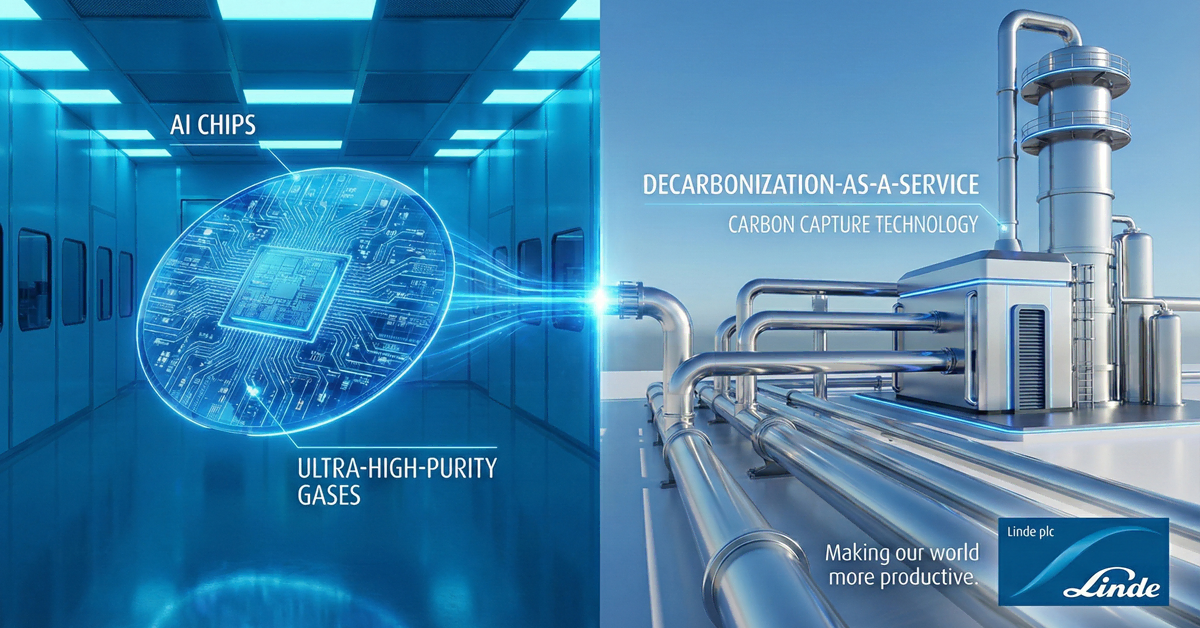
The global industrial gases sector has historically been viewed through the lens of traditional macroeconomic cyclicality, serving as a reliable but slow-growing proxy for global manufacturing and heavy industrial output. However, Linde plc has strategically engineered a structural decoupling from base industrial cycles. By rigorously aligning its capital allocation and technological capabilities with two of the most profound secular mega-trends of the twenty-first century, Linde has transformed its earnings profile and fortified its economic moats. These two defining pillars are the artificial intelligence semiconductor super-cycle and the global mandate for industrial decarbonization.
This research paper provides a comprehensive analysis of Linde plc as a thematic growth and technology investment. The report bypasses the generalized narratives surrounding broad industrial gas applications to focus precisely on the highest-margin, highest-growth vectors within the company portfolio. First, we examine the AI Gas Thesis, analyzing how the exponential surge in artificial intelligence infrastructure and advanced sub-3nm semiconductor manufacturing is driving unprecedented demand for ultra-high-purity specialty gases. Crucially, we evaluate how Linde localized network density in vital semiconductor hubs like Arizona and Taiwan creates an almost insurmountable barrier to entry for competitors such as Air Products.
Second, we explore the paradigm shift of Decarbonization-as-a-Service. Moving beyond the speculative hype of the nascent green hydrogen economy, we dissect Linde highly pragmatic and immediately profitable strategy of providing end-to-end carbon capture, utilization, and storage solutions to legacy heavy industries. We will analyze the financial mechanics of monetizing United States Section 45Q tax credits and demonstrate how twenty-year take-or-pay contracts fundamentally de-risk Linde cash flows. This contractual architecture engineers utility-like earnings visibility, thereby structurally elevating Linde valuation multiples above its traditional chemical and materials peer group. Ultimately, this report outlines how Linde leverages immense capital intensity and highly localized infrastructure to secure localized monopolies, ensuring resilient, compounding returns on invested capital regardless of broader macroeconomic volatility.
The AI Gas Thesis: Powering the Next Generation of Semiconductors
The Semiconductor Super-Cycle and Silicon Complexity
The proliferation of artificial intelligence, driven by the training and inference requirements of large language models, has ignited a structural super-cycle in the semiconductor industry. To process the immense computational workloads required by AI, fab operators and chip designers are aggressively pushing the boundaries of Moore Law. This necessitates the rapid transition to advanced manufacturing nodes, specifically three-nanometer, two-nanometer, and below architectures. As transistor dimensions shrink to atomic scales, the architectural complexity of the silicon wafer increases exponentially, requiring novel transistor designs such as Gate-All-Around field-effect transistors and advanced packaging techniques.
However, this miniaturization introduces a critical manufacturing vulnerability: as the physical dimensions of the circuitry decrease, the tolerance for chemical impurities and particulate contamination approaches zero. A microscopic contaminant that might have been benign on a legacy twenty-eight-nanometer node will catastrophically bridge the gap between transistors on a three-nanometer node, rendering the entire chip defective. Consequently, the semiconductor manufacturing environment must be controlled with unprecedented precision. This environment is not merely maintained by cleanroom air filtration; it is fundamentally constructed and sustained by industrial and specialty gases.
Linde operates as the invisible architect of this manufacturing environment. Advanced semiconductor fabrication facilities require continuous, massive volumes of ultra-high-purity gases. Nitrogen, used extensively for purging vacuum pumps, inerting environments, and abatement systems, is consumed at rates reaching tens of thousands of cubic meters per hour in a single modern fab. Oxygen is utilized for growing oxide layers during the etching process, while Helium is essential for plasma processing, rapid cooling, and leak detection. As fabs grow larger to accommodate AI chip demand, the consumption baseline for these atmospheric and noble gases scales proportionately, creating a massive, recurring revenue stream for the gas supplier deeply embedded within the fab infrastructure.
The Essential Chemistry: Ultra-High-Purity and Specialty Gases
Beyond the immense volumes of bulk atmospheric gases, the AI semiconductor thesis for Linde is predicated on the highly specialized, high-margin electronic specialty gases that enable the actual atomic manipulation of the silicon. Advanced lithography, the process of printing intricate patterns onto the wafer, is highly dependent on proprietary gas mixtures. Extreme Ultraviolet lithography, the cornerstone of sub-five-nanometer manufacturing, requires massive quantities of high-purity hydrogen to continuously clear tin debris from the delicate mirrors within the multi-million-dollar scanners. Without a flawless, uninterrupted supply of hydrogen, the lithography process halts, costing the fab operator millions of dollars per hour in lost throughput.
Linde technological leadership extends deep into the molecular and isotopic level. For instance, the company provides Nitrogen Trifluoride for the meticulous cleaning of process chambers and complex etching sequences. Tungsten Hexafluoride is supplied for the chemical vapor deposition of tungsten interconnects that link the billions of transistors on an AI accelerator chip. Furthermore, Linde provides isotopically enriched specialty gases that solve highly specific physics problems at the cutting edge of chip design. The company produces isotopically pure Boron-11 Trifluoride, which allows semiconductor designers to construct devices that successfully avoid the disabling effects of thermal neutron capture. Similarly, Deuterium and deuterium-substituted gases are utilized to passivate the silicon surface, making the microscopic devices robust against hot electron damage. By providing solutions at the isotopic level, Linde transcends the role of a commodity chemical supplier and establishes itself as a mission-critical technology partner embedded in the semiconductor research and development roadmap.
The Competitive Moat: Network Density in Arizona and Taiwan
While the technological capabilities regarding specialty gases are impressive, Linde true economic moat in the semiconductor space is forged by physics and geography. Industrial gases are heavy, low-value-to-volume commodities when considered in their bulk forms. It is economically ruinous and logistically impractical to transport bulk nitrogen or oxygen across oceans or even across long terrestrial distances via truck. Therefore, the optimal mode of supply for a massive semiconductor fab is localized infrastructure: either an on-site Air Separation Unit dedicated to a single customer, or a regional pipeline network connecting a massive, centralized Air Separation Unit to multiple nearby customers.
This geographic reality gives rise to the concept of network density, the most critical competitive advantage in the industrial gas sector. When evaluating Linde dominance in vital semiconductor manufacturing hubs like the Tainan Science Park in Taiwan or the rapidly expanding silicon desert of Phoenix, Arizona, network density emerges as an impenetrable fortress against competitors like Air Products and Air Liquide. Over decades, Linde has invested billions of dollars to construct interconnected pipelines and multiple Air Separation Units within these specific geographic clusters.
Consider the economic dynamics when a major semiconductor manufacturer decides to build a new fabrication facility in one of these hubs. If Air Products wishes to bid for the gas supply contract, they must factor in the massive capital expenditure of building a brand-new, standalone Air Separation Unit from the ground up, entirely dependent on the revenue from that single new fab. Furthermore, they must build redundancy into their system to guarantee the flawless uptime required by the fab operator, meaning they might have to build two units or secure vast amounts of liquid backup storage.
Conversely, Linde approaches the same bid from a position of overwhelming structural advantage. Because Linde already has a dense pipeline network crisscrossing the industrial park, they can often supply the new fab simply by extending a pipeline spur a few miles and utilizing the marginal excess capacity of their existing regional network. If a new Air Separation Unit is required, Linde can integrate it into the existing pipeline grid. This integration means the new plant benefits from the backup redundancy of all the other Linde plants in the area, drastically lowering the capital intensity required for backup systems.
This network density results in structurally lower capital costs and significantly higher reliability for Linde. The semiconductor manufacturer, whose primary concern is zero-downtime operations, will almost inevitably choose the supplier with the most robust, interconnected local network. Thus, Linde density in Taiwan and Arizona creates a localized natural monopoly. It locks in customers with high switching costs, expands operating margins through economies of scale, and creates a barrier to entry that Air Products cannot economically justify breaching. This dominant position ensures that as capital expenditure floods into AI chip manufacturing in these specific geographies, Linde captures a disproportionate share of the resulting industrial gas demand.
Decarbonization-as-a-Service: Beyond the Hydrogen Hype
The Shift from Molecule Supplier to End-to-End CCUS Partner
The second major thematic growth vector for Linde is the global energy transition. Much of the public and speculative market attention has focused on the promise of green hydrogen produced via renewable electrolysis. However, green hydrogen remains highly capital intensive and economically challenging without massive, sustained government subsidies. Linde has adopted a vastly more pragmatic, highly profitable, and immediately actionable strategy: Decarbonization-as-a-Service, focused on Carbon Capture, Utilization, and Storage for existing heavy industries.
Traditional industrial sectors such as steel manufacturing, chemical refining, and ammonia production are characterized by massive, concentrated carbon dioxide emissions. These industries are under immense regulatory and social pressure to decarbonize, yet they cannot simply shut down their essential operations, nor can they easily electrify the intense thermal processes required for their manufacturing. Linde steps into this breach not merely as a supplier of industrial gases, but as a comprehensive engineering and operational partner.
Instead of just selling oxygen to a steel mill or hydrogen to a refinery, Linde is increasingly contracting to build, own, and operate the entire decarbonization infrastructure on the customer site. This involves deploying proprietary autothermal reforming technology, constructing the complex pressure swing adsorption units to purify the output, capturing the resulting carbon dioxide emissions at the source, compressing the carbon dioxide into a supercritical fluid, and managing the transportation and geological sequestration of the carbon. By absorbing the immense technical complexity of the carbon capture process, Linde allows the heavy industrial operator to focus on their core competency, whether that is making steel or synthesizing ammonia. This evolution from selling molecules to providing a holistic, technology-driven service cements Linde as an indispensable partner in the industrial supply chain.
The Financial Alchemy of Section 45Q Tax Credits
The economic viability and rapid acceleration of Linde Carbon Capture, Utilization, and Storage strategy in the United States have been fundamentally transformed by federal policy, specifically the enhancements to the Section 45Q tax credits enacted under the Inflation Reduction Act. The Section 45Q provision is a production tax credit that provides a guaranteed, performance-based revenue stream for every metric ton of carbon dioxide that is successfully captured and permanently sequestered.
Under the revised legislative framework, the value of the tax credit has been substantially increased, reaching up to eighty-five dollars per metric ton for carbon dioxide that is securely stored in dedicated saline geologic formations. Furthermore, the legislation extended the commencement of construction deadlines, providing the necessary long-term visibility for capital-intensive mega-projects. Crucially, the policy introduced direct pay and transferability mechanisms, allowing companies to monetize these credits efficiently, either by applying them directly against tax liabilities or selling them to unrelated taxpayers.
For Linde, the Section 45Q tax credit acts as financial alchemy. It transforms carbon dioxide, previously viewed strictly as an environmental liability and an unwanted industrial byproduct, into a highly lucrative, subsidized revenue stream. Because Linde possesses the deep engineering expertise to capture and compress carbon at a cost significantly below the eighty-five-dollar-per-ton credit value, the spread between the capture cost and the tax credit represents pure margin. Furthermore, these tax credits are guaranteed by the federal government for a period of twelve years from the date the capture equipment is placed into service. This creates a deeply entrenched, highly predictable layer of profitability that insulates Linde from the volatile commodity pricing that historically plagues the chemical and refining sectors.
Take-or-Pay Contracts: Engineering Valuation Stability
While the technological implementation of carbon capture and the monetization of tax credits are vital, the true genius of Linde business model lies in its contractual architecture. To justify the hundreds of millions, or even billions, of dollars in upfront capital expenditure required to build a world-scale decarbonization facility or a massive air separation unit, Linde insists upon ironclad commercial agreements known as take-or-pay contracts. These contracts are the bedrock of Linde valuation stability.
When Linde builds a custom decarbonization and gas supply facility adjacent to a customer plant, the two parties execute a long-term agreement, typically spanning fifteen to twenty years. Under the take-or-pay structure, the customer is legally obligated to pay a fixed, substantial capacity charge, or facility fee, every single month for the duration of the contract, regardless of whether the customer actually takes delivery of the gas or utilizes the carbon capture service. If a steel mill customer experiences a severe macroeconomic downturn and reduces its steel production by half, they still must pay Linde the full fixed capacity fee.
Furthermore, these contracts are meticulously engineered to pass through variable costs. If the price of electricity or natural gas spikes, those increased input costs are automatically passed directly to the customer through contractual formula adjustments. The contracts also invariably include strict inflation escalators, ensuring that Linde revenue and margins are protected against currency debasement and rising operational costs over the two-decade lifespan of the agreement.
The strategic implication of the twenty-year take-or-pay contract is profound. It completely eliminates volume risk and commodity price risk from Linde financial profile. Linde does not care what the spot price of steel, ammonia, or traditional chemicals is doing on the global market. They are solely taking on operational execution risk, betting entirely on their own engineering competence to keep the plant running efficiently. By converting massive industrial capital expenditures into guaranteed, inflation-protected, utility-like annuity streams, Linde structurally de-risks its cash flows.
Valuation Implications and Competitor Analysis
The combination of localized network density monopolies in the AI semiconductor space and the guaranteed cash flows of take-or-pay decarbonization contracts fundamentally alters how Linde should be valued by the capital markets. Traditional basic materials and chemical companies trade at lower valuation multiples due to their inherent cyclicality, their exposure to global commodity spot prices, and the volatility of their earnings. Linde, however, has engineered its business to exhibit the defensive characteristics of a regulated utility, combined with the secular growth tailwinds of the technology and clean energy sectors.
When comparing Linde to its primary global competitor, Air Products, distinct strategic divergences become apparent. Air Products has chosen to allocate massive amounts of capital toward pioneering, high-risk green hydrogen mega-projects, such as the multi-billion-dollar NEOM facility in Saudi Arabia. These projects expose Air Products to significant execution risks, sovereign risks, and the uncertain future demand curves for liquid green hydrogen in global markets.
Linde, by contrast, has demonstrated superior capital discipline. The company has focused its investments primarily in North America and Europe, capitalizing on robust, legally secure subsidy frameworks like the US Inflation Reduction Act. Rather than building speculative merchant capacity, Linde tightly binds its capital expenditures to specific, credit-worthy industrial customers through the aforementioned take-or-pay contracts. This disciplined, risk-averse approach to capital allocation is reflected in Linde industry-leading Return on Invested Capital. By leveraging existing network density to win semiconductor contracts with marginal capital outlay, and by utilizing government subsidies to enhance the returns on decarbonization infrastructure, Linde consistently generates higher cash flow per dollar invested than its peers.
This relentless focus on compounding high-quality, derisked cash flows allows Linde to maintain a pristine balance sheet and support a robust, continuously growing dividend program. The market recognizes this structural superiority, awarding Linde a premium price-to-earnings multiple that reflects its transformation from a cyclical industrial supplier into an indispensable, monopolistic enabler of the digital and green economies.
Conclusion
Linde plc represents a highly sophisticated thematic investment vehicle, offering leveraged exposure to two of the most critical industrial transformations of our era. In the semiconductor domain, the insatiable computational demands of artificial intelligence require sub-three-nanometer chip architectures, which in turn require exact, ultra-high-purity specialty gas environments. Linde localized network density in vital fabrication hubs creates an unassailable moat, ensuring captive customers and expanding margins. Simultaneously, the global mandate for industrial decarbonization has allowed Linde to pioneer Decarbonization-as-a-Service. By monetizing Section 45Q tax credits and wrapping complex carbon capture infrastructure in twenty-year, inflation-protected take-or-pay contracts, Linde has successfully engineered utility-like earnings stability. Through disciplined capital allocation and profound technological expertise, Linde has transcended traditional industrial cyclicality, positioning itself as a resilient, compounding growth engine at the intersection of advanced technology and sustainable energy.