
Table of Contents
The Industrialization of Intelligence: A Strategic Analysis of the Magnificent Seven’s AI Infrastructure and Roadmap (2025–2026)
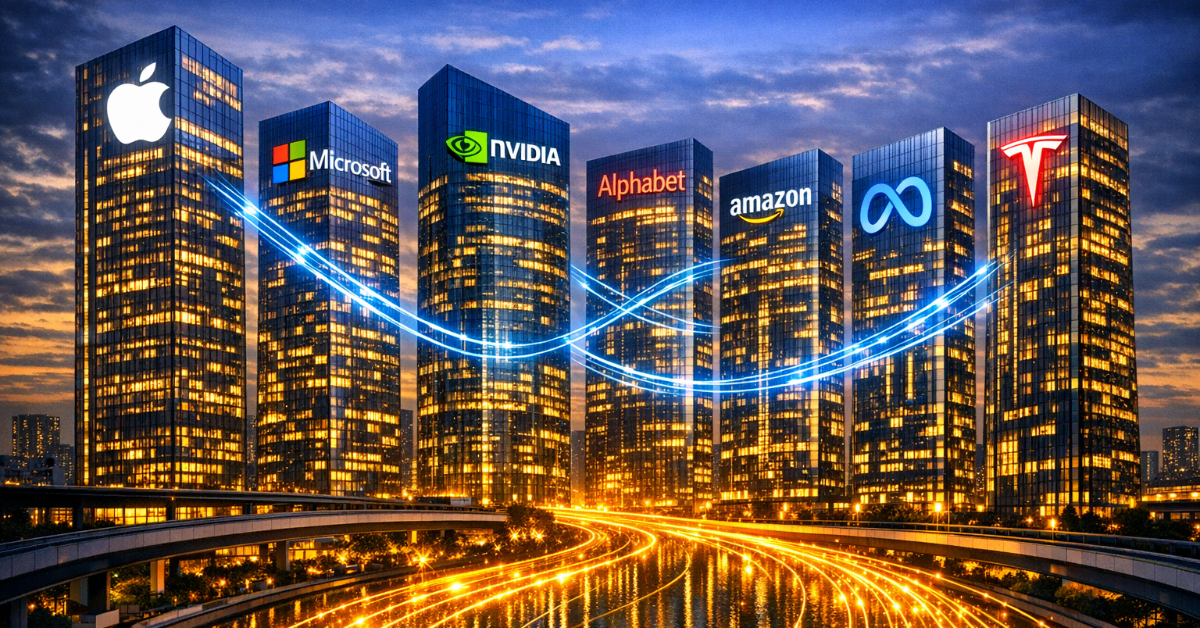
The global equity landscape in early 2026 is defined by a singular, overwhelming structural shift: the transition of artificial intelligence from speculative software experimentation into a massive, capital-intensive industrial build-out. The “Magnificent Seven”—comprising Alphabet, Amazon, Apple, Meta, Microsoft, NVIDIA, and Tesla—have evolved beyond their historical roles as consumer and enterprise platforms to become the architects of the world’s digital railroads. This transformation is underscored by a collective commitment to capital expenditure that is unprecedented in corporate history, with the group projected to invest approximately $650 billion in AI-related infrastructure during the 2026 calendar year alone. This analysis examines the innovations, investment cycles, and competitive positioning of these firms, evaluating the sustainability of their strategies in an environment where the market increasingly demands tangible proof of return on investment.
The dominance of this cohort has morphed into a broader conversation regarding the “AI Hyperscalers,” reflecting their outsized role in providing the compute power necessary for modern civilization. While these companies drove the recovery from the 2022 bear market, the 2026 environment is characterized by a “Great Convergence,” where the rest of the market—sectors like industrials, financials, and healthcare—are finally capturing productivity gains pioneered by these technology giants. However, this shift is accompanied by a transition from “blind faith” in GPU clusters to a rigorous “ROI audit” that is reshaping the S&P 500’s trajectory.
The Macroeconomic Context: Valuations and Concentration Risk
As 2026 unfolds, investors are forced to reconcile expectations with a more mature reality. Current valuations for the Magnificent Seven assume near-perfect execution. The forward price-to-earnings ratio for the largest AI beneficiaries sits approximately 40% above the rest of the U.S. large-cap market, trading at an average of 28 times forward earnings as of late 2025. This premium is rooted in the belief that AI will create new pools of profit large enough to justify the current magnitude of investment, with some models assuming that AI capex could drive a world where operating profits double over the next three to four years.
However, the dominance of a handful of stocks has reshaped the composition of the U.S. equity market in ways that invite comparisons to the “Nifty Fifty” of the 1970s and the dot-com bubble of 2000. The ten largest-cap companies now account for a share of the S&P 500 Index that exceeds levels seen during the 2000 bubble. This concentration creates asymmetric risk; when sentiment shifts in a crowded trade, exits become congested, leading to downside potential that far exceeds traditional risk models.
| Metric | Magnificent Seven (Early 2026) | Dot-Com Era Top 7 (1999 Peaks) |
| Average Forward P/E | 28.0x | 65.6x |
| Highest Sector P/E | 27.0x (Info Tech) | 45.0x+ (Info Tech) |
| Aggregate Profit Margin | ~28% | ~14% |
| S&P 500 Weighting | ~31% | ~25% |
The data indicates that while today’s valuations are elevated, they remain significantly below the absolute peaks of the 1990s, primarily because today’s leaders are generating record-breaking cash flows and profit margins.
NVIDIA: The Arms Dealer and the Rubin Leap
NVIDIA remains the undisputed leader in the hardware layer of AI, maintaining a market valuation exceeding $4.5 trillion in early 2026. Its graphics processing units (GPUs) have become the critical pipeline for training and running large models because they can handle the matrix multiplication and accumulation (MMA) operations required for AI workloads more effectively than general-purpose processors. NVIDIA currently controls between 80% and 92% of the AI accelerator market, a position that appears unshakeable due to its deep software lock-in through the CUDA ecosystem.
The Rubin Architecture: A Fundamental Economic Shift
At CES 2026, CEO Jensen Huang unveiled the “Rubin” platform, the successor to the Blackwell architecture. Rubin represents a fundamental shift in data center economics, promising a 10x reduction in inference token costs. The Rubin GPU, manufactured on TSMC’s 3nm process, features 336 billion transistors and incorporates next-generation HBM4 memory.
| Specification | Blackwell (2025) | Rubin (2026) | Improvement Factor |
| Transistor Count | 208B | 336B | 1.6x |
| Process Node | TSMC 4NP | TSMC N3 | 1 Generation |
| HBM Capacity | 192GB HBM3e | 288GB HBM4 | 1.5x |
| Memory Bandwidth | 8 TB/s | 22 TB/s | 2.75x |
| FP4 Inference | 20 PFLOPS | 50 PFLOPS | 2.5x |
| Interconnect | NVLink 5 | NVLink 6 | 2x Bandwidth |
The Rubin platform uses extreme co-design across six new chips, including the Vera CPU, which features 96 custom ARM cores and 512GB of LPDDR6 memory. This architecture is specifically designed to accelerate “agentic AI” and mixture-of-experts (MoE) models at a massive scale.
Competitive Edge and Market Share Risks
Despite its dominance, NVIDIA faces intensifying competition on two fronts. First, direct challengers like AMD have launched the MI450 Helios platform, which offers 192GB of memory and aggressive pricing to lure cost-sensitive customers. Second, and perhaps more dangerously, NVIDIA’s largest customers—the hyperscalers themselves—are developing custom silicon to reduce their dependency on expensive third-party hardware. While NVIDIA still wins on performance per cluster, it may no longer win on cost per inference.
| Vendor | 2026 Est. AI Accelerator Revenue | 2026 Projected Market Share |
| NVIDIA | 70–85% | |
| AMD | 8–15% | |
| Google (TPU) | 2–5% | |
| AWS (Trainium) | 2–5% | |
| Microsoft (Maia) | 1–4% |
The projections suggest an erosion of NVIDIA’s monopoly toward an oligopoly, where custom silicon captures internal hyperscaler inference workloads.
Microsoft: The Enterprise Agentic Ecosystem
Microsoft’s AI strategy is built upon the dual pillars of its Azure cloud infrastructure and the deep integration of AI into the enterprise workflow through Microsoft 365 and Copilot. In early 2025, the company launched the Agent Development Kit (ADK), which transitioned Copilot from a conversational chatbot into a digital employee capable of autonomous action.
Infrastructure and Capacity Expansion
Microsoft’s capital expenditure reached a record $37.5 billion in a single quarter of late 2025, putting the company on a run-rate for over $140 billion in fiscal year 2026. Much of this spend is directed toward GPUs and the construction of massive data center capacity, including the “Fairwater” supercomputer in Wisconsin, which is designed to scale to two gigawatts. Microsoft’s AI capacity is set to increase by over 80% this year to meet demand signals that the company describes as “supply-constrained”.
Monetization and Revenue Contribution
The investment in AI is already yielding significant revenue. Azure and other cloud services grew 40% in late 2025, with Microsoft Cloud revenue surpassing $49 billion per quarter. Analysts estimate that AI cloud adoption could add up to $25 billion to Microsoft’s revenue by the end of its 2026 fiscal year. Copilot now boasts over 100 million monthly active users, representing a transition from experimental tools to essential productivity software.
| Microsoft Financial Result | Q4 FY 2025 | Q1 FY 2026 |
| Total Revenue | ||
| Azure Growth (cc) | 39% | 39% |
| Cloud Gross Margin | 68% | 68% |
| Commercial RPO |
While revenue growth remains robust, Microsoft’s gross margins have taken a modest hit due to the scaling of expensive AI infrastructure.
Alphabet: Search Resilience and the Cloud Breakthrough
Alphabet emerged as the “undisputed winner” of late 2025, proving that generative AI tools like ChatGPT would not erode Google Search’s dominance. Instead, the company has effectively integrated AI into search, enhancing the user experience while maintaining an 80% market share.
The Gemini 3 Model and AI Adoption
Alphabet’s Gemini platform ended 2025 with 750 million monthly active users, adding 100 million in a single quarter. The success of the Gemini 3 model has fueled a surge in Google Cloud revenue, which jumped 48% to $17.7 billion in the final quarter of 2025. For the first time, Cloud has become the primary engine of structural growth for Alphabet, supported by a $240 billion backlog.
Custom Silicon and Infrastructure Strategy
Alphabet’s capital expenditure is guided to reach between $175 billion and $185 billion in 2026, nearly double its 2025 outlay. This spending is heavily focused on data centers and custom Tensor Processing Units (TPUs). Alphabet’s proprietary TPUs provide a critical competitive edge by reducing reliance on NVIDIA and offering a fourfold cost advantage for inference workloads.
| Alphabet Segment | Q4 2025 Revenue | Operating Income |
| Google Search & Ads | (Consolidated) | |
| Google Cloud | est. | |
| YouTube Ads | N/A | |
| Total Revenue |
The achievement of crossing the $400 billion annual revenue mark highlights how AI and cloud computing are reshaping a company once solely dependent on digital advertising.
Amazon: The $200 Billion Infrastructure Bet
Amazon Web Services (AWS) remains the crown jewel of Amazon’s portfolio, with revenue growth accelerating back to 24% in late 2025. Amazon has unveiled a staggering $200 billion capital expenditure plan for 2026, the highest in corporate history, predominantly allocated to AI infrastructure and its custom silicon strategy.
Custom Silicon: Trainium and Graviton
Amazon’s custom compute engines—the Graviton CPU and Trainium/Inferentia accelerators—ended 2025 with a $10 billion annualized revenue run rate, growing at triple-digit percentages. Trainium3, manufactured on a 3nm process, is now delivering production workloads, with supply expected to be fully committed by mid-2026. Project Rainier, featuring 500,000 Trainium2 chips, powers the majority of inference on Amazon Bedrock, which is used by over 100,000 companies.
Robotics and Fulfillment Efficiency
In the retail segment, Amazon is leveraging AI and robotics to structurally improve margins. The company has deployed over one million warehouse robots, changing the shape of its fulfillment network to support faster delivery and lower per-order labor costs. Same-Day Delivery has expanded to over 1,000 cities, and the Rufus AI shopping assistant has generated nearly $12 billion in incremental annualized sales.
| Amazon Metric | FY 2025 Result | 2026 Guidance |
| Total Net Sales | growth | |
| AWS Revenue | ~ run rate | |
| AWS Operating Margin | 34.5% | 30-35% range |
| Capital Expenditure |
The magnitude of this capital deployment is pressuring free cash flow, which declined 71% year-over-year to $11.2 billion, raising investor concerns about near-term returns.
Meta: From Metaverse to Generative Ad Dominance
Meta Platforms has won investor favor by delivering near-term gains through AI-driven advertising revenue growth. In late 2025, the stock reached all-time highs as shareholders realized that AI was driving a 20%+ increase in ad revenue.
The Llama 4 Model and Open Source Strategy
Released in early 2025, Llama 4 provided the backbone for Meta AI, which is now integrated into WhatsApp, Instagram, and Facebook. Meta’s “managed-source” strategy has cemented its role as the primary alternative to the closed ecosystems of OpenAI and Google. The company is currently developing “Project Avocado,” a series of models aimed at human-level reasoning and advanced multimodal capabilities for 2026.
Quantifiable Ad ROI and Custom Chips
Meta’s AI-driven ad platform, Advantage+, reached a $60 billion annual run rate in 2025. AI-powered video generation tools reached a $10 billion run rate, growing nearly three times faster than overall ads revenue. Furthermore, the company’s custom MTIA chips, along with the Andromeda ads retrieval model, have nearly tripled compute efficiency for ad delivery.
| Meta Financial Item | Q4 2025 Result | YoY Change |
| Ad Revenue | 24% | |
| Ad Impressions | N/A | 18% increase |
| Average Price Per Ad | N/A | 6% increase |
| Consolidated Revenue | 24% |
Despite this success, Meta has signaled a massive jump in capital expenditures for 2026, with estimates nearing $100 billion to $135 billion, which could lead to negative free cash flow in 2027 and 2028.
Apple: The Ecosystem Moat and Capital Restraint
In contrast to its competitors, Apple has opted for a conservative, capital-light strategy, causing market perception to view the company as a stable refuge during periods of AI anxiety. Apple’s capital expenditures were only $12.7 billion in fiscal 2025, less than 10% of Alphabet’s projected 2026 spend.
Apple Intelligence and Siri 2.0
The launch of iOS 26 introduced “Apple Intelligence,” featuring Writing Tools, Image Playground, and a revamped Siri. Adoption of iOS 26 has tracked closely with previous versions, with 74% of iPhones introduced in the last four years running the new software by February 2026. Apple is expected to launch “Siri 2.0″—a more conversational assistant capable of personal data awareness—later in 2026, bridging the gap with rival chatbots.
The M5 Silicon and On-Device Processing
Apple’s primary competitive advantage lies in its vertically integrated M5 silicon, which is optimized for on-device AI acceleration. The M5 chip features an improved 16-core Neural Engine capable of 45+ TOPS (trillions of operations per second) and a 30% increase in unified memory bandwidth to 153 GB/s. This architecture allows larger AI models to run completely on-device, preserving user privacy—a key differentiator for the brand.
| Chip Model | Neural Engine Performance | Memory Bandwidth |
| M4 (2025) | ~38 TOPS | ~118 GB/s |
| M5 (2026 expected) | 45+ TOPS | 153 GB/s |
| M5 Pro/Max (2026) | Enhanced | ~400 GB/s+ |
Apple’s strategy centers on increasing the value of existing hardware without incurring the massive infrastructure costs faced by pure cloud players.
Tesla: Autonomy, SaaS Margins, and the Humanoid Pivot
Tesla is undergoing a fundamental business model transformation, shifting from one-off vehicle sales to a recurring revenue, software-led machine. The company plans to more than double capital expenditures to approximately $20 billion in 2026 to fund its Robotaxi fleet and Optimus humanoid robots.
Robotaxi Roadmap and FSD Subscriptions
Tesla’s Full Self-Driving (FSD) active subscriptions increased 38% to 1.1 million users by early 2026. The company began removing safety monitors from its Robotaxi fleet in Austin, and CEO Elon Musk expects fully autonomous vehicles to operate in up to half of the U.S. by year-end. ARK Invest research suggests that Tesla could price its Robotaxi service as low as $0.25 per mile at scale, significantly undercutting traditional human-driven ride-hail services.
Optimus: The Mass Production Milestone
Management has announced plans to begin mass-producing the Optimus humanoid robot by the end of 2026. To enable this, Tesla will stop production of its Model S and X vehicles, retooling the factory for robotics. While analysts remain cautious about immediate revenue contributions, the potential for Optimus to disrupt industrial automation is a primary driver of Tesla’s $1.5 trillion market capitalization.
| Tesla Business Driver | 2025 Performance | 2026 Target |
| Vehicle Deliveries | 1.6 million units | Recovery focused |
| FSD Revenue Model | One-time + Sub | Subscription-only shift |
| Robotaxi Fleet | ~500 vehicles | 1,000+ scaling monthly |
| Optimus Production | Prototypes | Mass manufacturing |
Tesla’s successful transition to “transportation as a service” could shift its valuation from automotive metrics to software-as-a-service (SaaS) margins that traditional competitors cannot match.
Market Share and Adoption Dynamics in 2026
The landscape of artificial intelligence in 2026 is defined by a shift from “AI Enablers” to “AI Adopters”. Approximately 79% of global enterprises now use AI in at least one business function, and 40% of enterprise applications are forecast to embed task-specific AI agents by the end of the year.
Cloud Infrastructure Market Share
The “Big Three” cloud providers continue to achieve hypergrowth, with Google Cloud narrowing the lead held by AWS and Azure.
| Cloud Provider | Market Share (Q4 2025) | Market Share (Q4 2024) |
| Amazon AWS | 28% | 30% |
| Microsoft Azure | 25% | 20% |
| Google Cloud | 14% | 12% |
| Others (Oracle, IBM, etc.) | 33% | 38% |
Google Cloud’s 48% growth rate is the fastest among the majors, reflecting strong enterprise adoption of the Gemini ecosystem.
Generative AI Model Market Share
OpenAI’s ChatGPT remains the general-purpose leader, but the market for business-focused assistants is fragmenting.
| Generative AI Chatbot | Market Share (Feb 2026) | Primary Model |
| ChatGPT | 60.7% | GPT-5 |
| Google Gemini | 15.0% | Gemini 3 |
| Microsoft Copilot | 13.2% | GPT-5.1/5.2 |
| Claude AI | 4.1% | Claude 4 / Opus 4.6 |
| Perplexity / Others | 7.0% | Various |
Claude AI is currently the fastest-growing chatbot, with 14% quarterly user growth, driven by its reputation for safety and long context windows.
Financial Implications of the AI Infrastructure Sprint
The “Colossal Tech” spending cycle is significantly altering the courses of nations, with the Magnificent Seven’s capex now larger than the GDP of 75% of all countries. However, this investment comes at the cost of near-term financial flexibility.
Free Cash Flow and Debt
Alphabet, Amazon, and Meta have signaled that capital intensity will remain high beyond 2026. Alphabet completed a $45 billion bond sale to fund its infrastructure, while Amazon’s free cash flow sank 71% to $11.2 billion. Meta’s Reality Labs division continues to burn roughly $19 billion annually, though losses are expected to peak in 2026.
Profit Margin Sustainability
Despite the capex surge, the Magnificent Seven maintain aggregate profit margins of approximately 28%, nearly double those of the rest of the S&P 500.
- Alphabet: Reported a profit of $34.5 billion in its latest quarter, supported by cloud growth.
- Amazon: AWS operating margin reached 34.5% in 2025.
- Microsoft: Operating income rose 23% to $34.3 billion.
- Meta: Operating income reached $83.3 billion for the full year 2025.
The market is currently rewarding “tangible AI”—revenue from cloud services and ad efficiency—while punishing “speculative AI” projects with distant revenue horizons.
Evaluation of Strategy for Investors
The Magnificent Seven are no longer a monolithic block. The divergence seen in late 2025 has accelerated into 2026, with Alphabet and Amazon appearing best positioned to lead the charge.
2026 Power Ranking and Consensus
| Company | Wall Street Consensus | Average Upside | Buy Rating % |
| NVIDIA | Strong Buy | 38% | 94% |
| Microsoft | Strong Buy | 36% | 96% |
| Amazon | Strong Buy | 27% | 95% |
| Meta Platforms | Strong Buy | 36% | 90% |
| Alphabet | Buy/Hold | -2% (Near PT) | 88% |
| Apple | Hold/Buy | 11% | 55% |
| Tesla | Hold/Sell | Volatile | ~20% |
Data reflects consensus estimates from early 2026.
Strategic Recommendations
For the “AI Enablement” phase, NVIDIA remains the critical holding, though its “pure-bet” nature makes it the most sensitive to sentiment shifts. For investors seeking “AI Adoption” exposure, Alphabet and Amazon offer more balanced risk-reward profiles due to their massive advertising businesses and retail automation. Meta Platforms is the primary choice for investors focusing on social media engagement and open-source model dominance.
Apple and Microsoft are viewed as “Sector Average” performers for 2026; while their future looks bright, they face higher bars for monetization and internal refresh cycles. Tesla remains the ultimate high-beta play, suitable only for investors with high risk tolerance who believe in the imminent regulatory approval of unsupervised autonomy.
Conclusion: The ROI Audit of 2026
The era of blind faith in AI infrastructure is over. As 2026 progresses, the market’s fixation on raw compute power is being replaced by a laser focus on operational efficiency and software monetization. The Magnificent Seven have successfully built the foundation of a new era, but they must now prove that the “trains” on their digital railroads are carrying profitable cargo. While the technology is undoubtedly transformative, the curse of high expectations means that even modest disappointments in monetization or power supply constraints could trigger outsized market reactions. The winners of this phase will be the firms that can successfully navigate the transition from being “AI Enablers” to becoming the most efficient “AI Adopters” within their own massive ecosystems.