
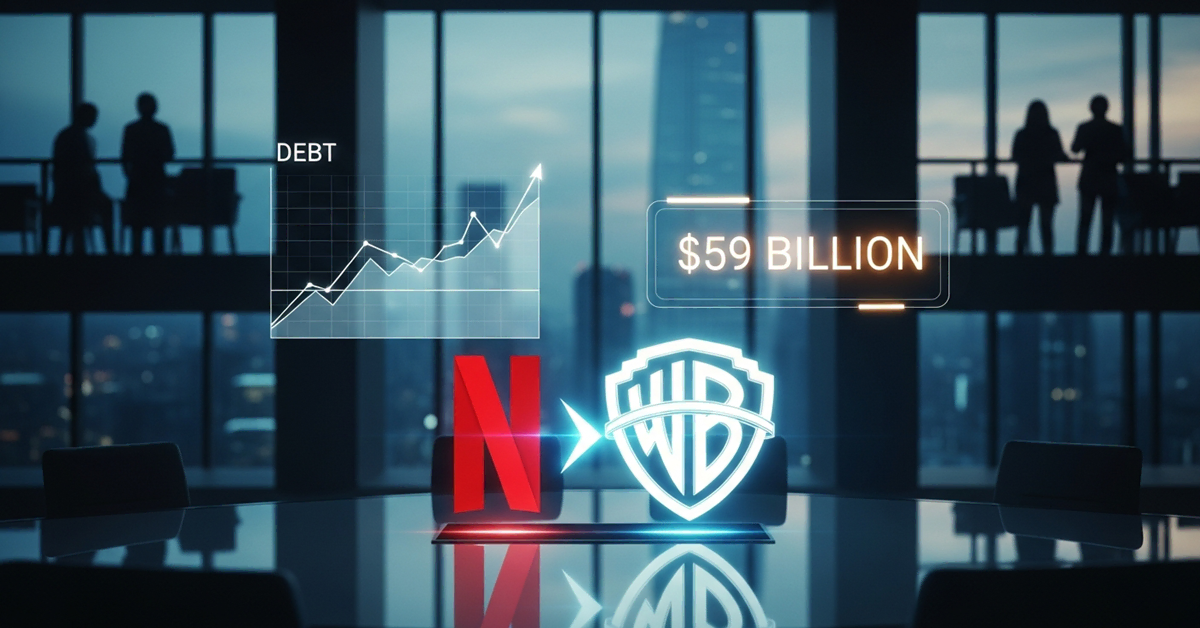
For over a decade, Netflix, Inc. (NASDAQ: NFLX) operated under a disciplined “builder, not buyer” philosophy. However, the 2026 definitive agreement to acquire the “Warner Bros.” streaming and studio division from Warner Bros. Discovery (WBD) marks a seismic shift in corporate strategy. While the merger promises a dominant 30.7% share of the U.S. streaming market, it introduces a significant financial hurdle: a $59 billion bridge loan and committed financing package to fund an all-cash transaction. This white paper analyzes whether the resulting leverage threatens to destroy shareholder value or if Netflix’s cash flow engine can absorb the burden.
Table of Contents
I. The Transaction Structure and Leverage Profile
The deal is valued at an enterprise value of approximately $82.7 billion. Netflix moved from an initial cash-and-stock offer to a simplified all-cash structure in early 2026 to provide certainty to WBD shareholders and accelerate the closing process. To fund this, Netflix has secured roughly $59 billion in new debt from a syndicate of global banks including Wells Fargo, HSBC, and BNP Paribas.
Prior to this acquisition, Netflix’s balance sheet was remarkably healthy. As of late 2025, the company had reduced its debt-to-equity ratio to approximately 0.54, with total debt standing at $14.5 billion. The addition of $59 billion in acquisition-related debt will increase the company’s total indebtedness to over $73 billion. This leap will shift Netflix from a “modest leverage” profile to one of the most debt-heavy entities in the media sector, necessitating a rigorous repayment and integration strategy.
II. Cash Flow: The Primary Defense Against Insolvency
The core argument for Netflix’s ability to manage this debt lies in its robust Free Cash Flow (FCF) generation. In 2025, Netflix exceeded financial objectives, generating significant cash from its 325 million paid memberships. For 2026, the company forecasts revenue between $50.7 billion and $51.7 billion, with operating margins projected at 31.5%.
Management expects the acquisition to be accretive to GAAP earnings per share by the second year. The strategic rationale rests on two financial pillars:
- Cost Synergies: Netflix aims to realize at least $2 billion to $3 billion in annual cost savings by the third year through the consolidation of streaming infrastructures and studio operations.
- Content Efficiency: By acquiring the Warner Bros. library (including HBO and DC Studios), Netflix reduces its long-term reliance on high-cost third-party licensing and “hit-or-miss” original production spending.
III. Risks to Shareholder Value
Despite the projected synergies, the “Debt Dilemma” presents three primary risks that could erode shareholder value:
1. Interest Rate Sensitivity: While Netflix maintains an investment-grade credit rating, the sheer volume of a $59 billion loan exposes the company to interest rate fluctuations. Even a 1% shift in the cost of debt could result in hundreds of millions in additional annual interest expense, potentially eating into the capital allocated for stock buybacks.
2. Integration and Execution Risk: Merging the corporate cultures of a Silicon Valley tech giant and a legacy Hollywood studio is notoriously difficult. If the anticipated $3 billion in synergies fail to materialize, or if the transition to an ad-supported model (forecasted to double revenue in 2026) stalls, the debt service coverage ratio could tighten dangerously.
3. Opportunity Cost: The suspension of share buybacks to prioritize debt repayment is a direct hit to immediate shareholder returns. Investors who valued Netflix for its “clean” balance sheet may pivot to competitors with less encumbered cash flows.
IV. Comparative Market Position
The acquisition effectively neutralizes one of Netflix’s largest threats by absorbing HBO Max’s 10.9% market share. Pro-forma estimates suggest the combined entity will dwarf Disney+ and Amazon Prime Video in terms of engagement hours. This scale provides Netflix with immense pricing power, which is the company’s most potent tool for accelerating debt retirement. In 2025, price increases in North America and Western Europe proved that Netflix’s “must-have” status remains intact despite market saturation.
V. Conclusion
Netflix’s move for Warner Bros. is a high-stakes gamble that replaces organic growth with aggressive consolidation. The $59 billion debt load is massive, but it is supported by a company that generates over $12 billion in annual free cash flow and maintains high operating margins. If Netflix successfully integrates the Warner library and achieves its synergy targets, the increased “Average Revenue per User” (ARM) and reduced churn should prevent the destruction of shareholder value. However, the margin for error has narrowed significantly; for the first time in its history, Netflix’s primary challenge is not just winning the “streaming wars,” but managing the massive balance sheet that won them.