
Table of Contents
Executive Summary: The Bedrock of the Energy Transition
As of March 2026, NextEra Energy, Inc. (NYSE: NEE) stands at a pivotal juncture in its corporate history. While the broader utility sector has grappled with the twin pressures of volatile interest rates and shifting federal energy policies, NextEra has fortified its position as the premier “growth utility” in North America. This strength is underpinned by its dual-engine strategy: the regulated reliability of Florida Power & Light (FPL) and the aggressive renewable expansion of NextEra Energy Resources (NEER).
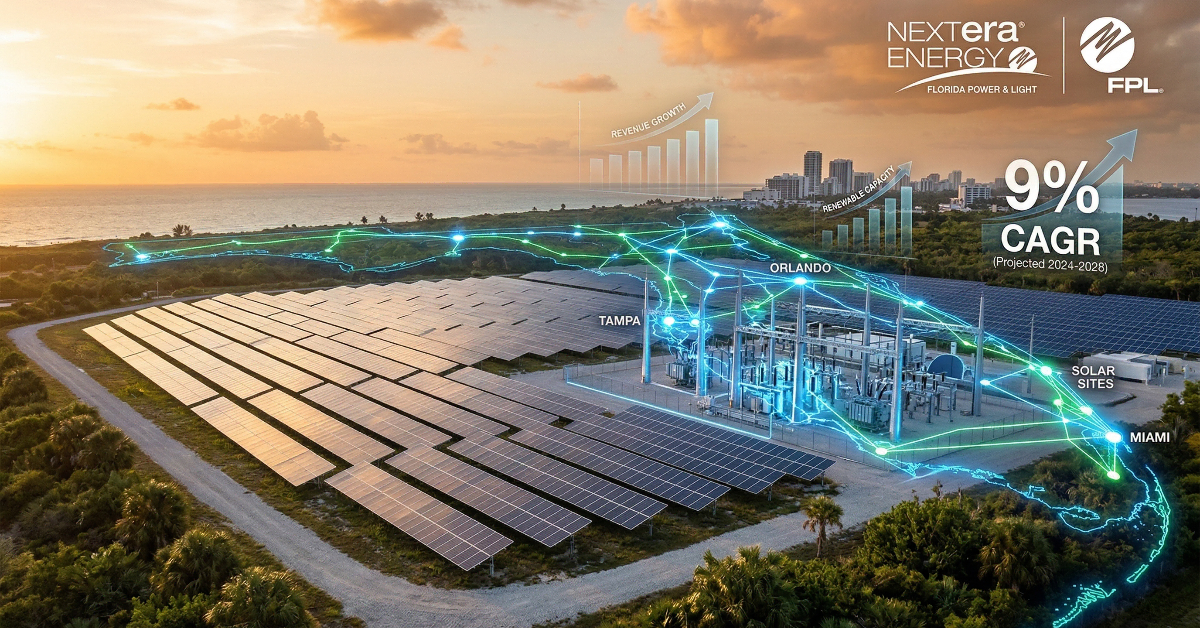
The primary catalyst for 2026 and beyond is the newly implemented 2026–2029 FPL Rate Agreement. This four-year settlement, approved by the Florida Public Service Commission (FPSC) in late 2025, provides a transparent, predictable “floor” for earnings. With an authorized Regulatory Return on Equity (ROE) of 10.95% and a projected 9% Compound Annual Growth Rate (CAGR) in regulatory capital, FPL is positioned to deploy approximately $90 billion to $100 billion in capital through 2032.
This report evaluates the strategic implications of the rate settlement, the demographic “Florida Surge” driving load growth, and the company’s valuation in an era of surging AI-driven electricity demand.
I. The 2026–2029 Rate Agreement: Constructing the Earnings Floor
On January 1, 2026, FPL transitioned into a new regulatory regime that will define its financial trajectory for the next four years. The settlement represents a sophisticated balance between shareholder returns and ratepayer affordability—a balance that has historically allowed NextEra to maintain its “regulatory goodwill” in Tallahassee.
Key Financial Components
The settlement authorizes a series of base rate adjustments designed to recover the massive capital investments FPL is making in grid hardening and solar integration:
- 2026 Base Increase: An annualized retail base revenue increase of $945 million.
- 2027 Base Increase: An additional $705 million starting January 1, 2027.
- SoBRA Mechanism: For 2028 and 2029, FPL will utilize the Solar and Battery Base Rate Adjustment (SoBRA) mechanism, allowing for incremental rate increases as specific solar and storage projects are placed into service.
Authorized Returns and Capital Structure
One of the most attractive features for investors is the 10.95% authorized ROE, which sits within a “trigger” range of 9.95% to 11.95%. This is significantly higher than the national average for regulated utilities, which typically hovers around 9.5% to 9.8%.
- Equity Ratio: The agreement maintains a strong 59.6% equity ratio, providing FPL with a robust balance sheet to fund its capital program without over-leveraging.
- Rate Stabilization: A $1.155 billion rate stabilization mechanism (using deferred tax liabilities) gives management the flexibility to smooth earnings and maintain the earned ROE within the authorized band even during years of high operational expense or weather-related volatility.
II. Investment Angle: The 9% CAGR in Regulatory Capital
While many utilities struggle to find meaningful ways to deploy capital, FPL is essentially “starved” for it due to Florida’s explosive growth. The 2026–2029 period marks a shift from maintenance-heavy spending to modernization and decarbonization.
Capital Deployment Strategy
FPL’s projected 9% CAGR in regulatory capital employed is not merely a reflection of inflation; it is driven by three distinct pillars:
- Grid Hardening & Resiliency: Florida remains the most hurricane-prone state in the U.S. FPL is investing billions in undergrounding power lines and “smart grid” technology. In 2025 alone, smart-grid devices helped FPL customers avoid an estimated 2.7 million outages.
- Solar Expansion: FPL’s “30-by-30” plan has evolved into an even more ambitious target. By the end of 2029, solar is expected to comprise nearly 20% of FPL’s generation mix, up from roughly 9% in 2024.
- Battery Storage: To manage the intermittency of solar, FPL is deploying utility-scale battery storage at a pace that dwarfs its peers, creating a “virtual peaker plant” effect that reduces the need for expensive gas-fired generation.
The Affordability Metric: “Regulatory Goodwill”
A critical risk for any regulated utility is “rate shock.” NextEra has mitigated this by ensuring that despite the rate hikes, FPL remains one of the most affordable providers in the nation.
- Customer Impact: The average residential bill increased by approximately $2.50 per month in January 2026.
- National Comparison: When adjusted for inflation, FPL’s typical bill is 20% lower than it was 20 years ago. Current rates remain 20% to 25% below the national average. This affordability is the “social license” that allows the FPSC to approve high ROEs and massive capital plans without significant political blowback.
III. The “Florida Surge”: Demographic and Economic Tailwinds
NextEra Energy is, at its core, a bet on the continued economic dominance of the State of Florida. The “Florida Surge” is not a temporary post-pandemic blip but a structural shift in American migration.
New Customer Growth
FPL expects to add more than 335,000 new customer accounts between 2026 and 2029. This growth is equivalent to adding a city the size of Orlando to the grid every few years.
- Income Migration: Florida leads the nation in “wealth migration.” Higher-income residents typically consume more electricity through larger homes, electric vehicle (EV) charging, and high-end HVAC systems.
- Corporate Relocations: The shift of financial and tech firms to the “Silicon Beach” (Miami/Fort Lauderdale) and West Palm Beach areas is driving industrial and commercial load growth that outpaces the national average by a factor of 3x.
AI and Large Load Demand
Beyond residential migration, FPL is seeing an unprecedented surge in Large Load interest, particularly from data center developers.
- FPL has reported over 20 GW of large load interest in its pipeline, with approximately 9 GW in advanced discussions.
- For investors, every 1 GW of data center load translates to roughly $2 billion in incremental capital expenditure for transmission and generation. FPL’s ability to offer clean energy (via solar) and high reliability makes it a primary destination for the “AI Buildout.”
IV. The Synergy of NextEra Energy Resources (NEER)
While FPL provides the stable “floor,” NEER provides the “ceiling” for growth. NEER is the world’s largest generator of renewable energy from the wind and sun.
The 30 GW Backlog
As of early 2026, NEER maintains a development backlog of approximately 30 GW. The strategy here has shifted from simply “building renewables” to “building integrated energy solutions.”
- Data Center Hubs: NEER is pursuing a “Data Center Hub” strategy, aiming to place 15 GW of new generation near data center clusters by 2035.
- Nuclear Recommissioning: The 2026 plan includes the high-profile recommissioning of the Duane Arnold nuclear plant, supported by a long-term Power Purchase Agreement (PPA) with Google. This highlights NEER’s ability to provide 24/7 carbon-free “firm” power, which is the “holy grail” for hyperscalers.
V. Financial Outlook and Dividend Growth
NextEra Energy’s financial guidance remains the most consistent in the utility sector. The company has a track record of meeting or exceeding its targets regardless of the macroeconomic environment.
Earnings per Share (EPS) Targets
For the 2026 fiscal year, management has set an adjusted EPS range of $3.92 to $4.02.
- Growth Trajectory: The company expects an 8%+ CAGR in adjusted EPS through 2032.
- Operational Efficiency: FPL’s non-fuel O&M (Operations & Maintenance) costs per customer are 71% lower than the industry average. This “relentless” focus on efficiency is what allows the company to reinvest in capital while keeping bills low.
Dividend Policy
NextEra remains a “Dividend Aristocrat” in the making.
- 2026 Dividend: The company is targeting roughly 10% growth in dividends per share through 2026.
- Post-2026 Outlook: From 2027 through 2028, dividend growth is expected to moderate slightly to 6% annually, aligning more closely with the 8% EPS growth target to maintain a healthy payout ratio.
| Metric | 2025 (Actual/Est) | 2026 (Target) | 2027-2029 (Projected) |
| Adjusted EPS | $3.71 | $3.92 – $4.02 | 8%+ CAGR |
| Dividend Growth | 10% | 10% | 6% CAGR |
| FPL Regulatory Capital | $70B (Base) | +$10B+ Annual Spend | $90B – $100B Total (thru 2032) |
| Authorized ROE | 10.8% | 10.95% | 10.95% |
VI. Risk Assessment: Challenges to the Thesis
No investment is without risk, and NextEra faces three primary headwinds:
- Political and Legislative Scrutiny: The Florida Senate Bill 126 (SB 126), which takes effect in July 2026, introduces new benchmarking requirements for the PSC. While FPL’s efficiency metrics are world-class, increased transparency and potential reforms to the PSC’s structure could create a more contentious regulatory environment in the next decade.
- Cost of Capital: A “higher for longer” interest rate environment increases the cost of debt for NextEra’s $75B+ five-year investment plan. While FPL can recover these costs through rates, NEER’s project returns may face compression if they cannot re-price PPAs quickly enough.
- Fuel Volatility: Although FPL is shifting toward solar, natural gas still accounts for approximately 70% of its generation mix in 2026. A spike in global LNG prices would be passed through to customers, potentially eroding the “affordability gap” that FPL uses to maintain regulatory goodwill.
VII. Conclusion: A Core Infrastructure Holding
NextEra Energy is no longer just a utility; it is a technology-enabled infrastructure company. The 2026–2029 Rate Agreement has effectively “derisked” the next four years of the FPL story, providing a guaranteed return on a massive, growing capital base.
The combination of Florida’s 335,000+ new customers and the AI/Data Center power surge creates a demand environment that is essentially decoupled from broader U.S. GDP trends. While the stock often trades at a premium P/E ratio compared to peers like Duke Energy (DUK) or Southern Company (SO), this premium is justified by its superior EPS growth and its dominant position in the renewable energy transition.
Investor Verdict: NextEra Energy remains a “Core Buy” for long-term investors seeking a blend of 10% dividend growth and high-single-digit capital appreciation, anchored by the most favorable regulatory environment in the United States.