
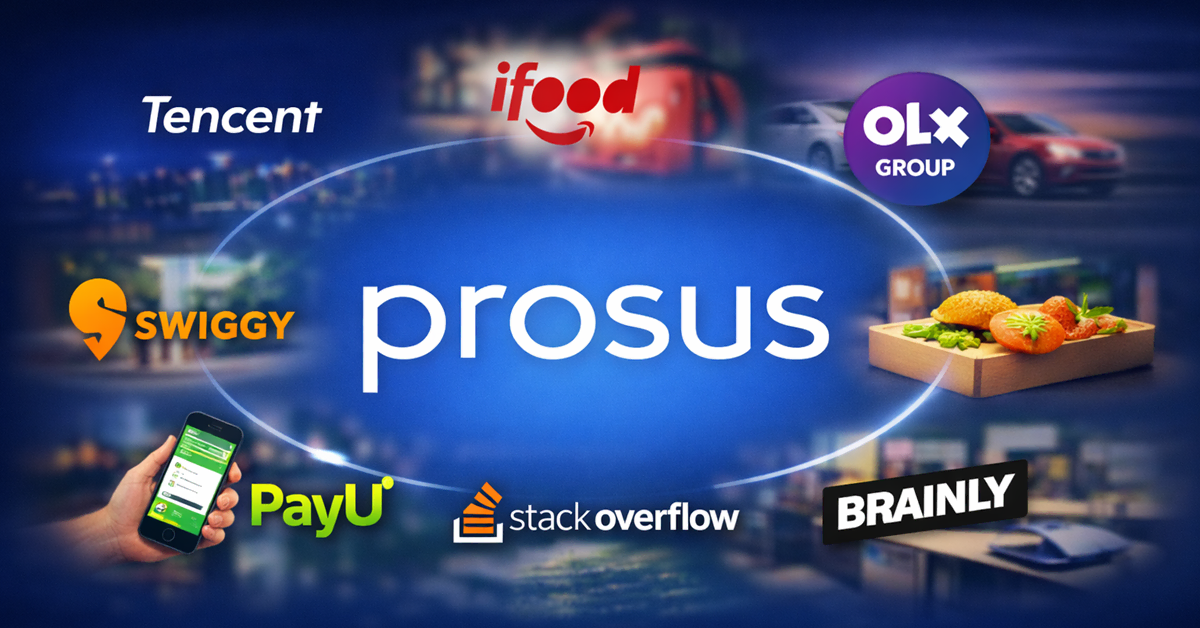
Prosus NV, the global consumer internet group and one of the largest technology investors in the world, has undergone a fundamental transformation in its operational and capital allocation strategies. Historically viewed primarily as a holding vehicle for its massive stake in Tencent, Prosus has successfully pivoted toward operational profitability in its consolidated e-commerce portfolio. This report analyzes the group’s profitability trajectories and corporate management efficacy to determine its investment potential for 2026.
Table of Contents
Profitability Analysis: The E-commerce Pivot
The defining characteristic of Prosus’s recent financial performance is the transition of its e-commerce segments from loss-making growth engines to profitable enterprises. As of the 2025/2026 financial cycle, the group has moved beyond “peak investment” and is now harvesting margins across its core verticals: Classifieds, Food Delivery, and Payments/Fintech.
E-commerce Segment Performance
| Vertical | Key Asset | Performance Trend (FY2025-FY2026) |
|---|---|---|
| Classifieds | OLX Group | High-margin growth (35%+ EBIT margins) driven by motors and real estate. |
| Food Delivery | iFood | Dominant market position in Brazil with accelerating profitability (17% EBIT margin). |
| Payments & Fintech | PayU | Strong revenue growth in India; narrowing losses with a path to break-even in 2026. |
| Online Travel | Despegar | Recent $1.7 billion acquisition contributing to regional ecosystem synergy in LatAm. |
For the first half of the 2026 financial year, Prosus reported a 22% increase in consolidated e-commerce revenue to $3.6 billion. More importantly, adjusted EBITDA for the e-commerce portfolio grew by 70% to $530 million. Management has provided guidance for a full-year 2026 e-commerce adjusted EBITDA of at least $1.1 billion, representing a significant leap from the $443 million achieved in FY2025.
Corporate Management and Capital Allocation Strategy
Under the leadership of CEO Fabricio Bloisi, corporate management has adopted “The Prosus Way,” a management model emphasizing disciplined execution, AI-first integration, and aggressive value unlocking. The strategy for 2026 is centered on three pillars:
- The Open-Ended Buyback Program: Since June 2022, Prosus has utilized its Tencent dividends and small tranches of Tencent share sales to repurchase its own stock. This program has successfully narrowed the “NAV discount” (the gap between the stock price and the value of its underlying assets) and increased the per-share exposure to Tencent’s earnings.
- AI-Driven Operational Efficiency: Management has deployed over 20,000 AI agents across its portfolio companies. This is not merely cosmetic; it has led to tangible improvements in customer acquisition costs and logistics optimization, particularly within iFood and OLX.
- Portfolio Rationalization: The group has become a disciplined seller, divesting non-core or underperforming assets such as its stakes in Meituan, Trip.com, and various Edtech units to focus capital on high-conviction regional ecosystems in India and Latin America.
Valuation and Net Asset Value (NAV)
The investment case for Prosus remains tethered to its NAV. As of late 2025, the Net Asset Value per share is estimated at approximately €78.7. With the stock trading at a significant discount to this figure, the buyback program acts as a continuous accretive force. Management’s goal for 2026 is to double e-commerce revenue and triple e-commerce EBITDA compared to 2024 levels, which would fundamentally re-rate the “non-Tencent” part of the portfolio from a drag on valuation to a value driver.
2026 Stock Investment Potential
Looking toward 2026, Prosus presents a compelling “GARP” (Growth at a Reasonable Price) opportunity. The investment potential is supported by several catalysts:
1. Structural Narrowing of the Discount: As the e-commerce portfolio generates meaningful free cash flow (independently of Tencent), the market is likely to reward Prosus with a higher valuation multiple, recognizing it as an operating company rather than just a proxy for Chinese tech.
2. Tencent’s Resilience: Tencent continues to provide a rock-solid foundation of earnings and dividends, which fuels the Prosus buyback machine.
3. Indian Market Upside: The successful IPO of Swiggy and the growth of PayU India position Prosus as one of the best vehicles for European investors to gain exposure to the Indian digital economy.
Investment Risks: Potential headwinds for 2026 include geopolitical tensions affecting Tencent’s valuation in China and the execution risk associated with integrating large acquisitions like Just Eat Takeaway.com and Despegar.
In conclusion, Prosus enters 2026 with its strongest operational balance sheet in history. The combination of a disciplined management team, a self-funding buyback program, and a portfolio that has finally reached the “profitability plateau” suggests significant upside potential for long-term investors.