
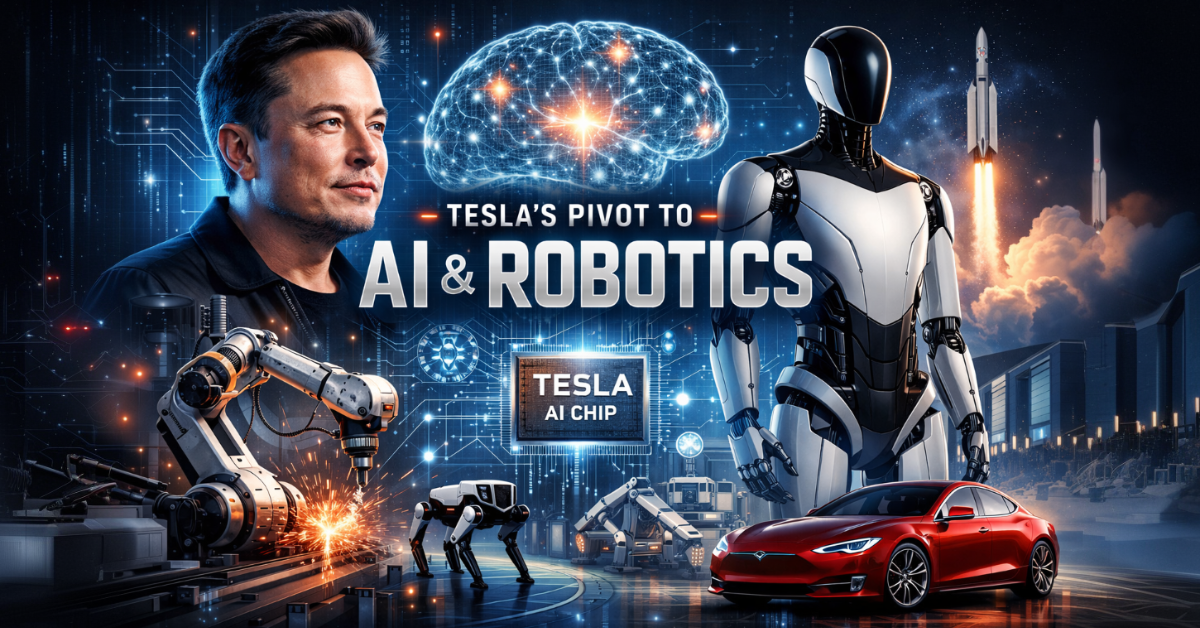
Tesla, Inc. (NASDAQ: TSLA) is undergoing a significant strategic transformation, shifting its core value proposition from being primarily an electric vehicle (EV) manufacturer to a leader in Artificial Intelligence (AI) and robotics. This paper analyzes the company’s ambitious roadmap, recent product and service developments, and the probability of meeting the lofty expectations currently baked into its valuation.
Table of Contents
The Evolving Roadmap: From EVs to Sustainable Abundance
Tesla’s historical “Master Plans” have guided its expansion, but the most recent vision, exemplified by “Master Plan Part IV,” clearly elevates AI and robotics to the forefront. While EV manufacturing remains the foundational cash-generating segment, its long-term role is increasingly viewed as a platform for deploying advanced AI. The roadmap is now centered on achieving “sustainable abundance” by unifying hardware and software at a massive scale.
- Vehicle Autonomy (Full Self-Driving – FSD and Robotaxis): The immediate pivot involves commercializing Full Self-Driving technology. The company continues to roll out FSD updates, with recent data suggesting substantial improvements in miles traveled between interventions. The development is leading directly to the launch of an autonomous ride-hailing service, often referred to as ‘Robotaxi,’ and the dedicated ‘Cybercab’ vehicle. This transition is expected to unlock a recurring, high-margin software and service revenue stream, dramatically changing the company’s profitability structure.
- Humanoid Robotics (Optimus): The Optimus project, a general-purpose, bi-pedal autonomous humanoid robot, is a critical component of the future roadmap. It is designed to perform repetitive, unsafe, or boring tasks, essentially addressing labor shortages and expanding Tesla’s market potential beyond transport and energy. Analyst commentary suggests Optimus and other AI ventures could account for the vast majority of the company’s long-term valuation.
- Energy Storage and Generation: Alongside vehicles, Tesla’s energy division, including Powerwall, Powerpack, and Megapack, continues to scale. Recent launches like the Megapack 3 and Megablock focus on reducing the cost and time of large-scale battery installations. These products are being integrated and optimized by AI services like ‘Autobidder’ and ‘Virtual Power Plants,’ reinforcing the company’s mission in sustainable energy.
Recent New Products and Services: The AI and Service Focus
Recent developments underscore the move away from viewing Tesla purely as an automotive volume play:
- Robotaxi/Cybercab Launch: Confirmed testing of fully driverless and passenger-free Robotaxis in cities like Austin, Texas, is the most direct indicator of progress toward the FSD monetization vision. This is a critical near-term catalyst for investor sentiment.
- Software/Service Business Model Expansion: Increased focus on FSD software subscription and one-time purchase revenue. The success of Robotaxi will be key to increasing the adoption rate of FSD, which historically has been low.
- Affordable Vehicle Options: The introduction of more affordable variants, such as the Model 3 and Model Y Standard, is a defensive and expansionary move to maintain market share amid intense EV competition, especially from Chinese manufacturers. The anticipated “Model 2” (or similar mass-market vehicle) is a future volume play intended to scale the hardware base for AI services.
- Megapack 3 and Megablock: These new utility-scale energy storage products simplify deployment and scale, directly supporting the high-growth energy segment.
Meeting Investor Expectations: An Analysis of the Bull and Bear Case
The Bull Case: Transformational Growth and AI Multiples
Investors are increasingly valuing Tesla not on current automotive delivery figures, which are experiencing near-term softness, but on its projected future as an AI and robotics giant. This is evidenced by stock movements driven by Robotaxi and AI updates, rather than quarterly vehicle delivery results. Key to the bull case is the belief that Tesla will successfully transition from a cyclical auto company to a high-margin technology platform. Bullish analysts foresee a potential market valuation in the trillions, justifying this by:
- FSD/Robotaxi Monetization: Full autonomy unlocks the potential for a massive, high-margin, scalable ride-hailing network globally, which is essentially a logistics and software business.
- Optimus Commercialization: The successful scaling of Optimus would open up an entirely new industrial market for autonomous labor, which some estimate could exceed the automotive business in value.
- Vertical Integration: Tesla’s full vertical stack—from custom AI chips (FSD Chip), Dojo supercomputer, and software to physical hardware—provides an execution advantage over competitors.
The Bear Case: Execution Risk and Premium Valuation
Despite the optimism, meeting current investor expectations remains a considerable challenge. The stock’s valuation, often exceeding traditional auto and even tech industry multiples, is largely predicated on the successful execution of projects that have not yet reached maturity or mass-market commercialization. Core risks include:
- Regulatory and Safety Hurdles: The global rollout of unsupervised, fully autonomous vehicles faces significant regulatory, legal, and safety hurdles that vary by region, which could slow down the Robotaxi deployment timeline.
- Competition: The EV market is intensely competitive, with new entrants and established automakers eroding Tesla’s first-mover advantage, particularly on range and price. In autonomy, competitors like Waymo are already operating commercial driverless services in some areas, potentially positioning Tesla as a late-mover in commercial robotaxis.
- Sustained Profitability and Margin Pressure: Operating income and profit margins have faced pressure from increased operating expenses (especially R&D for AI/Robotics) and price adjustments to maintain sales volume. The company must successfully monetize FSD/Robotaxi to offset these pressures.
Conclusion
Tesla’s roadmap is unequivocally ambitious, centered on the transformative potential of Full Self-Driving, Cybercab, and Optimus. The question of meeting investor expectations is less about the traditional automotive growth rate and more about the successful and timely transition to a dominant AI and robotics platform. If Tesla can scale its FSD/Robotaxi and Optimus programs into high-margin revenue streams on schedule, the current elevated investor expectations will likely be met and potentially exceeded. However, any significant delay in achieving true unsupervised autonomy, combined with mounting competitive pressure in its core EV business, poses a severe risk to its premium valuation, which is currently less grounded in near-term fundamentals and more in a futuristic vision of “sustainable abundance.”