
Table of Contents
Executive Summary: The Harvest Begins
Texas Instruments (NASDAQ: TXN) is currently executing one of the most significant strategic pivots in the semiconductor industry’s history. For the better part of the last five years, TI has been defined by its aggressive, some would say “painful,” capital expenditure (CapEx) cycle. While the broader semiconductor market chased the ephemeral highs of the post-pandemic boom and subsequent AI gold rush, TI focused on the foundational: capacity.
As of early 2026, the narrative has shifted. The era of multi-billion dollar “drag” on Free Cash Flow (FCF) is ending, giving way to what management terms the “harvest phase.” With CapEx projected to fall from a peak of nearly $4.6 billion in 2025 to a normalized range of $2 billion–$3 billion in 2026, the company is positioned to unlock massive shareholder value. Central to this thesis is the company’s stated goal of achieving $8.00+ in Free Cash Flow per share by the end of 2026.
This report deep-dives into the three pillars of the TI bull case: the normalization of capital spending, the structural cost advantage of 300mm wafer production, and the resurgence of the industrial and automotive end-markets.
I. The “Post-CapEx” Transition: From Investment to Inflow
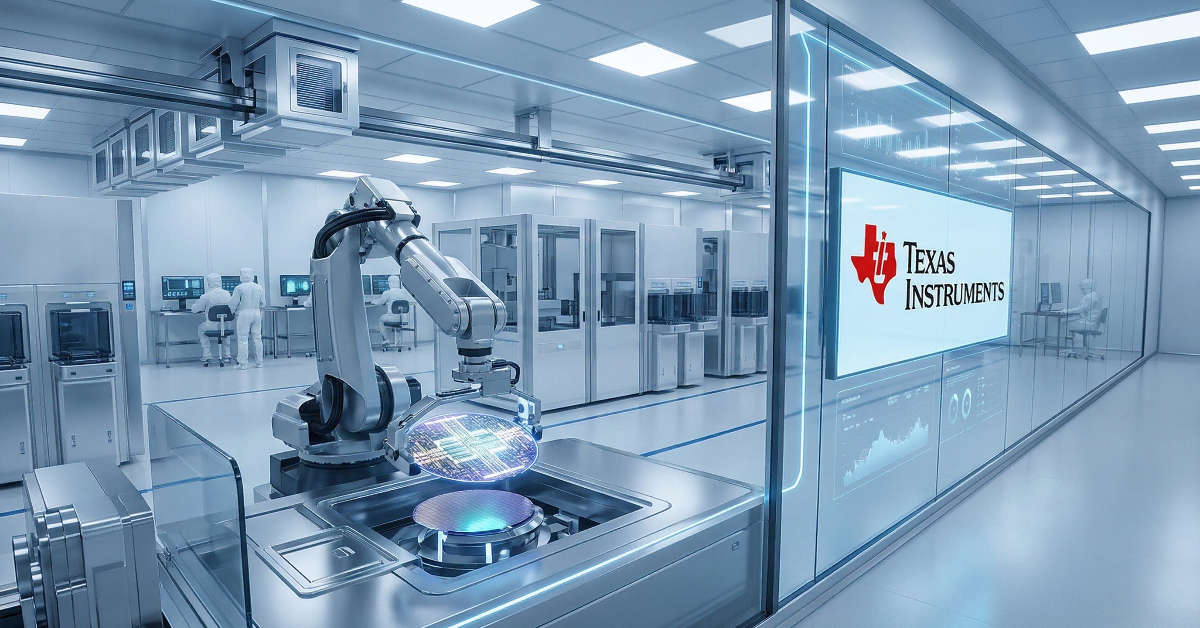
For years, Texas Instruments’ financial statements were a source of frustration for short-term oriented investors. While revenue remained relatively stable, FCF was consistently pressured by a massive infrastructure build-out. Between 2022 and 2025, TI invested heavily in its “geographic diversity” and internal capacity, specifically building out its 300mm fabrication facilities in Sherman and Richardson, Texas, and Lehi, Utah.
The Peak of the Cycle
In 2025, CapEx hit a staggering $4.6 billion, representing nearly 26% of the company’s $17.68 billion in revenue. For a company that historically prided itself on being a cash-generation machine, this was a radical departure. The pressure from activist investors, most notably Elliott Investment Management in 2024, catalyzed a more disciplined communication strategy regarding these outlays.
The 2026 Capital Management update has finally provided the relief the market sought. By guiding 2026 CapEx down to $2B–$3B, TI is essentially turning a massive “cash valve” back toward the shareholders.
Why the Transition Matters Now
The semiconductor industry is notoriously cyclical. TI’s decision to build capacity during the downturn of 2023-2024 means they are now entering 2026 with:
- Fully outfitted facilities: Ready to scale without significant new construction costs.
- High Inventory Levels: Targeting 150-250 days of inventory, allowing TI to capture market share immediately as industrial and automotive demand rebounds, while competitors are still dealing with lead-time lags.
II. The $8.00 North Star: 2026 Free Cash Flow Analysis
Management has been unusually explicit about its “True North”: the growth of Free Cash Flow per share. The target for 2026 is a minimum of $8.00 per share, a figure that many analysts previously viewed as overly optimistic.
The Mathematics of $8.00
To understand the path to $8.00, we must look at the components of the FCF equation. With approximately 913 million shares outstanding, an $8.00 FCF/share target requires a total Free Cash Flow of approximately $7.3 billion.
| Component | 2025 Actual (Approx) | 2026 Projection (Target) |
| Revenue | $17.68 B | $19.5 B – $20.5 B |
| Cash Flow from Ops (OCF) | $7.15 B | $9.5 B – $10.0 B |
| Capital Expenditure (CapEx) | $4.60 B | $2.50 B (Midpoint) |
| Total Free Cash Flow | $2.94 B | ~$7.3 B |
| FCF Per Share | $3.22 | $8.00+ |
Drivers of the Jump
The nearly 150% increase in FCF per share from 2025 to 2026 is not merely a result of lower spending; it is a “double-whammy” effect.
- Top-line Recovery: Industrial and automotive sectors, which represent over 60% of TI’s revenue, have shown a clear “U-shaped” recovery starting in Q4 2025.
- Operating Leverage: As 300mm fabs reach higher utilization rates, the fixed costs are spread over a larger volume of chips, dramatically increasing the cash flow from operations.
- CHIPS Act Benefits: TI is expected to receive significant investment tax credits and direct funding (up to $1.6B over multiple years), which acts as a direct offset to CapEx, effectively boosting the FCF metric.
III. The 300mm Advantage: A Structural Moat
While capacity is about volume, 300mm is about efficiency. Most of TI’s competitors in the analog space still rely on 200mm (8-inch) wafers. TI’s shift to 300mm (12-inch) is not just a marginal improvement—it is a structural game-changer.
The 40% Cost Reduction
A 300mm wafer has more than 2.25 times the surface area of a 200mm wafer. However, the cost to process the larger wafer is nowhere near 2.25 times higher. The math is simple but devastating for competitors:
- Dies per Wafer: A standard analog chip might yield ~140 dies on a 200mm wafer. On a 300mm wafer, that same chip yields over 310 dies.
- Cost per Die: Management has confirmed that an unpackaged chip built on 300mm costs approximately 40% less than one built on 200mm.
Margin Expansion and Pricing Power
This 40% cost advantage provides TI with two lethal strategic options:
- Price Aggression: TI can lower prices to win long-lived “sockets” in automotive and industrial designs while still maintaining higher margins than its competitors.
- Margin Capture: In a stable pricing environment, TI’s gross margins will naturally trend back toward the 65-70% range as 300mm production becomes the majority of the mix (targeted to be >80% of analog revenue by 2027).
Furthermore, by internalizing assembly and test operations (aiming for >90% internalization by 2030), TI is stripping away the margins previously paid to third-party foundries and OSATs (Outsourced Semiconductor Assembly and Test).
IV. End-Market Dynamics: Industrial, Auto, and the Data Center Surprise
TI’s revenue is heavily concentrated in high-quality, long-life cycles. In 2025, 75% of revenue came from Industrial, Automotive, and Data Centers.
1. The Industrial Rebound
After a period of inventory digestion that lasted nearly 18 months, industrial customers began placing significant orders again in late 2025. TI’s broad portfolio of over 80,000 products makes it the “GDP of the Industrial Economy.” As factory automation and “Industry 4.0” trends accelerate, TI’s analog-to-digital converters and power management chips are the primary beneficiaries.
2. Automotive: Electrification and ADAS
Despite the “EV cooling” headlines of 2024, the semiconductor content per vehicle continues to rise. Advanced Driver Assistance Systems (ADAS) and the shift toward 800V architectures in electric vehicles require more sophisticated power management—TI’s specialty. Automotive revenue grew 6% in 2025 and is expected to accelerate in 2026.
3. The Data Center Surge
The most surprising growth vector for TI has been the Data Center market, which saw a 70% year-over-year increase in the most recent quarter. While NVIDIA provides the “brains” (GPUs), TI provides the “muscle”—the power management systems required to deliver massive amounts of electricity to those GPUs efficiently. This segment is no longer a peripheral part of TI’s business; it is a core growth driver.
V. Strategic Integration: The Silicon Labs Acquisition
In a move that surprised the market in early 2026, TI announced the acquisition of Silicon Labs. This acquisition is highly complementary, particularly in the wireless connectivity and IoT (Internet of Things) space.
By integrating Silicon Labs’ low-power wireless expertise with TI’s massive sales channel and 300mm manufacturing power, TI is effectively sealing its dominance in the “Embedded Processing” space. This move addresses one of the few historical criticisms of TI: that its wireless connectivity portfolio was not as robust as its analog power portfolio.
VI. Risks to the Thesis
No investment is without risk. For TI, the primary concerns are:
- Geopolitical Friction: While TI has the most diversified “Western” manufacturing footprint, a significant portion of its sales still goes into the China market (which grew >25% in 2025). Any escalation in trade tariffs could disrupt these flows.
- Utilization Headwinds: If the global economy enters a sharp recession, TI’s massive new fabs will sit underutilized. In the chip world, underutilization is the ultimate margin killer due to high fixed depreciation costs.
- Inventory Obsolescence: While TI focuses on “long-lived” parts, holding 200+ days of inventory carries the risk of write-downs if technology shifts faster than anticipated.
VII. Conclusion: The Patient Investor’s Reward
Texas Instruments has spent the last four years being the “adult in the room”—investing for 2030 while the rest of the world worried about the next quarter. As we move through 2026, the fruits of that labor are becoming visible.
With CapEx normalizing, the $8.00 FCF per share target looks not only achievable but potentially conservative. When combined with a dividend that has been raised for 22 consecutive years and a share buyback program that is about to be supercharged by the “Post-CapEx” cash windfall, TXN remains a cornerstone holding for any diversified technology and income portfolio.
The transition is over. The harvest has begun.