
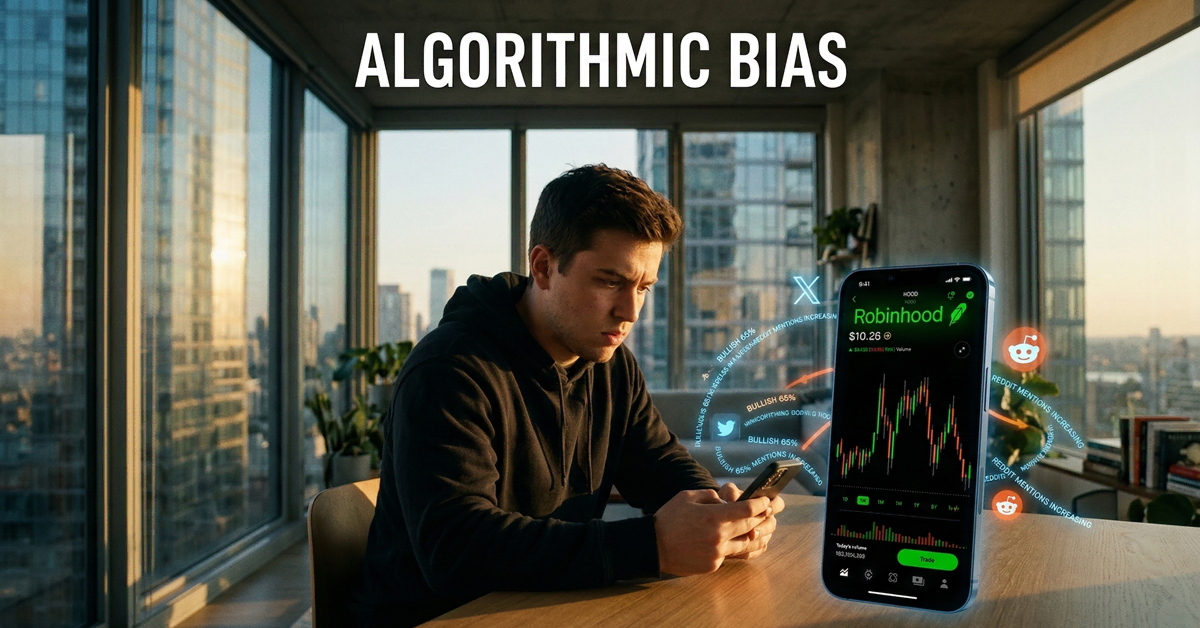
The global financial ecosystem has experienced a profound shift over the last decade, transitioning from a landscape dominated by institutional gatekeepers to one characterized by the democratization of market access. This evolution is driven by the convergence of mobile-first trading technologies, sophisticated algorithmic recommendation systems, and the pervasive influence of social media narratives. As retail participation has surged, particularly in the wake of the 2020 pandemic, the traditional frameworks of behavioral finance have been forced to expand, incorporating the complex interactions between human psychology and algorithmic influence. The emergence of the “meme stock” phenomenon and the rapid adoption of cryptocurrency suggest that retail investors are no longer peripheral noise but are central drivers of market volatility and price discovery, albeit often operating through distorted cognitive and technological filters.
Table of Contents
Behavioral Finance in the Technological Epoch
The study of investment behavior has historically been rooted in the tension between the Efficient Market Hypothesis and the observed irrationalities of individual actors. Traditional behavioral finance identifies cognitive biases such as overconfidence, anchoring, and loss aversion as the primary drivers of suboptimal investment outcomes. However, the modern era has introduced a new layer of complexity: the cognitive-algorithmic interface. Research indicates that technological innovation and rising retail activity have not mitigated traditional biases but have instead intensified behavioral distortions through new channels.
A Systematic Literature Review (SLR) focusing on publications between 2020 and 2025 reveals that while foundational biases like herding and the disposition effect remain prevalent, a newer phenomenon—automation bias—has emerged as a critical concern. Automation bias refers to the systematic over-reliance on artificial intelligence (AI) and fintech platforms, where investors treat algorithmic suggestions as inherently superior to their own judgment or fundamental analysis. This over-reliance creates a feedback loop where human irrationality is amplified by the very tools designed to facilitate efficient trading.
The progression of research in this field can be divided into three distinct phases. The foundational period (2008–2014) established the core relationship between investor size and trading patterns, identifying early markers of overconfidence. The expansion phase (2015–2019) began investigating the psychological dimensions of market structures and the role of information sources. The current acceleration period (2020–2024) is characterized by a doubling of annual publications, driven by the rise of digital platforms and growing concerns over the “gamblification” of investment markets.
Taxonomic Assessment of Contemporary Investor Biases
Individual decision-making is inherently associative and influenced by heuristics—mental shortcuts that simplify complex tasks but lead to predictable errors. In the context of modern retail trading, these errors are frequently systemic. Overconfidence bias remains one of the most destructive forces, leading investors to overestimate their predictive abilities and engage in excessive trading, which invariably degrades returns. This is often paired with the disposition effect, where the emotional pain of a loss outweighs the satisfaction of an equivalent gain, causing investors to hold losing assets for too long while selling winners prematurely to “lock in” profits.
| Bias Category | Psychological Mechanism | Market Consequence |
| Overconfidence | Overestimation of skill and information accuracy | Elevated trading volume and higher risk exposure |
| Herding | Lack of self-efficacy leading to mimicking others | Episodic price bubbles and sudden crashes |
| Anchoring | Excessive reliance on initial, potentially irrelevant data | Lagged adjustment to fundamental market shifts |
| Automation Bias | Uncritical trust in algorithmic and AI outputs | Systematic errors in automated decision-making |
| Disposition Effect | Asymmetric emotional response to gains vs. losses | Suboptimal portfolio liquidation patterns |
Recent empirical studies have utilized advanced machine learning models to predict these behaviors. For instance, a Random Forest algorithm applied to a dataset of 500 individual investors in urban settings demonstrated a 98.44% accuracy rate in forecasting herding behavior. The primary driver identified in this model was a lack of self-efficacy, which prompts investors to seek safety in the “wisdom of the crowd,” regardless of the crowd’s actual expertise or the fundamental value of the asset being traded.
The Emergence of Problematic Trading Patterns
The fusion of social media and mobile trading apps has fostered an environment where investing is often indistinguishable from gambling. Research conducted between 2020 and 2024 highlights that approximately 9.5% of retail investors exhibit problematic trading patterns characterized by frequent, entertainment-driven transactions and risk-seeking that exceeds rational portfolio optimization. A stricter subset, comprising 4.9% of the population, meets the clinical criteria for gambling disorder in a financial context. Digital interfaces and social media discussion feeds significantly amplify these behaviors, transforming the stock market into a high-stakes digital casino where the reward is as much social validation as it is financial gain.
Algorithmic Bias and the Logic of Recommendation Engines
Algorithms are not neutral conduits of information; they are active participants in financial cognition. Within fintech platforms, algorithmic systems act as “active participants” that both mitigate and amplify human biases. This interaction creates hybrid decision environments where computational rationality competes with algorithmic irrationality—a state where algorithms trained on biased historical data reproduce and scale human errors.
Mechanics of Fintech Recommendation Architecture
Modern trading platforms employ hybrid recommendation engines to enhance user engagement and facilitate product discovery. These systems generally integrate three primary methodologies: collaborative filtering, content-based filtering, and deep learning models.
- Collaborative Filtering: This technique operates on the principle that users who agreed in the past will agree in the future. It relies on a user-item matrix to identify similarities in trading history or preferences. For example, if User A and User B both invested in a specific set of high-growth tech stocks, the system will recommend additional stocks purchased by User B to User A.
- Content-Based Filtering: This approach focuses on the attributes of the assets themselves. If an investor frequently trades renewable energy stocks, the system will prioritize similar ESG-themed assets regardless of what other users are doing.
- Deep Learning and Reinforcement Learning: Advanced engines use neural networks to process vast streams of unstructured data—including app navigation, hover times, and transactional velocity—to predict “product affinity” in real-time.
While these systems improve the “user journey,” they introduce significant risks. Recommender systems can create winner-takes-all dynamics, where a few select assets dominate collective attention, leading to artificial price inflation and liquidity concentration. Furthermore, to maximize dwell time and engagement, these systems employ “hyper-nudges”—highly personalized interventions that subtly alter an investor’s mental “plausible path” and decision-making environment.
Mathematical Foundations of Algorithmic Influence
The effectiveness of these recommendation engines is often measured using metrics like Normalized Discounted Cumulative Gain (nDCG). In private recommendation engines being developed at institutions like MIT and Stanford, privacy-preserving protocols use matrix factorization to train models on secret-shared ratings. These systems aim to provide the same level of personalization as traditional models (scoring approximately 0.29 to 0.31 on nDCG benchmarks) while preventing the servers from accessing specific user preferences.
However, the “black box” nature of most commercial algorithms remains a concern. When predictive data analytics (PDA) optimize for platform revenue rather than investor welfare, they can nudge users toward high-margin, high-risk products like options or complex derivatives that the user may not fully understand.
Social Media Sentiment and Narrative-Driven Volatility
The role of social media in modern finance cannot be overstated. Platforms such as X (formerly Twitter) and Reddit have fundamentally altered the speed and scale of information diffusion. Unlike traditional media, which often acts as a stabilizing force by focusing on fundamentals, social media immediate creates market pressure through high-frequency, emotional discourse.
Indices of Digital Sentiment and Uncertainty
Researchers have developed sophisticated indices to track the impact of digital discourse on market stability. The Social Media Uncertainty Index (SMX), often derived from Tweet-based Market Uncertainty (TMU), provides a lens through which to view the relationship between online chatter and volatility. Longitudinal studies since 2011 show that a rise in SMX consistently amplifies stock market volatility, particularly in the short run.
| Index Type | Focus Area | Impact on Market Behavior |
| Tweet-based Market Uncertainty (TMU) | Broad online discourse on market risk | Direct correlation with short-term volatility spikes |
| Tweet-based Economic Uncertainty (TEU) | Macroeconomic policy and interest rates | Influence on long-term investor sentiment |
| Sentiment Scoring (Positive/Negative) | Emotional tone of asset-specific discussions | Predicts short-term price movements and reversals |
The intensity of social media sentiment has a documented impact on price movements, where positive sentiment scores correlate with price increases and negative scores with decreases. However, the predictive power of sentiment alone is limited; it is highly unstable and often serves as a signal for an impending reversal rather than a sustained trend.
The Gen Z Effect and “Meme Stock” Dynamics
The 2021 surge of “meme stocks” like GameStop (GME) and AMC provided a live case study of how social media mobilization can disrupt traditional market dynamics. Generation Z investors, fueled by online communities and a collective “Fear of Missing Out” (FOMO), demonstrated that retail traders could act as a coordinated force—sometimes described as an “angry mob”—to move markets against institutional short-sellers.
Survey data reveals that Gen Z traders are driven by a combination of herd mentality and the hope of “winning big,” effectively blurring the line between investing and social movement. This coordinated activity can inject massive short-term liquidity into specific stocks, but it also creates episodic bubbles. When these bubbles burst, the late-entering retail investors—who often buy at the peak of social media attention—bear the brunt of the losses.
Finfluencers and the Trust Gap
A new category of market participants, “finfluencers,” has emerged as a primary source of information for younger investors. Survey results show that Gen Z investors are 7.2 times more likely to trust the financial influencers they follow than traditional financial advisors. While some finfluencers provide valuable education, many operate with ulterior motives, such as generating commissions or promoting “pump and dump” schemes.
Experimental findings highlight the power of these figures: 24% of participants exposed to finfluencer-promoted assets purchased them, compared to just 7% in a control group. Interestingly, the research suggests that “non-investors” are even more susceptible to this influence than those with existing market experience, though they also respond more effectively to protective interventions like “prebunking” and disclosures.
The Impact of Digital Engagement Practices (DEPs)
Trading apps have revolutionized market access through “democratization,” but this access comes with the price of “gamification.” Platforms use Digital Engagement Practices (DEPs) to draw attention and lower psychological barriers, often encouraging frequent and risk-laden trading.
Taxonomy of Gamification Elements
The Ontario Securities Commission (OSC) and the Behavioural Insights Team (BIT) have categorized DEPs into several influential tactics. Their 2022 and 2024 reports provide empirical evidence on how these features alter investor decision-making.
| DEP Tactic | Mechanism | Quantitative Impact |
| Reward Points | Gamified “play money” or badges for trading | 40% increase in trading frequency |
| Top Traded Lists | Social proof signaling “popular” stocks | 14% higher likelihood to buy featured stocks |
| Copy Trading | Ability to mimic “star” traders directly | 18% more volume in promoted assets |
| Social Interaction Feeds | Fictitious or real posts from other users | 12% more volume in promoted assets |
| Leaderboards | Public ranking of user returns | 14% decrease in trading for top/bottom users |
The findings on leaderboards are particularly illuminating. While one might expect leaderboards to increase trading through competition, they actually led to a decrease in frequency for those at the extremes. Those in the middle of the ranking, however, traded more frequently in an attempt to ascend the board, suggesting that gamification creates different psychological pressures depending on an individual’s relative performance.
Digital Interfaces and Behavioral Persistence
DEPs like confetti animations and lottery-style stock rewards are designed to trigger dopamine responses, trivializing the act of investing. These design elements nudge customers toward frequent trades that benefit the brokerage through Payment for Order Flow (PFOF) or commissions, rather than promoting long-term saving or financial welfare. The State of Massachusetts, for instance, argued in a prominent case against Robinhood that such features breached the firm’s duty to act in accordance with ethical standards by encouraging inexperienced investors to engage in risk-laden behaviors like options trading.
Furthermore, mobile-first design exacerbates the “smartphone effect.” Research indicates that the ease of trading on a smartphone increases the probability of executing trades on “lottery-type” stocks (those with low prices and high potential for extreme returns) by 67%. This detachment from fundamental value is a core driver of the increased volatility observed in retail-favored securities.
Market Microstructure and Systemic Risk
The collective behavior of retail investors, mediated by technology, has significant implications for market microstructure. While retail participation can provide essential liquidity, it also introduces systemic vulnerabilities that traditional models often overlook.
Retail Investors as Liquidity Providers and Disruptors
Under stable market conditions, the influx of retail investors has improved overall trading volumes and baseline liquidity. During the COVID-19 pandemic, stocks with high retail participation showed 17% higher liquidity, suggesting that retail traders can act as a stabilizing force when institutional liquidity dries up. Retail order flow has also been found to reduce bid-ask spreads in less-followed stocks, lowering transaction costs for the broader market.
However, the “synchronized” nature of retail trading—driven by social media and app notifications—can lead to liquidity fragmentation. When millions of traders focus on a single asset (like GME), they create order flow imbalances that are difficult for market makers to manage. This concentration of activity can lead to “volatility shocks” where prices deviate significantly from fundamental values.
Price Discovery and the Role of High-Frequency Trading (HFT)
The role of High-Frequency Trading (HFT) firms is critical in this environment. HFTs act as wholesalers, internalizing retail trades and providing liquidity. Research using state-space models suggests that HFTs generally facilitate price efficiency by trading in the direction of permanent price changes and against transitory pricing errors or “noise”.
However, the internalization of retail orders prevents them from reaching public exchanges, which can impair the price discovery mechanism. Retail investors are often characterized as “noise traders” whose collective actions can cause episodic bubbles. The impact of a trade is typically higher when there is coordinated activity by one market participant group. While institutional investors have a higher individual price impact due to volume and research, the “angry mob” effect of retail coordination can achieve a similar result, forcing institutions to adjust their positions or face significant losses.
The Crypto Microstructure and Systemic Contagion
The cryptocurrency market serves as a vanguard for these systemic risks. Characterized by thin order books and fragmented trading across multiple global exchanges, crypto markets are highly vulnerable to “liquidity shocks”. A small number of “whale” wallets can dramatically influence prices, and algorithmic trading strategies can amplify price swings through rapid sequences of buying and selling.
Systemic risk in these markets is compounded by the lack of standardized settlement procedures. Shocks in one exchange can quickly propagate to others through cross-exchange arbitrage and derivative instruments. Retail investors, often seeking rapid gains without the knowledge to assess these structural risks, have borne a significant portion of the losses in recent cryptocurrency market collapses.
Quantitative Performance Analysis: Retail vs. Benchmarks
The most critical question for retail investors is whether these technological tools actually improve their financial outcomes. The empirical evidence is largely negative.
Underperformance of Social Media-Induced Trading
A comprehensive study of trades placed on days with abnormally high social media activity found that these transactions significantly underperformed at both the individual and portfolio levels.
- Equities: Returns on social media-induced trades were 1.6% to 2.8% lower than returns on other positions opened the same day.
- Portfolio Impact: A high share of social-media-driven trades was associated with a 1.7% to 2.8% reduction in annualized portfolio returns.
- Asset Class Consistency: This underperformance extends across cryptocurrency, foreign exchange, and commodities.
This performance lag is attributed to poor market timing—entering bubbles just as they are about to burst—and the disposition effect. While sophisticated short-term investors can profit if they trade at least five days before a peak in social media activity, the typical retail investor enters at or after the peak (Day t=0), precisely when returns begin to reverse.
The Role of Investment Experience and Literacy
Interestingly, social media’s impact is not entirely negative. For some investors, social media can reduce the disposition effect. Data from the platform Xueqiu.com suggests that social media information—particularly negative information—can help investors become more rational by providing the necessary signals to liquidate losing positions. However, this benefit is highly dependent on investor characteristics. Middle-aged investors have the strongest disposition effect, while more experienced investors and elderly investors are better at processing social information to make rational adjustments.
Furthermore, while trading apps democratize access, they do not necessarily democratize expertise. Participants with lower financial literacy are more likely to be drawn to “hedonic” gamification elements and often exhibit noisy, non-rational trading strategies compared to those who prefer non-gamified platforms.
Regulatory Landscapes and the PDA Rule Proposal
As the risks of algorithmic bias and DEPs have become clear, regulators have begun to propose more prescriptive frameworks.
The SEC’s Conflict of Interest Rules
In July 2023, the U.S. Securities and Exchange Commission (SEC) proposed Rules 15l-2 and 211(h)(2)-4, focusing on the use of predictive data analytics (PDA) and AI in investor interactions.
- Covered Technology: The definition is intentionally broad, covering any analytical function or algorithm that “optimizes for, predicts, guides, forecasts, or directs” investment behaviors.
- Conflict Neutralization: Unlike previous regulations that relied on disclosure, the new proposal would require firms to “eliminate or neutralize” the effects of conflicts of interest where the firm’s interests are placed ahead of the investor’s.
- Digital Engagement Focus: The proposal specifically cites curated lists and “most active” stock displays as triggers for these rules, as they may encourage trading to generate Payment for Order Flow revenue for the brokerage.
The IAC and the Innovation Debate
The SEC’s Investor Advisory Committee (IAC) has expressed concern that the broad definition of “covered technology” might inadvertently include benign tools like Excel or basic retirement calculators. The IAC has recommended narrowing the scope to target specific PDA technologies like machine learning, neural networks, and Large Language Models (LLMs). This debate highlights the central regulatory tension: how to protect investors from “algorithmic irrationality” without stifling the development of beneficial financial technologies.
2026: The Shift to Agentic and Social Finance
As we look toward 2026, the financial services sector is moving from isolated AI experiments to “enterprise-scale” AI orchestration. The era of the “agentic” financial system is emerging.
The Rise of AI Agents in Private Capital
By 2026, the market is expected to shift from passive chatbots to autonomous “AI agents.” Unlike current tools that merely generate text, AI agents can take action in the real world—executing multi-step workflows, researching deals, and managing customer portfolios without constant oversight.
For retail investors, this trend promises to accelerate the “retailization” of private capital. AI lowers the operational costs of onboarding smaller-ticket investors and uses machine learning to match them with tailored private market products based on their risk tolerance and liquidity needs. Projections suggest that retail assets under management (AUM) in the U.S. could grow from $80 billion to over $2 trillion by the end of the decade as AI flattens the sophistication gap between institutional and retail investors.
Robinhood and the 2026 Market Context
Platform performance data from early 2026 provides a window into this future. Robinhood (NASDAQ: HOOD) reported 27.2 million funded customers in January 2026, with total platform assets reaching $324 billion—a 59% increase year-over-year. This growth is driven by record net deposits ($68 billion in 2025) and a massive expansion in the margin book, which increased 122% to $18.4 billion.
| Metric (Jan 2026) | Value | Y/Y Change |
| Funded Customers | 27.2 Million | +7% |
| Total Platform Assets | $324 Billion | +59% |
| Equity Trading Volume | $227.3 Billion | +57% |
| Margin Book | $18.4 Billion | +122% |
| Gold Subscribers | 4.2 Million | +58% |
These figures underscore the increasing scale of retail participation and the heavy reliance on leverage (margin). The platform is also aggressively integrating AI, with its “Cortex” assistant and expanded social features slated for major rollouts throughout 2026.
SocialFi and the Decentralization of Influence
The convergence of social media and decentralized finance (DeFi), known as SocialFi, is expected to be a major trend by 2026. Under new regulatory frameworks like the EU’s MiCA, tokenization and DeFi are gaining legitimacy. This allows for new models of fractional ownership and community-led liquidity, where the “narrative” of a social group can be directly tokenized and traded. While this fuels innovation, it also risks creating even more powerful and volatile herd behaviors that are difficult to regulate through traditional national frameworks.
Conclusions: Navigating the Cognitive-Algorithmic Interface
The impact of algorithmic bias and social media sentiment on retail investor behavior is a multi-dimensional challenge that defies simple solutions. Technology has undeniably democratized finance, providing millions with tools once reserved for the elite. However, it has also created an environment where behavioral biases are not just present but are systematically harvested and amplified.
- Systemic Volatility: The coordination of retail investors via social media and the “nudging” of trading apps have introduced new forms of short-term volatility. While retail participation provides baseline liquidity, its synchronized nature can lead to severe market distortions and “meme” bubbles that detach prices from fundamental reality.
- Individual Performance Erosion: Despite the perceived “ease” of trading, the typical retail investor influenced by social media sentiment and gamified interfaces underperforms traditional benchmarks. The costs of frequent trading, poor market timing, and the disposition effect remain the primary inhibitors of long-term wealth creation.
- Algorithmic Accountability: The shift toward agentic AI by 2026 presents a double-edged sword. While autonomous agents can make more rational decisions and lower the entry bar for complex asset classes, they also risk “optimal herding” and the scaling of embedded biases.
The path forward requires a balanced approach. Regulators must move toward technology-neutral principles that emphasize fiduciary duty and conflict neutralization while avoiding overly broad definitions that stifle innovation. For the industry, the differentiator of the next decade will be “Responsible AI”—systems that are explainable, governed, and aligned with the financial rigor required to protect retail participants. Ultimately, the goal is to create a market where technology enhances human judgment rather than replacing it with a series of sophisticated, biased nudges.