
Table of Contents
Introduction to Next-Generation Trade Execution
In the intricate, hyper-connected landscape of modern financial markets, optimizing the execution of large institutional positions remains a paramount operational challenge for asset managers, quantitative hedge funds, and proprietary trading desks. The fundamental dilemma of institutional trading is the execution of substantial volume without signaling intent to the market, thereby avoiding adverse price movements. Historically, the financial industry has relied on schedule-based execution algorithms, predominantly Time-Weighted Average Price (TWAP) and Volume-Weighted Average Price (VWAP), to slice large parent orders into smaller, more manageable child orders. While these deterministic algorithms provide intuitive, rule-based solutions for volume participation, they fundamentally lack the dynamic responsiveness required to mitigate market impact and opportunity costs in highly volatile, fragmented liquidity environments. Schedule-based algorithms operate blindly regarding real-time microstructural phenomena; they do not adapt to limit order book (LOB) imbalances, transient volatility spikes, or the sudden influx of informed, toxic order flow.
The evolution of quantitative finance subsequently precipitated a shift toward stochastic optimal control methods, typified by the seminal Almgren-Chriss framework (2000). This mathematical approach balances execution speed against market impact variance, utilizing stochastic control to maximize performance. However, the analytical solutions required for these models rely on solving complex Hamilton-Jacobi-Bellman (HJB) equations or Quasi-Variational inequalities, which necessitate stringent, often unrealistic assumptions about linear price impacts and continuous market liquidity. These traditional models fail to capture the nonlinear, high-dimensional, and discrete reality of modern electronic limit order books. To transcend these limitations, quantitative researchers are increasingly adopting Deep Reinforcement Learning (DRL) paradigms.
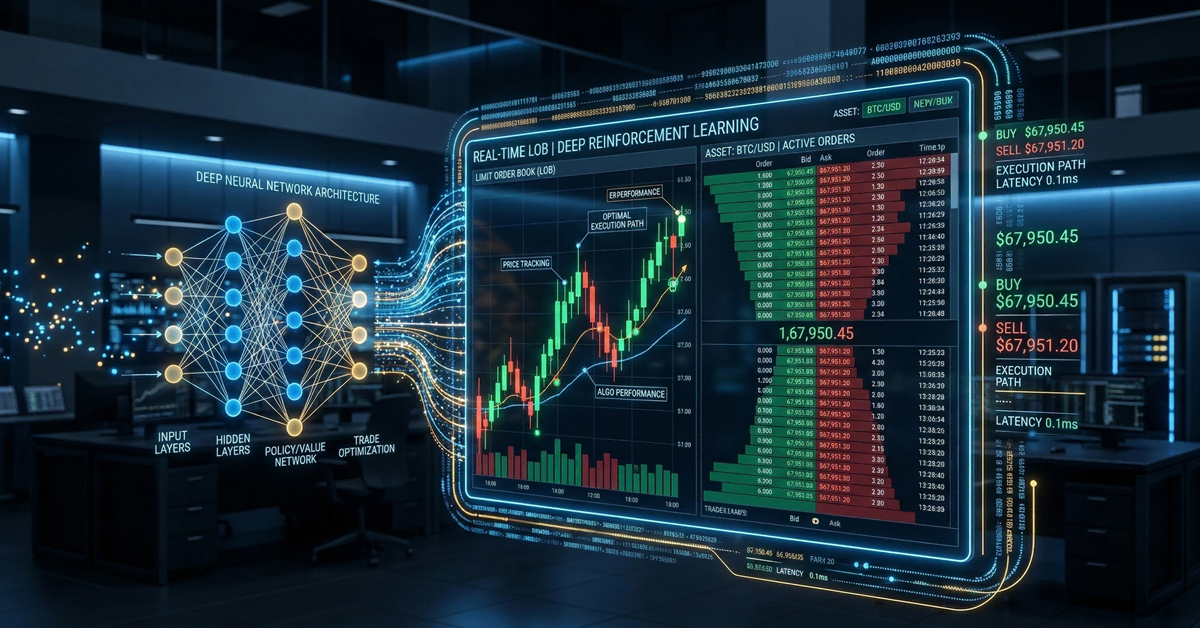
The “LOB-RL” framework represents the vanguard of this microstructural transition. By modeling trade execution as a sophisticated Markov Decision Process (MDP), LOB-RL deploys autonomous agents trained via Actor-Critic reinforcement learning to dynamically place, modify, and cancel limit and market orders directly within the LOB. Instead of merely crossing the spread and incurring immediate slippage like traditional algorithms, the LOB-RL agent strategically posts passive limit orders to capture the “quoted spread,” intelligently managing inventory risk while minimizing the overarching metric of institutional trading: Perold’s Implementation Shortfall (IS).
This comprehensive report provides an exhaustive, nuanced examination of the LOB-RL framework. It details the underlying microstructural mechanics, state and action space engineering, advanced neural network architectures, potential-based reward shaping methodologies, the integration of adversarial training for robustness, and the infrastructural hardware prerequisites for deploying these autonomous models in live, high-frequency trading (HFT) environments.
The Microstructural Mechanics of Limit Order Book Execution
To comprehend the efficacy of the LOB-RL framework, one must first deconstruct the environment in which it operates. A Limit Order Book (LOB) is a centralized, electronic ledger of outstanding offers to buy (bids) and sell (asks) an asset at strictly specified limit prices. In a modern order-driven market, liquidity is not provided by designated human market makers offering continuous quotes; rather, it emerges in a decentralized manner from anonymous participants submitting limit orders, governed by strict price-time priority matching engines.
Deconstructing Implementation Shortfall and Market Impact
The primary optimization objective of the LOB-RL execution agent is the absolute minimization of Implementation Shortfall (IS). Originally conceptualized by Perold (1988), IS is a comprehensive, empirical measurement of liquidity that captures the actual implicit costs of trading for end-investors. It encompasses prevailing bid-ask spreads, exchange fees, and the price impacts resulting from the execution of large orders.
Mathematically, the optimization problem in quantitative finance RL is formulated to minimize the expectation of the shortfall alongside its variance. This is expressed through the objective function:
In this formulation, represents the calculated shortfall, and is a critical risk-aversion parameter () weighting the penalty assigned to execution variance. If , the RL agent operates in a purely risk-neutral capacity, focusing solely on maximizing returns (minimizing the absolute shortfall) without regard for the volatility of the execution trajectory. A higher dictates a risk-averse policy, compelling the agent to prioritize execution stability and safeguard against adverse market scenarios.
Market impact itself, the primary driver of implementation shortfall, is bifurcated into two distinct components: temporary (direct) and permanent (indirect) impact.
| Impact Type | Microstructural Definition | RL Modeling Approach |
| Temporary (Direct) Impact | Arises from the immediate consumption of liquidity at the best available price levels. Aggressive market orders that exceed the depth at the Level 1 bid/ask will “walk up the book,” incurring immediate execution slippage. | Modeled using a Temporary Impact Function: , where is the fixed cost and is the impact coefficient relative to the execution rate . |
| Permanent (Indirect) Impact | Reflects the informational content of the trade. The execution of a large parent order signals directional intent, causing the fundamental asset price to drift adversely as other market participants adjust their valuations. | Highly complex to simulate purely from historical data. RL frameworks often mitigate this by enforcing strict inventory penalties and limiting the size of individual child orders. |
While traditional simulation environments can seamlessly model temporary impact by calculating instantaneous liquidity exhaustion across depth levels, permanent impact relies on the adaptive, game-theoretic reactions of other market participants, making it notoriously difficult to simulate accurately without adversarial frameworks.
Adverse Selection and the Threat of Toxic Order Flow
In the LOB, placing passive limit orders exposes the executing agent to profound adverse selection risks. Market makers and optimal execution algorithms attempt to capture the quoted spread, but they inevitably face “toxic flow”—trades initiated by counterparties possessing superior, short-term directional information or latency advantages. If an RL agent places a passive limit order and the market price suddenly trends against the agent due to informed trading, the agent’s order is executed just before the asset depreciates, leading to an immediate mark-to-market loss and unwanted inventory accumulation.
To preempt adverse selection, modern LOB-RL agents must rigorously monitor high-frequency microstructural signals that precede price formation. Two critical metrics are Trade Flow Imbalance and the Volume-Synchronized Probability of Informed Trading (VPIN).
Traditional TWAP execution stacks ignore the composition of the order flow they trade against, resulting in severe P&L bleeding during volatility windows because they cannot detect toxicity building in the order book. By integrating metrics like VPIN directly into the RL state space, the agent gains statistical visibility into the proportion of trade-initiated volume originating from informed participants rather than uninformed noise traders. This predictive capability allows the RL agent to dynamically adjust its quote depths, cancel exposed limit orders, or widen its spreads fractionally before toxic fills occur, thereby preserving execution quality.
Mathematical Formalization of the Reinforcement Learning Paradigm
To transcend the analytical limitations of traditional optimal control, the LOB-RL framework formalizes the optimal execution problem as a Markov Decision Process (MDP). The MDP provides a rigorous mathematical foundation for sequential decision-making under uncertainty, allowing the agent to discover optimal policies through continuous interaction with the environment.
The MDP is defined by the tuple :
- (State Space): The continuous or discrete observations of the LOB, internal inventory, and microstructural indicators at time .
- (Action Space): The set of available execution decisions, including the pricing and sizing of limit and market orders.
- (Transition Dynamics): The transition probability function , representing how the market state evolves in response to the agent’s actions and exogenous market shocks.
- (Reward Function): The immediate scalar feedback provided to the agent, typically formulated as the reduction in implementation shortfall or an increase in risk-adjusted returns.
- (Discount Factor): A parameter [0, 1] that dictates the present value of future rewards, crucial for balancing short-term spread capture against long-term execution goals.
The fundamental objective of the RL agent is to learn an optimal policy that maximizes the expected cumulative discounted reward over the trading horizon. Unlike the Almgren-Chriss framework, which requires predefined price impact functions to solve for this policy, RL is inherently model-free. The agent does not require prior analytical knowledge of the transition dynamics ; it approximates the optimal value functions incrementally through the application of the Bellman equation and temporal difference (TD) learning. This model-free adaptability allows the LOB-RL framework to excel in nonlinear market impact scenarios where traditional dynamic programming transmits compounding errors.
State Space Engineering: Extracting High-Dimensional Features
The empirical success of the LOB-RL framework is inextricably linked to the quality of its state space representation. Financial LOB data is exceptionally high-dimensional, noisy, and non-stationary, operating at the millisecond timescale. Providing an RL agent with raw, unfiltered LOB data often leads to sample inefficiency and catastrophic overfitting.
Consequently, robust LOB-RL systems employ State Representation Learning (SRL) algorithms, such as stacked denoising autoencoders (SDAEs), to systematically extract meaningful, low-dimensional, and Markovian representations from the LOB snapshots prior to policy evaluation. An effective state space must be value-representing, generalizable, and mathematically succinct.
The comprehensive state space () typically encompasses four distinct categories of variables:
| State Variable Category | Specific Microstructural Metrics | Rationale for RL Inclusion |
| Agent Constraints & Inventory | Current Inventory Level (), Available Cash Balance (), Remaining Execution Time (). | Dictates the urgency of the execution schedule. High inventory approaching the end of the trading horizon forces the agent to cross the spread aggressively, altering the policy from passive spread capture to aggressive liquidity consumption. |
| LOB Depth & Microstructure | Bid/Ask levels (up to 10 levels deep), Quoted Spread, Limit Order Book Imbalance. | Reflects immediate liquidity constraints and implicit transaction costs. LOB Imbalance is a statistically significant predictor of short-term mid-price movement and limit order arrival rates. |
| Market Regime Dynamics | Short-term Volatility, Relative Strength Index (RSI), VPIN, Trade Flow Imbalance. | Captures the macroeconomic regime and the probability of informed trading. Allows the agent to detect toxic flow building in the volume clock and systematically widen spreads to avoid adverse selection. |
| Execution Performance | Price divergence from the benchmark arrival price, Trailing Cumulative Implementation Shortfall. | Provides real-time feedback on the agent’s current execution quality relative to the initial decision price. Guides the agent to accelerate or decelerate trading based on historical slippage. |
By structuring the state space with these highly predictive meta-features, the RL agent can accurately map the current environment to the optimal execution action without being blinded by microstructural noise.
Action Space Design: Resolving the Continuous-Discrete Duality
Formulating the action space for limit order execution presents a complex mathematical challenge known as the “continuous-discrete duality”. The agent must dynamically decide both the volume of the sub-orders to deploy and the precise limit prices at which to post them.
From a mathematical and generalization perspective, price adjustments are naturally understood in continuous percentages. For instance, a policy dictating a adjustment relative to the mid-price is a continuous representation that allows a neural network to generalize its learned execution strategy across a broad universe of stocks, regardless of their nominal price levels or specific liquidity profiles.
Conversely, the physical architecture of electronic exchanges operates on strict, discrete tick sizes (the minimum allowable price increment determined by the exchange). An action dictating a continuous percentage price improvement must ultimately map to a valid, discrete tick level. This mapping is non-trivial; an action corresponding to a one-tick shift represents a massive 1.0% change for a penny stock priced at $1.00, but a mathematically negligible 0.01% change for a blue-chip stock priced at $100.00.
If the action space is modeled purely as discrete tick offsets (e.g., placing an order at Level 1, Level 2, or Level 3 of the LOB), the dimensionality of the action space grows exponentially, particularly in multi-asset execution environments. Traditional Value-Based RL methods fail under these high-dimensional discrete loads.
To resolve this duality, state-of-the-art LOB-RL frameworks employ hybrid RL methodologies combined with continuous action spaces. The continuous control agent first scopes a continuous action subset based on percentage-based spread captures, outputting a continuous value. Subsequently, a deterministic, fine-grained mapping function or a secondary discrete agent rounds this continuous intent to the nearest allowable, exchange-compliant tick size. This hybrid approach preserves the generalization capabilities of continuous neural networks while ensuring absolute compliance with market microstructure rules.
Actor-Critic Architectures for High-Frequency LOB Data
Reinforcement learning algorithms are broadly categorized into three paradigms: Critic-Only (Value-Based), Actor-Only (Policy-Based), and Actor-Critic methods.
Critic-Only methods, such as Deep Q-Networks (DQN) and Double Deep Q-Networks (DDQN), attempt to find the optimal value function and subsequently derive the policy by selecting the action with the highest Q-value. While DQNs have been utilized in optimal execution proofs-of-concept, they fundamentally struggle to scale into high-dimensional, continuous action spaces and often exhibit severe instability during training. Actor-Only methods search directly for the optimal policy in the continuous policy space but suffer from high variance in their gradient estimates.
Actor-Critic (AC) methods elegantly combine the advantages of both paradigms, making them the superior, mathematically preferred choice for LOB execution. In this architecture, the “Actor” network learns and parameterizes the optimal policy , directly proposing continuous execution actions. Concurrently, the “Critic” network learns the value function or action-value function , evaluating the performance of the Actor’s proposed actions. The Critic supplies the Actor with low-variance gradient updates (advantages) based on the temporal difference error, dictating how the Actor’s policy parameters should be adjusted.
Prominent Actor-Critic Algorithms: DDPG and PPO
Two Actor-Critic algorithms dominate the LOB-RL landscape: Deep Deterministic Policy Gradient (DDPG) and Proximal Policy Optimization (PPO).
- Deep Deterministic Policy Gradient (DDPG): DDPG is an off-policy algorithm designed explicitly for environments with continuous action spaces. It is highly effective for determining the optimal liquidation trajectory of large portfolio transactions because it directly outputs deterministic continuous actions. Unlike stochastic policies—which require an additional step to sample an action from a parameterized probability distribution (such as a Gaussian) at inference time—DDPG maps a given state directly to a specific action. This deterministic nature eliminates the execution variance inherent in random sampling, ensuring highly consistent and predictable routing decisions at every microsecond timestep.
- Proximal Policy Optimization (PPO): PPO is an on-policy algorithm that has become the industry standard for sequential financial decision-making. PPO operates by collecting trajectories through environment interaction and estimating the advantage of each action. Crucially, PPO utilizes a clipped surrogate objective function that strictly limits the size of policy updates. This clipping prevents destructively large, unstable updates that commonly occur in highly stochastic financial environments. Empirical evidence demonstrates that PPO achieves remarkable generalization; in one commercial application, a PPO-based execution algorithm successfully generalized across 50 different stocks on the Korea Stock Exchange (KRX) with execution horizons ranging from 165 to 380 minutes, consistently outperforming standard VWAP benchmarks.
Advanced Neural Network Topologies: CNNs and LSTMs
To process the profound temporal and spatial complexities inherent in limit order book data, the underlying neural networks parameterizing the Actor and Critic rely on sophisticated, hybrid topologies.
- Spatial Feature Extraction via CNNs: Convolutional Neural Networks (CNNs) are employed to extract spatial features from the limit order book. By treating the multi-level LOB depth array as a 1D or 2D spatial matrix (akin to an image), convolutional layers can effectively capture the structural shape of liquidity. This allows the agent to identify hidden clusters of bid and ask volume resting far away from the immediate spread, which act as microstructural support or resistance levels.
- Temporal Dependencies via LSTMs: Financial data is explicitly sequential; the current state of the LOB is heavily dependent on the trajectory of preceding trades. Long Short-Term Memory (LSTM) networks are integrated into the architecture to track these temporal dependencies. The LSTM memory cells allow the agent to remember fading liquidity trends or accelerating trade flow imbalances over time, enabling anticipatory order placement.
In a highly optimized, end-to-end PPO framework for active high-frequency trading, the architecture often utilizes shared hidden layers. A typical configuration might feature a Multilayer Perceptron (MLP) or CNN with two shared hidden layers (e.g., 64 neurons each) that process the raw state data. This shared representation then branches into two separate output layers: one single-valued output for the Critic’s state-value estimate, and another continuous output vector for the Actor’s policy. Sharing the lower-level feature representations encourages better generic learning of market microstructure, as these layers receive gradient updates from both the policy loss and the value loss simultaneously, significantly accelerating training speed and computational efficiency during live inference.
Reward Function Formulation and Potential-Based Shaping
The mathematical formulation of the reward function is unequivocally the most critical design element in the LOB-RL framework. The reward function is the sole mechanism through which the agent understands its objective; it must perfectly balance the immediate pursuit of spread capture against the long-term, compounding costs of market impact and inventory risk.
Formulating the Implementation Shortfall Reward
In optimal execution, rewarding the agent purely on gross Profit and Loss (P&L) is insufficient, as it ignores the initial decision benchmark. The reward must be intrinsically linked to the arrival price or a standardized benchmark like TWAP. A robust reward function is typically formulated as a composite equation:
In this formulation, represents the positive cash flow or mark-to-market portfolio change, while is the step-wise implementation shortfall incurred during the timestep.
To force the agent to strictly balance execution progress against risk, severe penalties are integrated directly into the reward. An inventory penalty (, where is the inventory at step and is a scaling factor) is subtracted to heavily penalize holding large residual positions. This penalty engenders risk-averse behavior, forcing the agent to prioritize systematic liquidation rather than holding the asset to speculate on favorable price drifts. Furthermore, a depth consumption penalty is applied if the agent utilizes aggressive market orders that consume liquidity beyond the first level of the LOB. This term mathematically teaches the agent the explicit cost of temporary market impact.
Solving the Sparse Reward Problem via Reward Shaping
A pervasive, systemic challenge in applying reinforcement learning to algorithmic trading is the issue of sparse rewards. If an execution algorithm only receives a terminal reward indicating its total implementation shortfall at the very end of a multi-hour trading horizon, it suffers from a massive credit assignment problem. The agent cannot accurately attribute which specific microsecond-level limit order placements contributed to the final success or failure. The native feedback loop is too delayed.
Reward shaping solves this limitation by providing localized, intermediate feedback based on prior knowledge and progress toward the goal. To ensure that adding these intermediate, dense rewards does not accidentally alter the mathematically optimal policy, researchers utilize Potential-Based Reward Shaping, a theory formalized by Ng et al. (1999). By defining a potential function over the state space, the intermediate shaped reward is defined as:
Because this shaping term telescopes over the episode, it guarantees policy invariance; the optimal execution policy remains completely unaltered, but the agent learns exponentially faster due to the dense gradient signals.
In practical LOB-RL implementations, this potential function is often benchmarked against a simulated TWAP execution. At each timestep , the algorithm calculates the mean-variance cost of the RL agent () and compares it to the cost of a baseline TWAP strategy (). The step-wise shaped reward is formulated as a relative improvement ratio:
If the RL agent outperforms the TWAP baseline at that specific step, it receives a positive proportional reward. A massive terminal bonus (e.g., +10) is applied at the final timestep if the cumulative implementation shortfall successfully beats the baseline, cementing the ultimate long-term objective. This localized advice effectively reduces the reward horizon, guiding the learning process efficiently through the vast, complex state space of the LOB.
Adversarial Reinforcement Learning (ARL) and Epistemic Robustness
Training RL execution agents exclusively on static, historical LOB data introduces a severe, often fatal vulnerability known as the “backtesting trap”. Agents optimized purely on historical environments tend to learn the idiosyncratic historical manifestations of price noise rather than the underlying stochastic market processes. This leads to catastrophic overfitting; the agent develops a false sense of predictability based on historical anomalies. Furthermore, static historical data cannot accurately capture the reactive, game-theoretic nature of live markets. In a live LOB, sophisticated HFT algorithms will detect the RL agent’s execution footprint and dynamically adapt their strategies to exploit it—a dynamic wholly absent from offline historical replays.
To guarantee robustness against epistemic uncertainty and toxic, predatory market participants, advanced LOB-RL frameworks incorporate Adversarial Reinforcement Learning (ARL). ARL fundamentally transforms the standard optimal execution problem (such as the single-agent Avellaneda-Stoikov market-making model) into a discrete-time, zero-sum Markov game between the RL execution agent and a continuously learning, strategic Adversary.
The Zero-Sum Markov Game Formulation
In the ARL framework, the fundamental asset price evolves stochastically according to the process:
Where is the drift, is volatility, and represents normally distributed random variables.
The Adversary acts as an intelligent proxy for the collective, predatory intelligence of the broader market. Rather than trading directly, the Adversary actively controls the hidden parameters of the market environment—specifically the drift (), the market order arrival rates (), and the liquidity volume distribution ()—with the explicit, zero-sum objective of minimizing the execution agent’s cumulative reward.
Both entities train concurrently using policy gradient algorithms, such as the Natural Actor-Critic (NAC-S) method. While the execution agent learns to place optimal limit price offsets to capture the spread, the Adversary learns a Beta policy to generate extreme volatility, dry up liquidity, and simulate toxic order flow precisely at the moments when the execution agent is most vulnerable (e.g., holding maximum inventory).
Emergent Risk Aversion and Model Robustness
The introduction of a strategic, learning adversary yields profound empirical results. Most notably, sophisticated risk-averse behavior emerges completely naturally in the execution agent, without the need for researchers to manually tune complex, domain-specific inventory penalties (). Subjected to the Adversary’s relentless attacks, the RL agent intrinsically learns to maintain neutral inventory and execute limit orders passively, having experienced the severe mark-to-market losses inflicted by sudden adversarial price jumps.
Empirical evaluations across various market simulations demonstrate that ARL-trained agents achieve significantly higher Sharpe ratios and exhibit drastically improved robustness to model misspecification between the training environment and live out-of-sample testing. By continuously adapting to worst-case adversarial environments generated by self-exciting Hawkes processes, the ARL agent develops a universally robust execution policy that strictly dominates agents trained in standard, static historical settings.
Navigating Fragmented Liquidity with Smart Order Routing (SOR)
Modern global equity, foreign exchange, and cryptocurrency markets are profoundly fragmented. Liquidity for a single underlying asset is no longer centralized but dispersed across a vast network of primary exchanges, multilateral trading facilities (MTFs), alternative trading systems (ATS), decentralized exchanges (DEXs), and dark pools. Executing a large institutional block order on a single venue inevitably exhausts local liquidity, causing severe negative slippage and exposing the trade to front-running. Consequently, the LOB-RL framework must extend beyond single-venue optimization to encompass AI-driven Smart Order Routing (SOR).
Multi-Hop Routing and Liquidity Aggregation
SOR technology acts as an intelligent aggregation layer, effectively pooling fragmented venues to create a single, deeper virtual limit order book. When applied to SOR, the RL agent’s state space expands to observe the simultaneous depth, varying transaction fees, and transmission latencies across multiple disparate LOBs. The action space concomitantly scales to include not just pricing, but venue selection and order fragmentation—optimally splitting a parent order and routing the child orders concurrently to lit venues like the LSE and Chi-X, or routing across blockchain bridges to AMMs like Uniswap and SushiSwap.
Advanced RL routers can execute multi-hop, cross-asset routing if a direct execution path suffers from prohibitive illiquidity. By mathematically mapping continuous execution paths through intermediate assets, the Actor-Critic network optimizes for the highest net return after accounting for all routing latencies, network gas fees, and compounding spread costs.
Multi-Agent Reinforcement Learning (MARL) and Dark Pools
Navigating dark pools—venues with absolute pre-trade opacity—adds an immense layer of complexity to the SOR problem. Orders routed to dark pools do not suffer pre-trade signaling risks, but they face highly uncertain execution probabilities and severe adverse selection if the dark pool is populated by predatory, informed participants.
To manage routing across dozens of lit and dark venues simultaneously, researchers have pioneered the use of Multi-Agent Reinforcement Learning (MARL), formulating the concept of “Financial Swarms”. Instead of relying on a single, monolithic, computationally heavy routing algorithm, a swarm of independent, rational RL agents operates concurrently.
Utilizing difference rewards within a Markov team games framework, these independent agents collectively optimize overarching market liquidity provision and execution routing without requiring centralized coordination or collusion. This decentralized MARL architecture allows the execution stack to rapidly adapt to fleeting, microsecond liquidity across multiple venues, significantly reducing the probability that toxic flow algorithms will detect a centralized institutional footprint and front-run the execution.
Infrastructure, Hardware, and Deployment Realities
The theoretical elegance and mathematical rigor of the LOB-RL framework are entirely immaterial without the specialized computational infrastructure required to deploy these models in high-frequency, ultra-low latency production environments. The uncompromising constraints of real-time algorithmic trading dictate the architecture of both the training and inference pipelines.
High-Fidelity Simulation Environments
Training deep Actor-Critic agents requires millions of iterative interactions with the environment to converge on an optimal policy. Because live financial markets cannot be utilized for trial-and-error exploration without incurring catastrophic financial ruin, institutions rely entirely on high-fidelity simulators. The ABIDES (Interactive-Agent-Based Simulator) environment is a paramount, industry-standard example. By accurately replaying historical Level-3 limit order book message data (sourced from datasets like LOBSTER), ABIDES reconstructs the exact price-time priority matching engines of major exchanges like NASDAQ.
Crucially, these simulators must accurately model direct market impact. They achieve this by dynamically injecting the RL agent’s exploratory limit and market orders directly into the historical data stream, systematically calculating how the agent’s actions consume available depth, alter the spread, and trigger instantaneous slippage. While even advanced simulators struggle to perfectly model the permanent, indirect impact of other participants’ behavioral reactions, they provide the essential, foundational stochastic sandbox required for Actor-Critic convergence.
Hardware Acceleration: GPUs and FPGAs
In live execution, the absolute latency between observing a microstructural state change in the LOB and deploying an optimized routing action must be measured in microseconds. Traditional Central Processing Units (CPUs) are fundamentally insufficient for processing deep convolutional and recurrent neural networks at this necessary speed.
The successful deployment of LOB-RL relies on highly specialized, hybrid hardware architectures:
- Distributed Training Pipelines: The training phase is intensely computationally heavy, relying on highly parallelized Graphics Processing Unit (GPU) clusters to process vast quantities of sequential LOB data and compute the complex gradients necessary for PPO or DDPG backpropagation. Architectures like APEX (Asynchronous Prioritized Experience Replay) are critical here; APEX decouples the acting and learning phases, distributing the workload across multiple asynchronous nodes to maximize sample efficiency and drastically reduce training times.
- Ultra-Low Latency Inference via FPGAs: The inference pipeline—where the trained model operates in live markets—is increasingly migrating exclusively to Field-Programmable Gate Arrays (FPGAs). FPGAs achieve superior power efficiency and, crucially, deterministic, ultra-low latency. By hardcoding the mathematically trained parameters of the Actor neural network directly onto the physical logic blocks of the FPGA, HFT execution systems can bypass the traditional operating system software stack entirely. The FPGA observes the market data feed, calculates the optimal limit price offset via the neural network, and fires the order directly to the exchange matching engine in fractions of a millisecond. This hardware acceleration is not merely an optimization; it is an absolute requisite. An RL agent cannot effectively widen its spread to avoid toxic flow if its computational reaction time is slower than the adversarial, predatory algorithms operating in the same market ecosystem.
Conclusion
The transition from static, schedule-based execution paradigms to autonomous, intelligent trading systems represents a fundamental, irreversible shift in the discipline of quantitative finance. The LOB-RL framework, powered by advanced Actor-Critic Deep Reinforcement Learning, provides a robust, mathematically sound mechanism for optimizing institutional trade execution and managing the complexities of modern market microstructure.
By formalizing the execution problem as a Markov Decision Process and engineering high-dimensional state spaces that incorporate critical predictive realities like VPIN and trade flow imbalance, these autonomous agents transcend simple time-slicing. They dynamically manage inventory risk, calculate continuous optimal price offsets, and strategically interact with the Limit Order Book to capture the spread while actively mitigating adverse selection. Furthermore, the integration of Adversarial Reinforcement Learning and potential-based reward shaping ensures that these agents do not merely overfit to historical noise, but develop emergent, robust risk-aversion capable of surviving toxic order flow and adversarial market conditions.
When seamlessly coupled with Multi-Agent Smart Order Routing architectures to navigate globally fragmented liquidity, and deployed natively on deterministic FPGA hardware infrastructure, the LOB-RL framework systematically dismantles the inherent inefficiencies and slippage of large-scale algorithmic trading. As global financial markets continue to rapidly increase in speed, fragmentation, and adversarial complexity, the adoption of deep reinforcement learning for optimal trade execution will cease to be a mere competitive advantage; it will unequivocally become a foundational, existential necessity for institutional survival.