
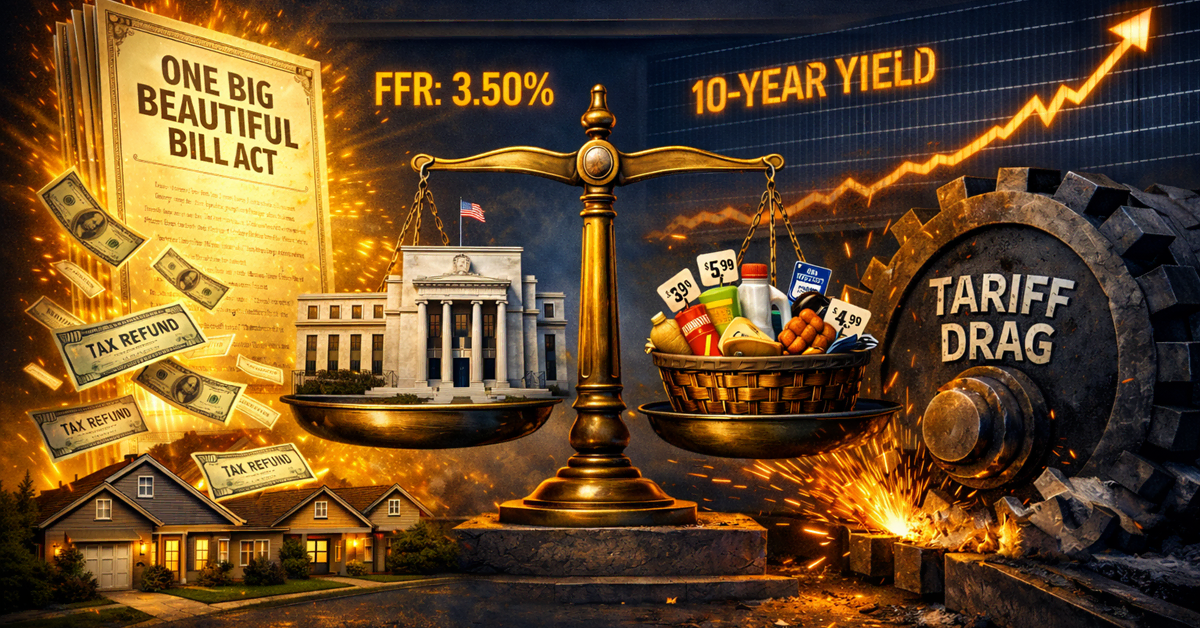
The first half of 2026 marks a pivotal juncture for the United States economy, defined by a massive and front-loaded fiscal impulse originating from the One Big Beautiful Bill Act (OBBBA). Signed into law on July 4, 2025, the OBBBA represents the cornerstone of the current administration’s economic agenda, combining permanent extensions of individual tax rates with aggressive new investment incentives and a restructuring of the federal safety net. As the nation enters the 2026 tax filing season, the “Big Beautiful Bill” is delivering what many analysts describe as the largest tax refund cycle in American history.
However, this fiscal tailwind does not exist in a vacuum. It is colliding with a significant “drag” from elevated import costs—the result of a shift toward an aggressive tariff-based trade regime that saw the effective tariff rate on customs duties climb to an estimated 11.7% by January 2026. This research paper explores the fundamental tension of 1H 2026: Is the OBBBA’s stimulus successfully offsetting the cost-push pressures of trade policy, or is it merely entrenching “sticky” inflation that prevents the Federal Reserve from normalizing interest rates below the 3.25% to 3.50% threshold?
Table of Contents
The 1H 2026 Fiscal Impulse: A Bumper Crop of Refunds
The OBBBA’s primary contribution to the 1H 2026 economy is a substantial injection of liquidity into the household sector. Because many of the bill’s provisions—including the expansion of the standard deduction to $32,200 for married couples, the permanent $200 increase in the child tax credit, and new deductions for tips and overtime—were enacted in mid-2025 but applied retroactively to January 1, 2025, the Internal Revenue Service (IRS) did not adjust withholding guidance in time for the 2025 tax year. Consequently, Americans overpaid their taxes throughout 2025 based on the old tax code.
This delay has created a massive “springboard effect” for early 2026. Estimates from the Joint Committee on Taxation (JCT) and private institutions like JP Morgan suggest that taxpayers are receiving an additional $91 billion in tax refunds above historical averages this season. When combined with the immediate boost from lower 2026 withholding schedules, the total fiscal relief for American families in 1H 2026 is projected to reach approximately $121 billion. Analysis suggests that if even 80% of these “excess” refunds are spent, it could boost annualized real GDP growth by more than 0.8% in the first quarter of 2026 alone.
Beyond individual consumers, the OBBBA has fundamentally altered the corporate landscape through investment incentives. The bill restored 100% upfront expensing (bonus depreciation) for business equipment and domestic R&D, while introducing a 35% tax credit for advanced semiconductor manufacturing effective January 2026. These provisions are designed to spark a “Capex Supercycle,” incentivizing firms to accelerate construction and equipment purchases to secure tax advantages before potential sunset dates in 2028.
The Tariff Drag: Inflationary Friction
Contrasting the OBBBA’s stimulative effects is the increasing burden of import costs. Throughout the latter half of 2025 and into 2026, the administration utilized executive authority to expand the scope and scale of tariffs. By early 2026, the effective tariff rate has jumped from a pre-2025 baseline of roughly 2.1% to nearly 12%. While the administration argues that these costs are borne by foreign exporters, economic data from early 2026 suggests a pass-through rate to U.S. consumers exceeding 50%.
This “tariff tax” acts as a regressive drag on the very consumption the OBBBA seeks to stimulate. Goldman Sachs and other forecasters estimate that the current tariff regime has added approximately 1% to the Consumer Price Index (CPI) between mid-2025 and mid-2026. For many households, the higher cost of imported electronics, automobiles, and industrial inputs is effectively neutralizing the “win” from larger tax refunds. In sectors like healthcare and food assistance, where the OBBBA also implemented spending cuts and stricter work requirements for SNAP benefits, lower-income households are finding the net economic impact to be negligible or even negative.
Sticky Inflation and the Federal Reserve’s Dilemma
The Federal Reserve enters 2026 in a state of “vigilant pause.” Following three 25-basis-point rate cuts in late 2025 that brought the federal funds rate to a range of 3.50% to 3.75%, the Federal Open Market Committee (FOMC) held rates steady in January 2026. The central bank is grappling with a “Cold, Hot, Cold” economic trajectory: the economy cooled in late 2025, is currently “heating up” in early 2026 due to the OBBBA stimulus, and is projected to cool again as the fiscal impulse fades in the second half of the year.
The core issue for the Fed is that the OBBBA stimulus may be too successful at the wrong time. By fueling demand in an economy already facing supply-side price pressures from tariffs, the OBBBA is contributing to “sticky” inflation. Core Personal Consumption Expenditures (PCE), the Fed’s preferred gauge, is hovering around 2.7% to 3.0%—well above the 2% target. Chair Jerome Powell has indicated that the Fed is unlikely to cut rates aggressively if tariff-related inflation looks like it might trigger a second round of price hikes or unanchor inflation expectations.
Market consensus now suggests a “terminal rate” for this cycle of 3.25%. Investors have largely abandoned hopes for a return to the “zero-bound” or even the 2.5% neutral rates of the previous decade. The combination of a $4 trillion increase in projected deficits over the next decade due to OBBBA and the persistent upward pressure on prices from trade policy has forced the Fed to maintain a more restrictive stance than would otherwise be necessary in a period of cooling labor markets.
Analysis: Offset or Fuel?
The central question of whether the OBBBA is an “offset” or “fuel” depends on the timeframe and the economic metric used. In the short term (1H 2026), the OBBBA is undeniably an offset to the tariff drag in terms of Headline GDP. The sheer volume of the $150 billion front-loaded stimulus is sufficient to keep real GDP growth above 2.2% for the first half of the year, preventing a recession that might have otherwise been triggered by the trade-induced slowdown of late 2025.
However, in terms of monetary policy and price stability, the OBBBA is acting as fuel for sticky inflation. By providing households with the liquidity to absorb higher tariff costs without significantly cutting back on spending, the bill is preventing the “demand destruction” that usually helps cool inflationary cycles. This necessitates the “Higher for Longer” interest rate environment that has become the hallmark of the 2026 economy. The Fed is essentially using high interest rates to “tax back” the excess liquidity the OBBBA provided, in an attempt to keep the economy from overheating.
The Long-Term Outlook and Structural Risks
As the “Big Beautiful” stimulus begins to wane in the second half of 2026, the structural risks of the OBBBA will become more apparent. The bill has significantly expanded the federal deficit, with the debt-to-GDP ratio on a trajectory toward 194% by the mid-2050s. While 1H 2026 is a period of “fiscal sugar high,” the long-term consequence is likely to be “crowding out” of private investment as government borrowing keeps the 10-year Treasury yield structurally higher.
Furthermore, the 2026 midterm elections will serve as a referendum on this “high-growth, high-inflation, high-interest-rate” model. If the labor market continues to soften—with non-farm payrolls averaging only 50,000 to 67,000 jobs per month—the administration may face pressure to enact even more stimulus, potentially leading to a stagflationary spiral that would further cement the Fed’s refusal to cut rates below 3.25%.
Conclusion
The One Big Beautiful Bill Act has succeeded in its immediate goal: providing a massive fiscal buffer that has kept the U.S. economy afloat in early 2026 despite the significant headwinds of a global trade war. Yet, the price of this growth is a permanent shift in the interest rate regime. The OBBBA has effectively traded lower taxes today for higher borrowing costs and “sticky” prices tomorrow. For the remainder of 2026, the U.S. economy will remain a laboratory for this unconventional experiment in “America First” fiscal and trade policy, with the Federal Reserve acting as the cautious, and perhaps frustrated, arbiter of the nation’s economic stability.