
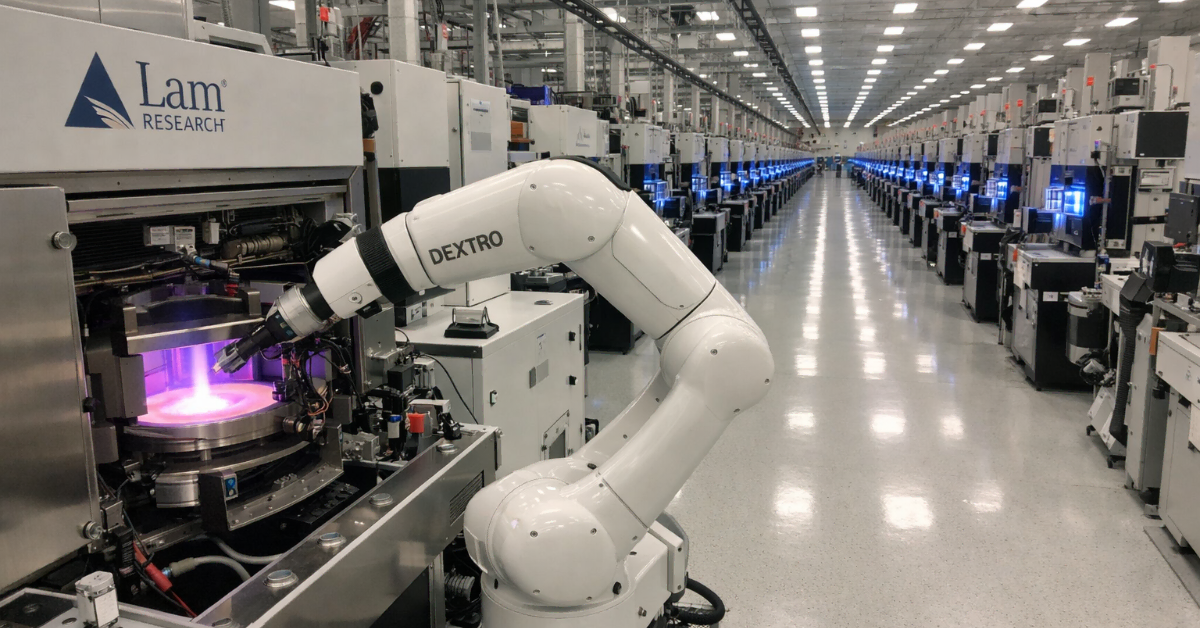
For decades, the investment thesis for Lam Research (NASDAQ: LRCX) was tethered to the brutal cyclicality of the Wafer Fabrication Equipment (WFE) market. Investors viewed the company primarily as a manufacturer of capital-intensive etching and deposition tools, leading to volatile valuation multiples that rose and fell with global chip demand. However, a fundamental shift has occurred. By surpassing an installed base of 100,000 chambers, Lam Research has effectively built a proprietary ecosystem that generates high-margin, recurring revenue. This white paper examines the “Services Moat” created by the Customer Support Business Group (CSBG), the integration of Dextro cobots, and why the “software-ization” of its hardware business necessitates a re-evaluation of its long-term valuation floor.
Table of Contents
The Evolution of the Semiconductor Lifecycle
Historically, the semiconductor equipment sector operated on a “boom and bust” logic. When chipmakers expanded capacity, they bought machines; when the market oversupplied, orders vanished. This created a high-beta environment for LRCX shares. Today, the complexity of 3D NAND and advanced logic nodes (GAA transistors) has changed the relationship between the tool manufacturer and the chip fabricator. A machine is no longer a “set and forget” asset. It is a living platform that requires constant tuning, parts replacement, and software updates to maintain yield efficiency.
Lam Research’s installed base has grown at a compound annual rate that significantly outpaces the broader WFE market. Reaching the milestone of 100,000 chambers is not just a vanity metric; it represents a captive market. Because Lam’s etch and deposition processes are deeply integrated into the specific recipes of chip production, switching costs for customers are prohibitively high. This creates a “razor-and-blade” model at an industrial scale.
CSBG: The High-Margin Engine
The Customer Support Business Group (CSBG) is the focal point of Lam’s transformation. In 2025, CSBG revenue reached a record $7.2 billion, representing a significant portion of the company’s total top line. Unlike the sale of new systems, which is subject to the capital expenditure budgets of companies like Samsung, TSMC, and Intel, CSBG revenue is driven by utilization. As long as the machines are running, Lam is earning. This makes the revenue stream counter-cyclical; even in years where new tool sales may dip, the service revenue remains resilient as chipmakers squeeze every ounce of productivity out of their existing fleets.
The margins associated with CSBG are structurally superior to hardware sales. While hardware involves significant research and development (R&D) and manufacturing costs, services and spares leverage the existing footprint. As the installed base grows, Lam benefits from economies of scale in logistics and parts inventory, further padding the bottom line.
The Technological Moat: AI and Dextro Cobots
Lam Research is not merely sending technicians with wrenches to fix machines. The company has digitized its service model through the deployment of “Dextro” cobots and AI-driven predictive maintenance. These technologies serve two purposes: increasing customer uptime and protecting Lam’s margins.
Dextro cobots are collaborative robots designed to perform high-precision tasks within the vacuum chambers, reducing the risk of human error and minimizing the time a chamber is offline. By automating the most repetitive and delicate parts of tool maintenance, Lam can service more chambers with fewer personnel, effectively decoupling revenue growth from headcount growth.
Furthermore, Lam’s AI-driven predictive maintenance utilizes the massive amounts of data generated by its 100,000+ chambers. By identifying potential failures before they occur, Lam can transition from “reactive” servicing to “proactive” servicing. For the customer, this prevents catastrophic yield loss. For Lam, it allows for optimized supply chain management, ensuring that parts are delivered exactly when and where they are needed, reducing carrying costs and improving service delivery margins.
The Financial Implications: A New Valuation Floor
The traditional P/E (Price-to-Earnings) multiple for semiconductor equipment stocks has historically been depressed compared to software or pure-play services companies because of the perceived risk of cyclicality. However, as CSBG grows to represent a larger share of the total revenue mix, the “quality” of Lam’s earnings increases. Recurring revenue is traditionally valued at a premium because of its predictability.
Investors must look at the “earnings power” of the installed base. If we treat the $7.2 billion in CSBG revenue as a standalone annuity, the valuation floor for the company rises significantly. In a downturn, while competitors may see earnings vanish, Lam’s service-heavy mix provides a buffer. This structural shift suggests that the historical “trough” multiples used to value LRCX are no longer appropriate. The market is beginning to price in a “service premium” that recognizes the stability of the installed base.
Market Dynamics and Competitive Positioning
While competitors like Applied Materials also have large installed bases, Lam’s concentration in etch and deposition—the two most critical processes for 3D scaling—gives them a unique advantage. In 3D NAND, for example, the number of layers continues to increase, requiring higher aspect ratio etches. Each additional layer increases the workload on the chamber, leading to more frequent part replacements and more intensive servicing requirements. In essence, as the chips get more complex, Lam’s service business becomes more essential.
This dynamic creates a feedback loop. The data gathered from servicing the current generation of tools informs the R&D for the next generation of hardware. This ensures that Lam’s new machines are not only more capable but also more “serviceable,” further locking in the high-margin revenue of the future.
Risks to the Thesis
No investment thesis is without risk. For Lam Research, the primary concerns involve geopolitical tensions and trade restrictions. As a key player in the semiconductor supply chain, Lam is subject to export controls, particularly concerning China. If a significant portion of the installed base in certain regions is rendered inaccessible due to political mandates, the service revenue could take a hit. Additionally, while the service model is counter-cyclical, a global depression that leads to a widespread shutdown of semiconductor fabrication plants—rather than just a reduction in new capacity—would eventually impact service utilization.
Conclusion for Investors
The “The Software-ization of Hardware” represents a maturation of the semiconductor equipment industry, with Lam Research at the forefront. The transition from $0 to 100,000 chambers was the growth phase; the transition from a hardware vendor to a service partner is the value-unlocking phase. For the long-term investor, the record $7.2 billion in CSBG revenue in 2025 is a signal that the company’s revenue profile is becoming smoother and more predictable.
By leveraging AI and robotics to scale its service capabilities, Lam Research is building a moat that is difficult for newcomers to bridge. The installed base is not just a collection of machines; it is a massive, high-margin asset that generates cash flow regardless of whether the world is buying new machines this quarter. As this “Services Moat” continues to widen, the market will likely continue to re-rate LRCX, moving it away from the “cyclical hardware” bucket and toward the “mission-critical industrial tech” category.
Investors should focus less on the quarterly fluctuations of WFE spending and more on the growth of the installed base and the expansion of service margins. In the age of AI and 3D chips, the company that keeps the machines running is just as valuable as the company that builds them.