
Table of Contents
Introduction
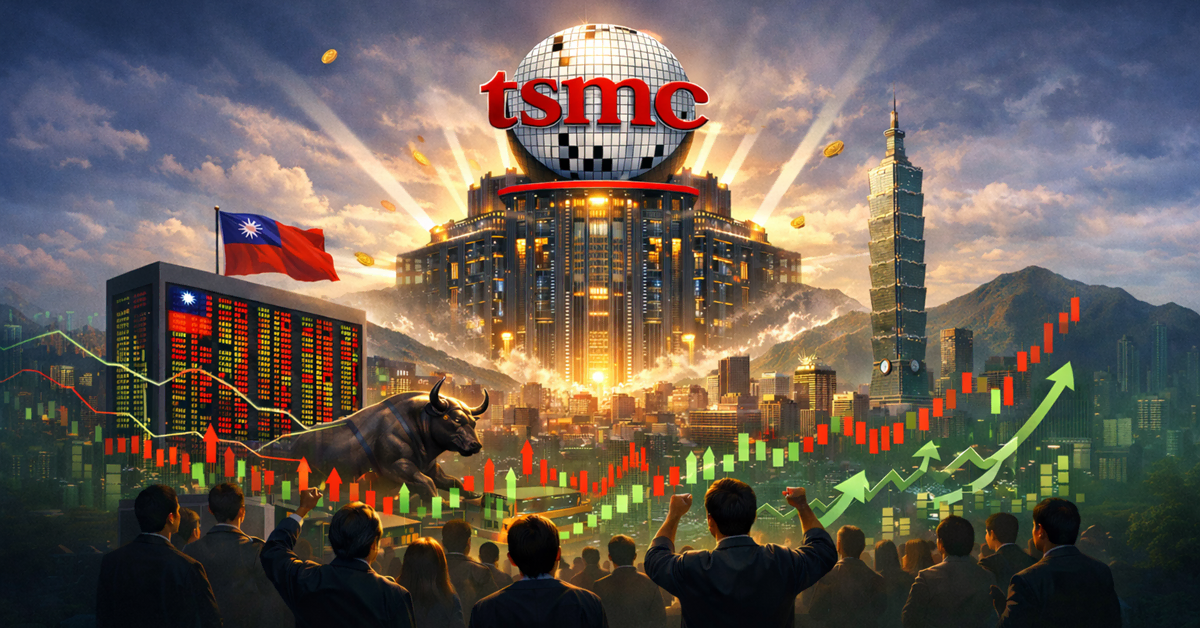
The Taiwan Capitalization Weighted Stock Index, commonly known as the TAIEX, serves as the primary benchmark for the Taiwan Stock Exchange (TWSE). In recent years, the index has become increasingly synonymous with a single entity: Taiwan Semiconductor Manufacturing Company (TSMC). As the world leader in advanced semiconductor fabrication, TSMC’s market valuation has surged, leading to a unique structural phenomenon where one stock exerts a disproportionate influence over an entire national economy’s benchmark.
The Mechanics of Index Distortion
The TAIEX is a market-capitalization-weighted index. This means that companies with larger market values have a greater impact on the index’s movement. Because TSMC’s market capitalization often exceeds 30% of the total index value, the TAIEX frequently ceases to reflect the broader performance of the Taiwanese corporate landscape. Instead, it functions as a leveraged proxy for the global semiconductor cycle.
This distortion creates a “decoupling” effect. On days when the majority of listed stocks in Taiwan are trading higher, the TAIEX may still close in negative territory if TSMC shares face a sell-off. Conversely, a strong rally in TSMC can mask systemic weakness in other sectors like textiles, plastics, or traditional banking. This concentration results in an index that is highly sensitive to industry-specific news rather than domestic macroeconomic indicators.
Assessing the Risks of High Weighting
For investors, the heavy weighting of TSMC introduces several specific categories of risk:
1. Concentration Risk
Standard diversification principles suggest that no single security should dominate a portfolio. Investors buying a TAIEX-tracking ETF are essentially making a massive bet on a single company. If TSMC faces operational hurdles, geopolitical tension, or a downturn in high-performance computing demand, the entire index suffers regardless of the health of other constituents.
2. Volatility Amplification
Because TSMC is a favorite for foreign institutional investors, it is often used as a “liquidity tap.” During global market retracements, institutions often sell large-cap, liquid names like TSMC to raise cash. This selling pressure causes outsized swings in the TAIEX that may not be fundamentally justified by the performance of the other 900+ companies on the exchange.
3. Geopolitical Exposure
TSMC is at the heart of the “silicon shield” and is central to US-China trade tensions. Any escalation in cross-strait relations or changes in export control policies impacts TSMC immediately. Due to its weight, these geopolitical shocks are instantly transmitted to the TAIEX, making the index more sensitive to international politics than many other emerging or developed markets.
Is it Too Risky to Invest?
Whether the TAIEX is “too risky” depends on an investor’s objective. It is important to distinguish between the risk of the index and the risk of the underlying economy.
The TAIEX remains one of the highest-quality benchmarks in Asia in terms of corporate governance and dividend yields. Furthermore, TSMC’s dominance is not accidental; it reflects the company’s “moat” and its role as a critical supplier to the global tech ecosystem. For those bullish on Artificial Intelligence (AI) and the long-term growth of the digital economy, the TAIEX provides concentrated exposure to the most vital link in the supply chain.
However, for investors seeking a broad-based reflection of the Taiwanese economy, the TAIEX is a flawed instrument. To mitigate this risk, many sophisticated investors look toward “Equal Weight” versions of the index or “TAIEX Ex-Electronics” indices, which provide a clearer picture of the non-tech sectors.
Conclusion
The TAIEX is undoubtedly distorted by TSMC. This concentration creates a high-beta environment where the index’s direction is dictated by semiconductor trends and foreign fund flows. While this presents a significant concentration risk, it also offers a unique vehicle for capturing the growth of global technology. Investors must decide if they are comfortable with a benchmark that behaves more like a specialized tech fund than a diversified national index.