
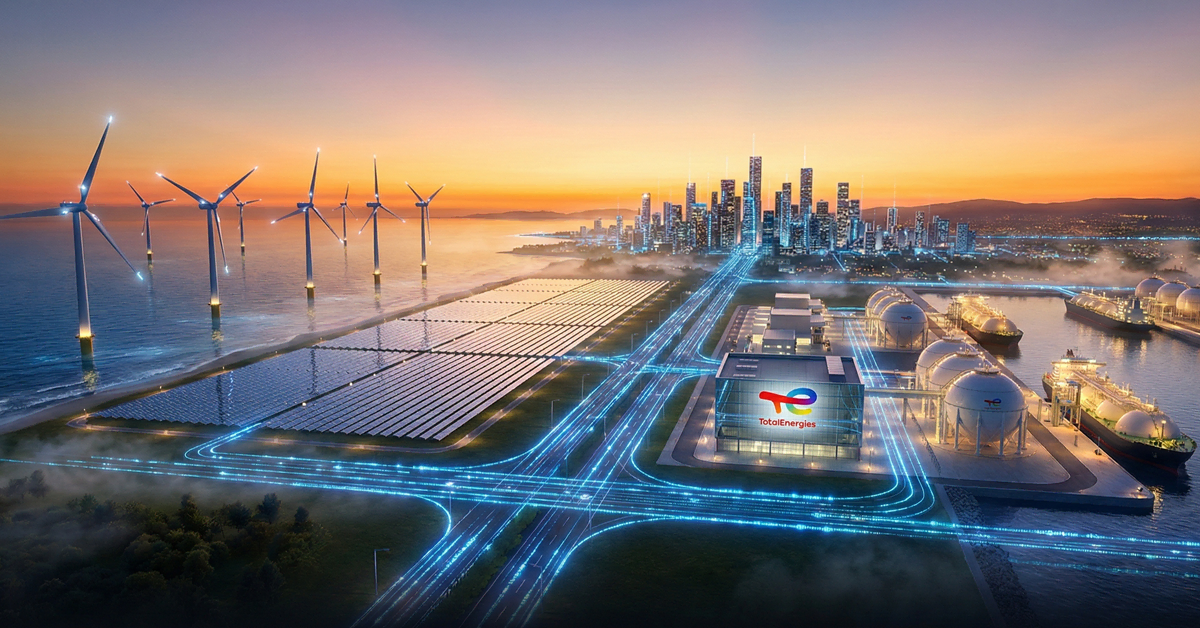
The global energy landscape is undergoing a fundamental transformation, driven by the dual imperatives of energy security and decarbonization. While many of its peers in the “Big Oil” category have maintained a relatively conservative approach, prioritizing legacy hydrocarbon returns or returning capital through buybacks, TotalEnergies SE has distinguished itself by executing an aggressive, multi-pronged pivot toward electricity and renewable energy. This strategic shift is not merely a branding exercise but a structural reorganization of the company value chain, aiming to transform a traditional oil and gas major into a broad-based energy company. This report examines the mechanics of this transition, the scalability of the integrated power model, and the critical financial questions regarding margin parity between green assets and traditional fossil fuels.
Table of Contents
The Integrated Power Model: Controlling the Value Chain
At the heart of the TotalEnergies strategy is the concept of Integrated Power. Unlike many independent power producers that focus solely on generation, or utilities that focus on distribution, TotalEnergies is attempting to replicate its successful “well-to-wheel” oil model within the electricity sector. This involves a comprehensive presence across the entire electricity value chain, encompassing generation, storage, trading, and retail distribution.
The logic behind integration is risk mitigation and margin capture. By owning the generation assets—primarily utility-scale solar and wind—TotalEnergies secures its supply. By investing in battery storage, such as through its subsidiary Saft, the company can manage the intermittency inherent in renewables, allowing it to sell power when prices are highest rather than when the sun is shining or the wind is blowing. The trading arm then optimizes these flows in real-time markets, while the retail division provides a direct channel to millions of residential and industrial customers. This circular ecosystem is designed to capture margins at every step, reducing exposure to the volatility of wholesale power prices.
TotalEnergies has been particularly active in the flexible generation space. Recognizing that a grid powered by renewables requires “firming” capacity, the company has acquired and developed combined-cycle gas turbine plants. These assets act as a bridge, providing reliable power when renewable output drops, thereby ensuring that the integrated portfolio can meet its delivery commitments to retail and corporate clients without relying on expensive spot-market purchases.
Renewable Energy Targets and the Path to 2030
The company has set ambitious benchmarks to define its success in the transition. By 2030, TotalEnergies aims to be among the top five global producers of renewable electricity. To achieve this, the firm is targeting a gross renewable energy generation capacity of 100 gigawatts by the end of the decade. This represents a massive scaling effort, requiring billions of dollars in annual capital expenditure directed toward solar farms, onshore wind, and increasingly, offshore wind projects.
Geographic diversification is a key component of this growth. TotalEnergies has avoided over-concentration in any single market, instead building a global footprint that includes significant positions in Europe, the United States, India, and Brazil. In India, for instance, the partnership with Adani Green Energy has provided a massive platform for solar expansion in one of the world fastest-growing energy markets. In the United States, the acquisition of Core Solar and development of offshore wind leases off the coast of New York and New Jersey demonstrate a commitment to the North American transition.
Offshore wind is a particularly strategic pillar for the company. While the sector has faced recent headwinds due to inflation and supply chain constraints, TotalEnergies views offshore wind as the only renewable technology capable of providing the scale and capacity factors necessary to power large industrial hubs. By leveraging its decades of experience in offshore oil and gas engineering—specifically in deep-water platforms and subsea infrastructure—the company possesses a competitive advantage in executing complex maritime energy projects that pure-play renewable firms may lack.
The Margin Challenge: Green vs. Black Assets
For investors, the central tension in the TotalEnergies thesis is the “return gap.” Historically, upstream oil and gas projects have delivered double-digit returns on average capital employed, often exceeding 15 percent in high-price environments. Conversely, regulated or long-term contracted renewable projects have traditionally offered lower, more stable returns in the range of 6 to 9 percent. The skepticism among the investment community is whether a company can maintain its valuation and dividend capacity while shifting its capital allocation toward lower-margin assets.
TotalEnergies argues that this comparison is overly simplistic. The company contends that while the headline return on a standalone solar farm might be lower than an oil well, the risk profile is also significantly lower. Oil projects are subject to extreme commodity price volatility, geopolitical risk, and the long-term threat of stranded assets. Renewable projects, once built, have near-zero marginal costs and often benefit from long-term power purchase agreements that provide predictable cash flows for decades.
Furthermore, the integrated model is intended to “boost” these base returns. By combining generation with trading and retail, TotalEnergies targets a return on equity of over 10 percent for its Integrated Power segment. This is achieved by capturing the “premium” associated with reliability and flexibility. As more intermittent renewables enter the grid, the value of being able to provide “firm” 24/7 green power to corporate clients increases. Companies like Amazon, Google, and Microsoft are willing to pay a premium for guaranteed renewable supply to meet their sustainability goals, and TotalEnergies is positioning itself as one of the few global entities capable of signing such large-scale, complex contracts.
Hydrocarbons as the Engine of Transition
Crucially, TotalEnergies is not exiting the oil and gas business. Instead, it is using the massive cash flows generated by its legacy hydrocarbon assets to fund the build-out of its power division. The company describes this as a “balanced” approach. It continues to invest in low-cost, low-emission oil projects—such as those in Brazil and Guyana—and remains a global leader in Liquefied Natural Gas.
LNG is viewed as the indispensable partner to the renewable pivot. As the world moves away from coal, natural gas provides a lower-carbon alternative for base-load power and industrial heat. TotalEnergies has secured a dominant position in the global LNG value chain, from production in Qatar and the U.S. to regasification terminals in Europe and Asia. The profits from this segment provide the financial “ballast” that allows the company to invest 3 to 4 billion dollars annually in Integrated Power without compromising its balance sheet or its progressive dividend policy.
Strategic Risks and Competitive Landscape
The path is not without significant risks. The first is execution risk. Building 100 gigawatts of capacity requires navigating complex permitting processes, local opposition, and fluctuating raw material costs for turbines and solar panels. Any significant delays in project timelines could erode the projected returns and allow competitors to capture market share.
The second risk is the competitive landscape. TotalEnergies is not just competing with other oil majors like BP or Shell, but also with specialized utilities like Iberdrola, Enel, and NextEra Energy, as well as institutional investors and infrastructure funds that have a lower cost of capital. In many auctions for renewable capacity, the bidding has become “white-hot,” driving down potential returns to levels that may be unattractive for a diversified energy major.
Finally, there is the risk of policy reversal. The transition is heavily underpinned by government subsidies, carbon pricing mechanisms, and mandates. A shift in the political climate in key markets—particularly the United States or Europe—could alter the economic viability of certain renewable investments. TotalEnergies mitigates this by focusing on projects that are “subsidy-free” or have reached grid parity, but the regulatory environment remains a critical variable.
Conclusion
TotalEnergies is currently conducting one of the most significant industrial experiments of the 21st century. It is attempting to prove that a massive fossil fuel incumbent can successfully pivot its core competency to electricity while maintaining the financial performance that investors demand. The integrated power strategy is a sophisticated response to the limitations of pure renewable generation, aiming to capture value through complexity and scale.
The success of the 2030 targets will depend on the company ability to execute its massive project pipeline while simultaneously optimizing its trading and retail operations to bridge the margin gap. If TotalEnergies can demonstrate that its integrated electricity model produces resilient, double-digit returns, it will likely serve as the blueprint for the survival of the traditional energy industry in a net-zero world. For now, the company stands as a unique outlier: a high-yielding dividend payer that is also a top-tier growth engine for the global energy transition.
The transformation from an oil major to a multi-energy provider is well underway. While the transition pace is a subject of constant debate, the direction of travel is clear. TotalEnergies is betting that the future of energy is not just green, but integrated, and it is spending billions to ensure it owns the infrastructure of that future.