
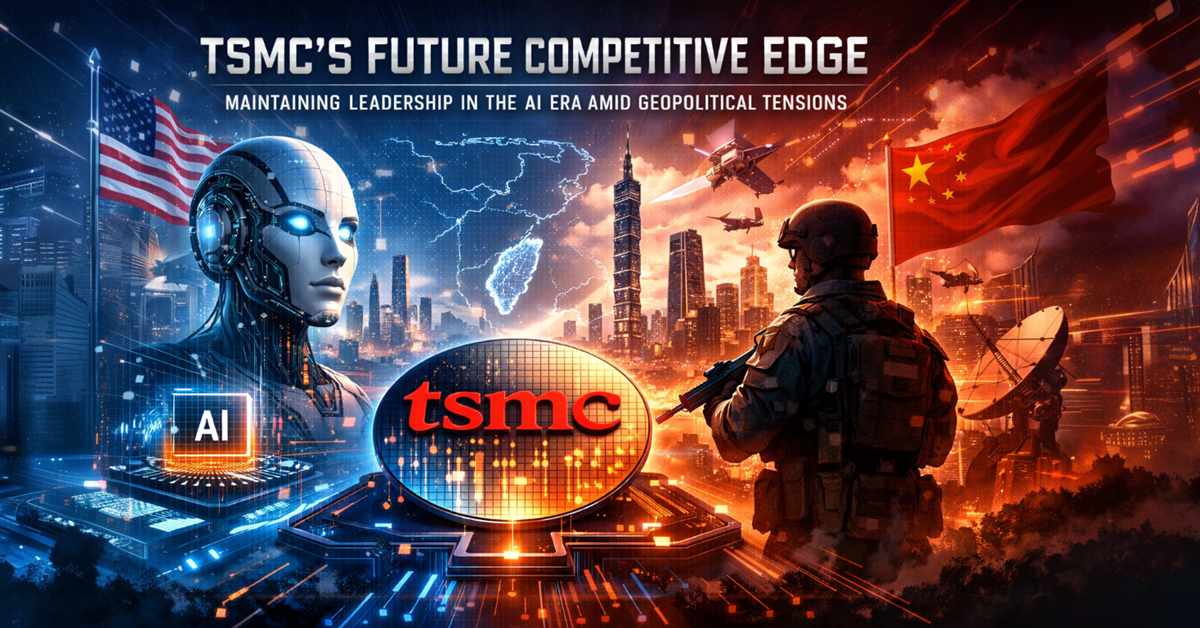
Taiwan Semiconductor Manufacturing Company (TSMC) is the world’s largest and most technologically advanced dedicated semiconductor foundry. The consensus across the industry and investment community indicates that TSMC is well-positioned to maintain its competitive edge and continue its growth trajectory over the next five years (2026-2030), primarily driven by its technological supremacy and its indispensable role as the primary supplier for the global Artificial Intelligence (AI) hardware revolution.
Table of Contents
Maintaining the Competitive Edge and Growth Trajectory (2026-2030)
TSMC’s core competitiveness is built on an exceptionally wide and deep technological moat that competitors struggle to breach.
1. Unmatched Technological Supremacy
TSMC has consistently maintained a process leadership lead over its primary competitors, Samsung Foundry and Intel Foundry Services (IFS). This is its most critical competitive advantage.
- Advanced Node Roadmap: TSMC is the first to achieve mass production for the most advanced nodes, currently dominating the market for 3-nanometer (nm) and more advanced processes. Its roadmap continues to push the boundaries, with the 2nm node on track for volume production, and subsequent research and development progressing on the A16 (Angstrom) nodes and beyond. This relentless progression ensures that major, high-volume customers (like Apple, NVIDIA, and AMD) must rely on TSMC for their most powerful and profitable chips.
- Advanced Packaging Leadership: The increasing complexity of AI chips requires not just smaller transistors, but sophisticated 3D stacking and packaging technologies. TSMC’s 3DFabric® platform, which includes the industry-leading CoWoS® (Chip-on-Wafer-on-Substrate) technology, is essential for high-performance computing (HPC) and AI accelerators. The current robust demand for CoWoS® is driving significant revenue growth and further cementing its integration with core customers.
2. The Indispensability of the AI Gold Rush
The structural demand for energy-efficient computing, fueled by the accelerating global AI arms race, is the single largest growth catalyst for TSMC.
- Key AI Enabler: TSMC is the exclusive or primary manufacturer for virtually all leading AI accelerators, including the flagship GPUs and ASICs (Application-Specific Integrated Circuits) that power global data centers. This demand is forecast to grow at a mid-40s% Compound Annual Growth Rate (CAGR) over the next five years.
- “Foundry-Only” Model: Unlike Integrated Device Manufacturers (IDMs) such as Intel, TSMC’s pure-play foundry model means it serves all major fabless chip companies without competing against them. This trust-based, long-term partnership approach makes TSMC the preferred and neutral manufacturing partner for the entire industry.
3. Financial Power and Scale
The extreme capital intensity of advanced chip manufacturing acts as a barrier to entry. TSMC plans to invest tens of billions of US dollars annually in Capital Expenditure (CapEx), with a large percentage dedicated to advanced process development. Its industry-leading profit margins, which often exceed 40%, enable it to fund this massive investment cycle, making it nearly impossible for competitors to match the spending pace required to catch up.
Addressing Competitive Threats and Geopolitical Risks
The main challenges to TSMC’s dominance come from competitor catch-up attempts and the volatile geopolitical landscape.
Dealing with Competitors (Samsung and Intel)
- Samsung Foundry: Samsung is the only other player currently mass-producing advanced nodes, but TSMC maintains a significant market share lead (around 90% in the high-end segment). TSMC’s consistently superior yield rates and execution in ramping up new technologies have kept it ahead.
- Intel Foundry Services (IFS): Intel is committing massive resources to challenge TSMC by aiming to catch up technologically and becoming a major contract manufacturer. While Intel has a clear roadmap, TSMC’s continuous investment, proven execution, and established customer trust make it highly likely to maintain a substantial lead over IFS in the core leading-edge market throughout the next five years.
- SMIC (China): SMIC focuses primarily on the domestic Chinese market, operating several generations behind TSMC’s most advanced nodes due to US export controls. Its main impact is limited to competition in TSMC’s mature-node and specialty technology segments within the China market.
Dealing with US Tariffs and Geopolitical Uncertainty
TSMC’s strategy to navigate US tariffs and geopolitical risks is centered on global diversification and strategic investment that aligns with the national security priorities of its key customers (the US, Japan, and Europe).
| Challenge | TSMC’s Strategic Response |
|---|---|
| Potential US Tariffs on Chips | Massive US Investment: TSMC announced significant investment expansions in the United States, notably in Arizona, for advanced manufacturing (including 4nm, 3nm, and planned 2nm facilities). This strategic overture is intended to mollify protectionist policies and mitigate the impact of tariffs by increasing domestic US chip production, thereby securing its market position in the US, which accounts for approximately 70% of its revenue. |
| Geographical Concentration Risk | Global Expansion of Production Footprint: TSMC is diversifying its manufacturing base beyond Taiwan by building new fabs in Japan (Kumamoto, focusing on specialty technologies) and planning one in Germany (Dresden, focusing on automotive/industrial specialty nodes). This “Fab for Fab” strategy helps secure stable supply chains for its global customers and reduces perceived geopolitical risk. |
| Impact on Profit Margins | Pricing Power and Operational Excellence: Management acknowledges that overseas fabs carry higher initial operating costs, which could dilute the company’s gross margin by a few percentage points annually. However, TSMC’s significant pricing power, driven by the indispensability of its advanced technology, allows it to manage and minimize this cost gap. Its financial strength enables it to absorb these initial costs while maintaining industry-leading margins. |
| US Export Controls on China | Compliance and Strategic Retreat: TSMC has fully complied with all tightened US export controls targeting advanced chips for China. While this limits its revenue from the Chinese HPC/AI market, the overwhelming demand from non-China customers (primarily the US-based AI giants) for the most advanced nodes has allowed TSMC to avoid significant financial damage and instead redirect capacity to higher-margin business. |
Conclusion
TSMC’s competitive edge remains firmly rooted in its unparalleled and sustained technology lead in advanced process nodes and packaging solutions, which is the cornerstone of the multi-trillion-dollar AI and HPC growth markets. The company’s massive, consistent CapEx spending acts as a firewall against competitors. While geopolitical tensions and the threat of US tariffs create operational and financial headwinds, TSMC is proactively addressing these risks through a strategic, multi-billion-dollar global production diversification plan that aligns its long-term strategy with the domestic supply chain goals of its largest global partners.