
Table of Contents
Executive Summary: The Asset-Light Autonomy Mandate
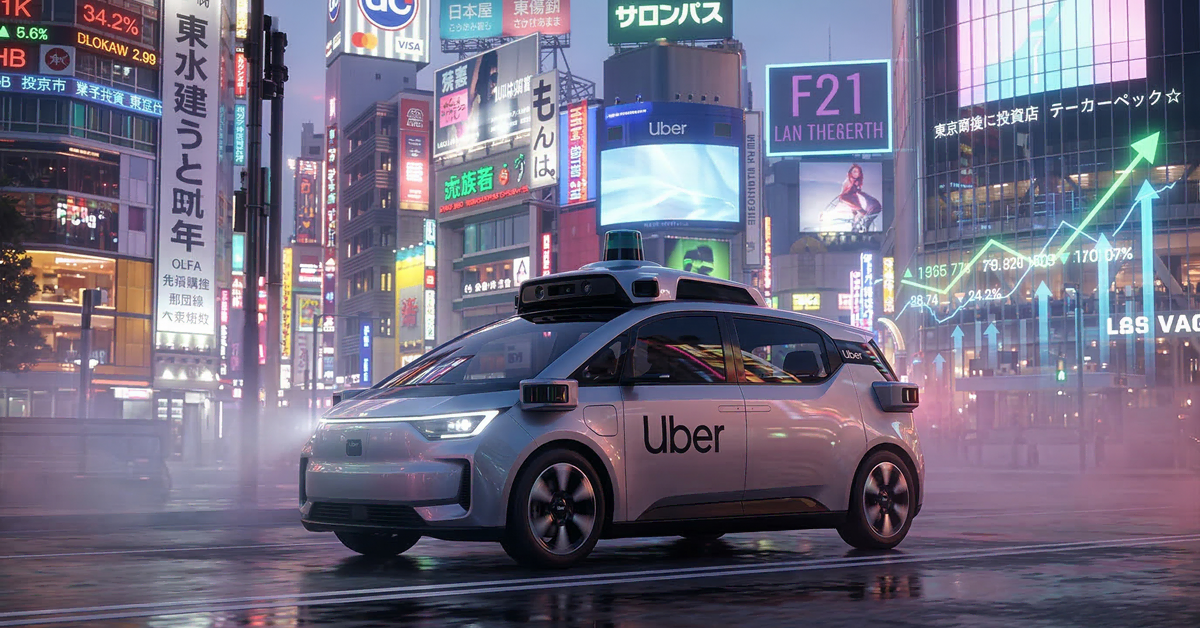
Uber Technologies Inc. (NYSE: UBER) has fundamentally transitioned from attempting to build proprietary self-driving hardware to positioning itself as the indispensable aggregation layer for the global autonomous vehicle (AV) industry. Following the strategic divestiture of its Advanced Technologies Group (ATG) in 2020, Uber has systematically built a robust, partner-agnostic ecosystem. The commercial viability of this strategy has dramatically accelerated in the first quarter of 2026, highlighted by two landmark developments: the commercial relaunch of Motional’s robotaxi fleet on the Uber network in Las Vegas, and the signing of a tripartite memorandum of understanding (MoU) with Nissan and Wayve for a 2026 robotaxi pilot in Tokyo.
For institutional investors, the core thesis surrounding Uber’s AV strategy centers on the “cost per mile” (CPM) equation. The removal of human drivers—who currently account for the vast majority of variable costs in the ride-hailing economic model—promises to structurally transform platform margins. By operating a hybrid network where third-party autonomous fleets handle baseline demand and human drivers absorb peak volatility, Uber mitigates the capital expenditures associated with fleet ownership while capturing the upside of lower operating costs. This research report deep-dives into these recent partnerships, the unit economics of driverless networks, and how Uber is securing its moat in the multi-trillion-dollar mobility market.
The Strategic Pivot: From Developer to Global Aggregator
To understand the significance of the Motional and Nissan/Wayve partnerships, investors must contextualize Uber’s strategic evolution. Developing Level 4 (L4) autonomous software is inherently capital-intensive, requiring billions in ongoing R&D, sensor procurement, and regulatory lobbying. By stepping back from in-house development, Uber conserved crucial free cash flow, accelerating its path to GAAP profitability.
Today, Uber operates as a global marketplace aggregator. Through its newly delineated “Uber Autonomous Solutions” framework, the company provides AV developers and Original Equipment Manufacturers (OEMs) with the precise infrastructure required to commercialize their hardware. This includes access to a liquid marketplace of over 150 million monthly active platform consumers, data-enriched mapping informed by tens of billions of historical trips, and fleet operations software.
AV developers face a critical “cold start” problem: deploying a fleet of billion-dollar robotaxis is economically ruinous without immediate, dense passenger demand. Uber solves this utilization dilemma. Rather than building competing consumer-facing apps, developers like Motional, Zoox, and Wayve are increasingly integrating directly into the Uber API, solidifying Uber’s position as the primary distribution channel for next-generation mobility.
Commercial Launch in Las Vegas: The Motional and Hyundai Integration
In mid-March 2026, Uber and Motional (a joint venture majority-owned by Hyundai Motor Group) officially launched a commercial robotaxi service in Las Vegas. This deployment represents a critical operational proof-of-point for Uber’s aggregator model in high-density, complex urban corridors.
Operational Footprint and the Rider Experience
The Las Vegas deployment utilizes all-electric Hyundai IONIQ 5 robotaxis, which are custom-engineered for ride-hailing and represent some of the first SAE Level 4-capable AVs certified under U.S. Federal Motor Vehicle Safety Standards (FMVSS). At launch, the service covers designated, high-demand rideshare zones along Las Vegas Boulevard—including Resorts World, Encore at the Wynn, and Westgate—as well as the Town Square shopping district and downtown sectors.
Crucially, the integration is frictionless for the consumer. Riders requesting an UberX, Uber Electric, or Uber Comfort vehicle may be automatically matched with a Motional AV at no additional cost. The entire rider journey—from unlocking the vehicle doors to accessing human customer support—is natively housed within the existing Uber app architecture.
Strategic Milestones and Timeline to Driverless
Currently, the Motional vehicles operate with a human safety operator monitoring the road from the driver’s seat. However, the explicit strategic objective mapped out by both management teams is to remove the safety operator by the end of 2026. Las Vegas serves as an optimal deployment zone due to its standardized grid, well-mapped casino ingress/egress points, and highly predictable tourist transit patterns. For Uber, facilitating a localized, high-utilization market like Las Vegas proves to potential AV partners that the platform can deliver sustained, paying volume to amortize the heavy fixed costs of AV fleets.
Expanding into APAC: The Tokyo 2026 Pilot with Nissan and Wayve
While Las Vegas represents the maturation of a domestic US partnership, Uber’s March 2026 MoU with Nissan and British AI startup Wayve signals an aggressive expansion into the Asia-Pacific (APAC) region. The tripartite agreement targets a late-2026 pilot deployment in Tokyo, introducing the Nissan LEAF powered by the Wayve AI Driver to the Uber platform.
The Technological Differentiator: Wayve’s Mapless Autonomy
Tokyo is universally recognized as one of the most challenging driving environments globally, characterized by labyrinthine road layouts, hyper-dense traffic, and stringent safety expectations. Traditional AV developers rely heavily on high-definition (HD) mapping and localized lidar rulesets. Wayve takes a radically different approach: Embodied AI.
Wayve’s “zero-shot” AI Driver learns directly from real-world data and generalizes across new environments without relying on pre-programmed HD maps. This mapless architecture theoretically allows for infinitely faster geographical scaling, as the system does not require months of localized geofencing prior to launch. By partnering with Wayve (which recently closed a $1.2 billion Series D heavily backed by SoftBank and Uber itself), Uber is hedging its bets across different software architectures, ensuring it retains access to whichever technological approach ultimately wins the scalability race.
Nissan’s Hardware and the Japanese Macro Environment
Nissan brings the necessary automotive scale, integrating the autonomous stack directly into the consumer-friendly LEAF electric vehicle platform. Furthermore, the macroeconomic environment in Japan serves as a potent catalyst for this pilot. Japan is facing a severe demographic crisis and an acute shortage of licensed taxi and commercial drivers. Autonomous mobility is not merely a convenience in Tokyo; it is rapidly becoming an economic necessity. Uber intends to launch this service through an existing licensed taxi partner in Japan, aligning with local regulatory frameworks and smoothing the path for municipal approval.
The Financial Linchpin: Deconstructing Unit Economics and “Cost Per Mile”
For equity analysts and institutional investors, the allure of the Uber AV narrative is fundamentally mathematical. The current ride-hailing industry is constrained by the inescapable cost of human labor. Transitioning to an autonomous model alters the entire margin structure of the platform.
The Baseline: Human-Driven Economics
Under the current paradigm, human-operated rideshare trips in the US average a cost to the consumer of roughly $2.50 to $3.25 per mile. Of the gross booking value, the driver typically retains 70% to 75% to cover their labor, fuel, insurance, and vehicle depreciation, leaving Uber with a take rate of approximately 25% to 30%. Because driver compensation represents the overwhelming majority of the variable cost, Uber’s ability to lower prices to stimulate further consumer demand is structurally capped. If fares drop too low, driver supply evaporates, leading to increased wait times and network failure.
The Autonomous Paradigm Shift
Replacing the human driver removes the largest single line item in the mobility supply chain. However, it replaces a variable cost (driver pay) with fixed and semi-variable capital costs:
- Capital Expenditure (CapEx): The upfront cost of the base vehicle plus the autonomous sensor suite (Lidar, Radar, compute nodes).
- Maintenance and Operations: Daily cleaning, sensor calibration, and preventative maintenance at localized depots.
- Energy/Charging: Electricity costs for the EV fleet.
- Insurance and Fleet Management: Teleoperations, localized safety monitoring, and commercial liability.
Despite these capital requirements, the projected unit economics are highly favorable at scale. Leading financial institutions, including Bank of America (BofA) Securities, project that robotaxi networks will achieve a tipping point when the cost per mile drops below the $1.50 to $2.00 threshold. At this level, the cost of utilizing a robotaxi approaches the comprehensive cost of private vehicle ownership (which AAA estimates at $0.70 to $1.06 per mile when factoring in depreciation, insurance, and maintenance).
Long-term modeling by firms such as ARK Invest suggests that at peak maturity and maximum fleet utilization, autonomous ride-hail services could theoretically be priced as low as $0.25 to $0.50 per mile.
Uber’s Economic Moat in the AV Era
It is critical to note that Uber does not intend to own these robotaxi fleets outright. Purchasing hundreds of thousands of $100,000 AVs would obliterate the company’s return on invested capital (ROIC). Instead, Uber operates on an agency or revenue-share model.
In a scaled AV future, an OEM (like Nissan) or a fleet operator (like Motional) provides the vehicles. Uber provides the demand, routing, pricing algorithms, and payment processing. Because the fleet owner no longer has to pay a human driver, they can accept a lower per-mile payout while still generating a robust internal rate of return (IRR) on the physical asset. Uber maintains—or potentially expands—its platform take-rate without taking on the heavy balance sheet risk of vehicle depreciation.
TAM Expansion and Price Elasticity of Demand
The reduction in the cost per mile is not merely a margin-expansion exercise; it is an aggressive Total Addressable Market (TAM) expansion strategy. The transportation market is highly price-elastic.
Currently, ride-hailing accounts for roughly 1% of total vehicle miles traveled in the United States. At $3.00 per mile, Uber is a discretionary utility used for airport transfers, nightlife, and occasional commuting. If autonomous partnerships allow Uber to push consumer pricing down to $1.50 per mile, the platform transitions from a discretionary service to a viable daily alternative to personal car ownership.
If the cost drops below $1.00 per mile, the economic rationale for owning a personal vehicle in an urban or suburban environment effectively collapses. BofA estimates that if autonomous technology can achieve a 20% penetration rate of all miles driven over the next 15 years, the robotaxi market will expand to a staggering $900 billion to $1.2 trillion in the US alone. By serving as the default routing network for these fleets, Uber stands to capture a massive share of this expanded TAM, translating to exponential gross bookings growth.
The Hybrid Network Advantage: Why OEMs Cannot Supplant Uber
A common bearish argument against Uber is the threat of disintermediation: if Waymo, Tesla, or Motional perfect the self-driving car, why wouldn’t they launch their own consumer apps and cut Uber out entirely?
The answer lies in network utilization and the volatility of urban transportation demand. Ride-hailing demand is characterized by massive peaks (e.g., Friday nights, rush hour, sudden rainstorms) and deep troughs (mid-day Tuesday).
If an AV operator builds a proprietary app, they face a localized capital dilemma. If they size their fleet to meet peak Friday night demand, 60% of their expensive robotic assets will sit idle in depots on Tuesday afternoon, bleeding depreciation and storage costs. If they size their fleet for Tuesday afternoon, their app will feature 45-minute wait times and surge pricing on Friday night, destroying consumer trust and retention.
Uber solves this through its “Hybrid Network.” Uber will dispatch autonomous vehicles for baseline, predictable demand to maximize their utilization rates (keeping the AV operators profitable). When demand spikes, Uber seamlessly surges prices and incentivizes its millions of human drivers to log online and absorb the peak volume. No standalone AV developer can dynamically scale supply like Uber’s human network. Therefore, to ensure their multi-million dollar fleets are utilized optimally 20 hours a day, AV developers are economically compelled to plug into Uber’s routing engine.
Risks and Regulatory Headwinds
While the financial modeling is compelling, investors must monitor several distinct risk factors:
- Regulatory Friction: The late-2026 timeline for the Tokyo pilot with Nissan and Wayve is heavily contingent upon municipal approvals. While Japan has shown willingness to adapt due to driver shortages, any safety incident during testing could result in immediate, nationwide moratoriums.
- Commercial Liability: The insurance burden for Level 4 autonomous incidents remains a grey area. While OEMs and tech providers bear the brunt of the liability, Uber faces significant reputational risk and potential platform liability if third-party AVs malfunction on its network.
- Hardware Deflation Delays: If the cost of Lidar, high-compute chips, and electric vehicle batteries does not deflate as forecasted, fleet operators will demand higher per-mile payouts from Uber, compressing platform margins and delaying the timeline to sub-$1.50 consumer pricing.
Investment Conclusion
The recent deployments in Las Vegas with Motional and the slated 2026 pilot in Tokyo with Nissan and Wayve validate Uber’s strategic positioning. The company has successfully navigated away from the capital sinkhole of hardware development, emerging instead as the premier digital tollbooth for global autonomous mobility.
As AV technology matures, the dramatic reduction in the “cost per mile” will not only expand platform margins but permanently alter global consumer transit habits, shifting trillions of dollars from personal vehicle ownership into on-demand mobility networks. Uber’s hybrid model—leveraging human drivers to absorb peak volatility while relying on third-party capital to supply the AV baseline—provides a distinct, insurmountable moat. For long-term investors, Uber remains the most risk-adjusted, high-probability vehicle to capture the impending autonomous revolution.