
Table of Contents
Executive Summary
As global supply chains continue to realign in the post-pandemic era, North American nearshoring has transitioned from a theoretical corporate strategy into a foundational economic reality. At the epicenter of this manufacturing migration is Mexico, which has seen unprecedented foreign direct investment from the automotive, aerospace, and heavy appliance sectors. Union Pacific Corporation (NYSE: UNP) has strategically positioned itself to capture the lion’s share of this expanding cross-border freight volume.
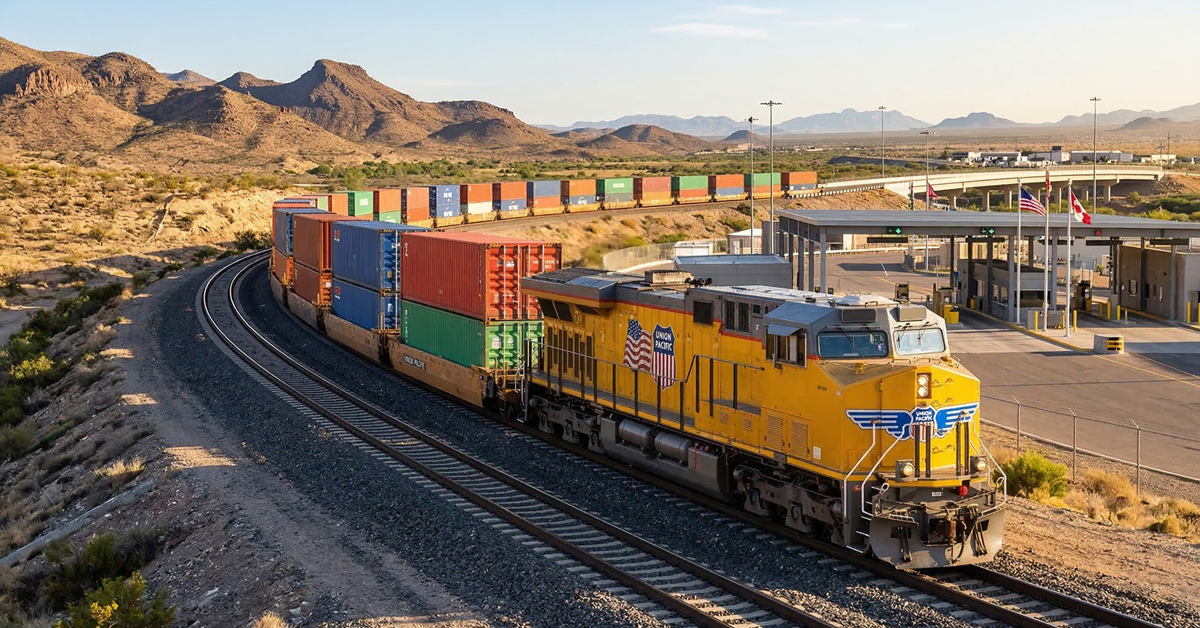
Through highly targeted capital expenditures, expansive joint ventures, and rigorous operational overhauls, Union Pacific is transforming its intermodal network. The cornerstone of this strategy is the “Falcon Premium” service—a best-in-class, tri-national intermodal partnership with Canadian National (CN) and Grupo México Transportes (GMXT). By drastically reducing transit times, maximizing heavyweight loading capabilities, and bypassing highly congested vehicular border checkpoints, Union Pacific is successfully converting long-haul truck traffic to rail.
Following a record-breaking financial and operational performance in 2025—highlighted by a 6% growth in net income, an adjusted operating ratio of 59.3%, and the safest operational year on record—Union Pacific is entering 2026 with unparalleled momentum. Furthermore, the proposed transformational combination with Norfolk Southern to create America’s first transcontinental railroad signifies a paradigm shift in North American logistics. This report provides a comprehensive evaluation of Union Pacific’s cross-border partnerships, intermodal growth trajectory, and overall investment profile as the premier logistics provider for the North American nearshoring boom.
Macroeconomic Catalysts: The Reshaping of Global Supply Chains
The structural vulnerabilities of offshore manufacturing were severely exposed during the supply chain crises of the early 2020s. Overextended maritime routes, volatile shipping rates, and geopolitical tensions forced multinational corporations to reevaluate their reliance on trans-Pacific supply lines. The resulting pivot toward nearshoring—shifting manufacturing and assembly operations closer to the end consumer—has structurally elevated Mexico’s status within the global industrial complex.
The Rise of the Mexican Manufacturing Hub
Mexico offers a unique confluence of advantages for North American production: highly skilled and cost-effective labor, deep integration via the United States-Mexico-Canada Agreement (USMCA), and geographic proximity to the world’s largest consumer market. In the first half of 2023 alone, Mexico recorded over $42 billion in announced foreign direct investments, establishing new hubs for electric vehicle production, steel manufacturing, and advanced electronics. This momentum has aggressively compounded through 2024 and 2025, creating a sustained surge in cross-border freight demand.
The Cross-Border Bottleneck and the Intermodal Imperative
While manufacturing capacity in Mexico has expanded rapidly, the physical infrastructure required to move finished goods and raw materials across the U.S.-Mexico border has struggled to keep pace. Highway congestion, critical shortages in the trucking labor market, deteriorating road conditions, and security concerns regarding freight theft have plagued over-the-road transportation.
This environment has created a massive total addressable market for cross-border intermodal rail. Intermodal shipping—which utilizes standardized containers that can be seamlessly transferred between ships, trains, and trucks without unloading the cargo itself—offers a highly efficient alternative. By transitioning volume to rail, shippers bypass vehicular border lines through advanced customs pre-clearance protocols, secure consistent capacity, and benefit from substantially lower cost-per-ton-mile economics. Union Pacific foresaw this macro shift, initiating strategic investments years in advance to ensure their network could handle the incoming wave of nearshored freight.
Strategic Anatomy of Falcon Premium Service
To dominate the north-south trade corridor, Union Pacific launched the Falcon Premium intermodal service in 2023, a venture that has continuously evolved and optimized to become the fastest, most reliable intermodal rail service connecting Mexico, the United States, and Canada.
Tri-National Synergy and Route Optimization
Falcon Premium is an innovative partnership between three Class I operators: Canadian National (CN), Union Pacific (UP), and Grupo México Transportes (GMXT). The service fundamentally alters the logistics map of North America by connecting CN origin points across Canada and Detroit, Michigan, directly to GMXT terminals in Monterrey, Nuevo León, and Silao, Guanajuato.
The route’s architecture leverages the unique geographic and operational strengths of each partner:
- GMXT: Provides best-in-class transit times originating from the deep industrial zones of Silao and Monterrey, smoothly conveying freight to the Texas border at Eagle Pass.
- Union Pacific: Utilizes its unmatched, geographically shortest physical route from the Texas border to the critical rail hub of Chicago, Illinois.
- Canadian National: Executes the final leg, connecting Chicago to points across Canada via the highly efficient EJ&E Chicago bypass, avoiding the notorious congestion of the inner-city Chicago rail network.
Operational Superiority and Transit Time Reductions
In the logistics industry, transit time is the ultimate currency. Shortly after its initial launch, Union Pacific and its partners successfully engineered the removal of a full 24 hours of transit time from the Falcon Premium schedule. Currently, the service runs from Monterrey, Mexico, to Brampton, Ontario in approximately 5.1 days—a remarkable operational feat that aggressively competes with long-haul trucking schedules.
This speed is achieved through continuous operational flow, advanced interchange logistics in Dolton and Harvey, Illinois, and seamless customs processing that identically mirrors the efficiency of domestic truck transfers without the border delays.
The Heavyweight Loading Advantage
A highly distinct, yet frequently underappreciated, competitive advantage of the Falcon Premium service is its heavyweight loading policy. Highway weight restrictions severely limit the payload a standard truck can carry. Because Falcon Premium operates primarily on heavy-duty rail infrastructure across its three-country route, shippers are permitted to maximize lading weights significantly beyond standard highway limits.
For industries transporting heavy metal concentrates, coiled steel, lumber, paper, and heavy machinery, this capability is transformative. By optimizing the weight hauled per container, shippers drastically reduce their overall transportation costs per ton, enhancing their margin profile and firmly embedding Union Pacific into their core supply chain architecture.
Expanding the Cross-Border Network: Eagle Premium & Gateway Dominance
While Falcon Premium anchors the tri-national strategy, Union Pacific has simultaneously developed robust bilateral solutions to capture market share across all North American geographies.
Eagle Premium: Bypassing Border Friction
Operating in conjunction with GMXT, Union Pacific’s Eagle Premium service delivers seamless, six-day-per-week intermodal transit between Chicago and Monterrey. Recognizing the dispersion of demand, Union Pacific has aggressively expanded the Eagle Premium network to service the West Coast and Pacific Northwest, establishing highly efficient corridors from Monterrey directly to Lathrop and Los Angeles, California, as well as Seattle, Washington.
By utilizing advanced customs brokerage services and high-security seals, Eagle Premium ensures that freight bypasses congested border checkpoints, mitigating the risk of vandalism and theft that frequently plagues highway transport in border regions. This non-stop operational flow reduces transit volatility, allowing automotive and appliance manufacturers to run leaner, more predictable “just-in-time” supply chains.
Unmatched Gateway Access and Terminal Capacity
Union Pacific holds a geographical monopoly as the only Class I railroad to serve all six major gateways on the U.S.-Mexico southern border: Brownsville, Laredo, Eagle Pass, El Paso, Nogales, and Calexico. This pervasive footprint provides shippers with unparalleled optionality and resilience; if one gateway experiences geopolitical friction or temporary embargoes (such as the migrant-related volume surges seen at Eagle Pass in late 2023), Union Pacific can dynamically reroute freight through alternative corridors.
To support this massive throughput, Union Pacific has methodically expanded its terminal infrastructure. Since 2021, the company has increased systemwide terminal capacity by over 10%. Crucial investments include the expansion of the Twin Cities Intermodal Terminal in Minnesota, providing new reach into the Upper Midwest, and the Inland Empire Intermodal Terminal, giving shippers direct access to California’s largest warehouse district. With plans to add over one million lift capabilities to its intermodal ramps, Union Pacific is heavily fortifying its economic moat.
Financial Analysis: 2025 Performance & 2026 Capital Outlook
Union Pacific’s strategic initiatives have translated into exceptional financial results, demonstrating the company’s ability to drive volume growth while simultaneously achieving rigorous operational efficiency.
Record-Breaking FY25 Results
On January 27, 2026, Union Pacific reported its full-year 2025 earnings, characterizing the period as a record-breaking year for safety, service, and operations.
- Earnings and Income: The company reported a full-year net income of $7.1 billion, representing a 6% year-over-year growth. Diluted earnings per share (EPS) reached $11.98, an 8% improvement over 2024.
- Operating Efficiency: The reported operating ratio (OR)—a critical metric in the rail industry measuring operating expenses as a percentage of revenue—improved by 10 basis points to 59.8%, with an adjusted operating ratio reaching a highly efficient 59.3%.
- Volume and Productivity: Freight revenue (excluding fuel surcharges) grew by 3%, driven by strength in intermodal, metals, minerals, and industrial chemicals. The network’s fluidity metrics were outstanding: freight car velocity increased by 8% to 225 daily miles per car, and workforce productivity improved by 7% to 1,132 car miles per employee.
2026 Capital Allocation and Shareholder Returns
Union Pacific’s robust cash generation engine—converting 77% of cash flow from operations—enables aggressive reinvestment alongside shareholder value creation. Management has outlined a comprehensive $3.3 billion capital plan for 2026. This capital expenditure will be highly concentrated on track infrastructure, terminal expansions, and locomotive modernization, including a landmark $1.2 billion agreement with Wabtec to modernize the AC4400 locomotive fleet.
The company remains deeply committed to capital returns, recently declaring a Q1 2026 quarterly dividend of $1.38 per share, maintaining its legacy of consistent annual dividend increases.
The Transcontinental Catalyst
Looming over the 2026 financial horizon is the proposed transformational combination with Norfolk Southern. If approved by regulators, this merger will create America’s first true transcontinental railroad. For cross-border intermodal shippers, this represents the holy grail of logistics: a single-line network connecting the manufacturing hubs of Mexico directly to the dense consumer markets and ports of the U.S. East Coast, entirely bypassing the historical friction of interchanging railroads in Chicago or Memphis.
ESG and Sustainable Supply Chain Tailwinds
As nearshoring grows, so does corporate scrutiny regarding Scope 3 emissions and sustainable supply chain practices. Intermodal rail is unequivocally the most environmentally responsible method for moving terrestrial freight, serving as a massive commercial tailwind for Union Pacific.
Carbon Footprint Reduction
Trains are nearly four times more fuel-efficient than trucks. By converting long-haul highway shipments to the Falcon or Eagle Premium rail networks, shippers can reduce their transportation-related greenhouse gas (GHG) emissions by up to 75%. For Fortune 500 companies facing strict internal ESG mandates and increasing regulatory pressure, this carbon mitigation is no longer a peripheral benefit—it is a core requirement for vendor selection.
Infrastructure and Social Responsibility
Beyond emissions, shifting heavy freight from trucks to trains drastically reduces highway congestion, minimizes wear and tear on publicly funded infrastructure, and lowers noise pollution in local communities. Furthermore, Union Pacific’s safety metrics lead the industry. The Federal Railroad Administration (FRA) data highlighted 2025 as the safest year on record for the rail industry, with truck incident rates remaining exponentially higher than rail (6.84 per 100 million gross ton-miles for trucks vs. 0.45 for rail). Union Pacific’s modernized AC4400 fleet will further depress emissions and improve fuel efficiency, cementing its status as an ESG leader.
Competitive Landscape and Forward-Looking Risks
Despite its dominant positioning, Union Pacific operates in a fiercely competitive and highly cyclical environment that warrants investor consideration.
The CPKC Rivalry
The primary rail competitor for cross-border freight is Canadian Pacific Kansas City (CPKC). Following the merger of Canadian Pacific and Kansas City Southern, CPKC launched its Mexico Midwest Express (MMX) service. MMX offers a highly competitive 98-hour transit time from Chicago to San Luis Potosí. Union Pacific’s aggressive optimization of the Falcon Premium schedule is a direct response to CPKC, ensuring that UP retains its market share by leveraging its shorter physical route distances and superior Chicago bypass capabilities via CN.
Trucking Rate Cyclicality
While intermodal offers structural cost advantages, the spot market for trucking is highly volatile. During periods of loose trucking capacity, spot rates can plummet, temporarily compressing the price spread between rail and over-the-road transport. However, Union Pacific mitigates this through long-term contracts and by marketing the non-price benefits of intermodal, such as capacity guarantees, sustainability, and border-delay avoidance.
Geopolitical and Regulatory Frictions
The U.S.-Mexico border remains a politically sensitive environment. Surges in migration or shifts in border enforcement policies can lead to abrupt, temporary embargoes on rail gateways, as seen in late 2023 at Eagle Pass. Furthermore, the massive proposed merger with Norfolk Southern will undoubtedly face intense regulatory scrutiny from the Surface Transportation Board (STB). While the operational synergies are clear, the timeline and eventual approval of a transcontinental monopoly remain notable risk factors.
Investment Conclusion
Union Pacific has strategically built a wide, highly defensible economic moat around the North American nearshoring megatrend. Through visionary partnerships like the Falcon Premium service, the company has successfully created an intermodal network that rivals the speed of long-haul trucking while offering unparalleled benefits in cost efficiency, heavyweight capacity, and ESG compliance.
Financially, the company operates with exceptional discipline. Record 2025 profitability metrics, a streamlined operating ratio, and highly targeted $3.3 billion capital investments for 2026 indicate a management team executing flawlessly on its strategic mandate. The sheer scale of its network—boasting exclusive access to all six Mexican gateways—provides a structural advantage that competitors cannot easily replicate.
As foreign direct investment continues to pour into Mexico and supply chains solidify their North American footprint, Union Pacific is positioned not just as a participant, but as the foundational infrastructure enabling this economic shift. For investors seeking exposure to the nearshoring boom, industrial renaissance, and sustainable logistics, Union Pacific represents a premier, high-conviction asset with clear catalysts for long-term compound growth.