
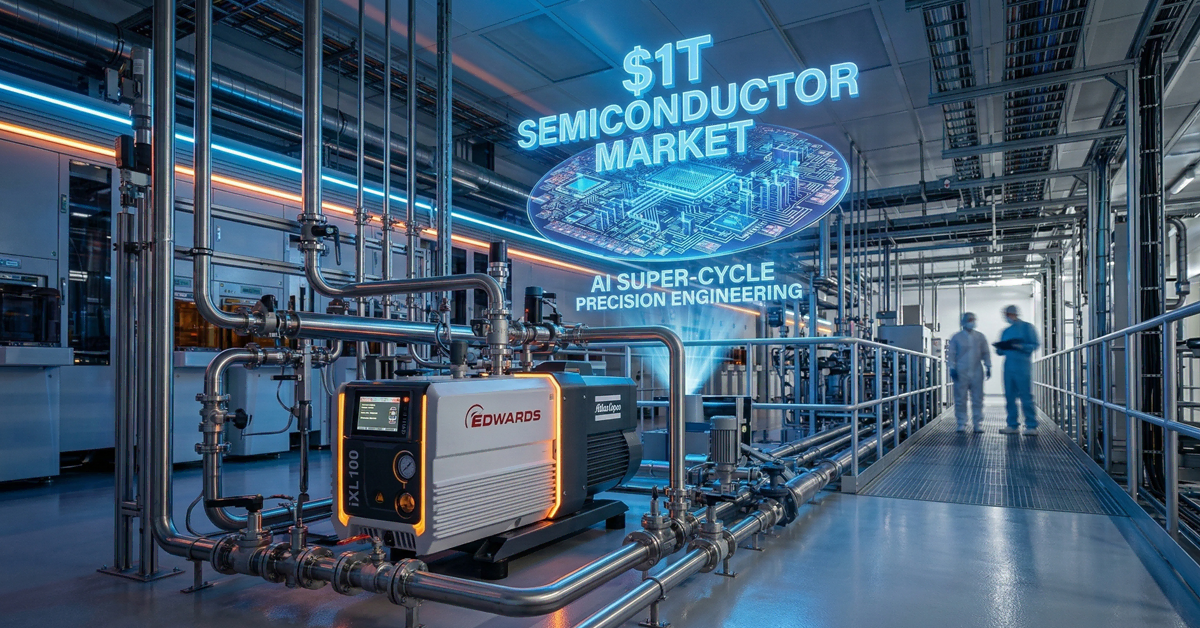
As the global semiconductor market hurtles toward its forecasted $1 trillion valuation by 2030, investor attention is naturally fixed on the “glamour” stocks of the silicon age—chip designers like NVIDIA and foundry giants like TSMC. However, a deeper analysis of the AI infrastructure value chain reveals a more fundamental, physically indispensable layer: the high-precision vacuum environment.
Atlas Copco AB (STO: ATCO A), primarily through its Vacuum Technique business area and the Edwards brand, has positioned itself as the silent but essential partner to the AI revolution. Vacuum technology is not merely a peripheral utility; it is a critical process enabler for Extreme Ultraviolet (EUV) lithography, High-Bandwidth Memory (HBM) production, and advanced node fabrication below 3nm.
This report examines how Atlas Copco is transitioning from a traditional industrial giant into a high-tech powerhouse, fueled by the “AI Super-cycle.” By analyzing the technical requirements of advanced chipmaking and the structural shifts in the industry, we evaluate if Atlas Copco’s strategy of building a massive, high-margin service base provides a sufficient “moat” to protect investors from the notorious cyclicality of the semiconductor industry.
Table of Contents
The AI Super-cycle: Scaling to a $1 Trillion Frontier
The semiconductor industry is currently navigating a period of unprecedented transformation. By early 2026, the global market is expected to surpass $975 billion in annual sales, a historic peak driven by an intensifying AI infrastructure boom. Unlike previous cycles—which were often tied to volatile consumer demand for PCs or smartphones—the current trajectory is anchored by institutional investment in data centers and sovereign AI capabilities.
The Vacuum-Intensive Nature of Advanced Nodes
AI chips (GPUs and ASICs) require the highest transistor densities ever achieved. Moving from 7nm to 5nm, 3nm, and the upcoming 2nm nodes necessitates a radical increase in the number of process steps performed in a vacuum. Vacuum pumps are required to remove atmospheric contaminants that would otherwise ruin silicon wafers at the atomic level.
For Atlas Copco, this means that as the industry moves toward more complex architectures, the “intensity” of vacuum equipment per wafer increases. A modern 3nm fab requires significantly more pumping power and sophisticated abatement systems than a legacy 28nm facility. This structural increase in equipment density per square foot of fab space is a primary tailwind for the Vacuum Technique division.
Deep Dive: EUV Lithography and the Edwards Dominance
At the heart of the AI chip explosion is Extreme Ultraviolet (EUV) lithography. EUV is the only technology capable of printing the intricate features required for high-performance AI processors. However, EUV is physically impossible to achieve in an atmospheric environment because EUV light is absorbed by almost all matter, including air.
Edwards (an Atlas Copco brand) is the market leader in the sub-fab (the area beneath the cleanroom) vacuum and abatement systems that support ASML’s EUV scanners.
- The Hydrogen Challenge: EUV light sources generate enormous amounts of heat and use tin droplets to create plasma. To prevent tin from contaminating the optics, a constant stream of hydrogen is used as a buffer. Edwards’ specialized iXH and pXH series pumps are designed specifically to handle these high flows of flammable hydrogen while maintaining ultra-clean vacuum levels.
- System Integration: An EUV scanner is not a standalone unit; it is supported by a massive “Sub-Fab” ecosystem. For every EUV tool installed, dozens of Edwards vacuum pumps and integrated abatement systems (which neutralize toxic process gases) must be deployed.
As ASML ramps up shipments of its High-NA (Numerical Aperture) EUV machines in 2026, the demand for even more powerful and reliable vacuum systems will accelerate. Atlas Copco’s first-mover advantage and massive installed base in this niche create a significant barrier to entry for competitors.
The Memory Factor: HBM and Advanced Packaging
While GPUs grab the headlines, the bottleneck of AI performance often lies in memory. High-Bandwidth Memory (HBM), produced by leaders like SK hynix, Samsung, and Micron, is critical for feeding data to AI accelerators.
The production of HBM3e and the upcoming HBM4 involves a process called Advanced Packaging, specifically Through-Silicon Vias (TSVs) and wafer-to-wafer bonding. These processes are extremely sensitive to particles and gas pockets.
- Vacuum in Bonding: To stack 12 or 16 layers of DRAM chips with micron-level precision, the bonding must occur in a vacuum to prevent air bubbles from being trapped between layers, which would cause thermal failure.
- Yield Protection: In a market where HBM prices are soaring—often reaching $700 per unit by early 2026—fab yield is the difference between profit and loss. High-reliability vacuum pumps from Edwards ensure that the environment remains pristine, directly impacting the manufacturer’s bottom line.
The Service Moat: Can Maintenance Mitigate Cyclicality?
The “Key Question” for any Atlas Copco investor is whether the company can withstand the inevitable cooling of semiconductor capital expenditure (CapEx). Historically, the “Vacuum Technique” division has seen sharp revenue drops when chipmakers pause fab expansions.
However, a structural shift is occurring: The transition to a Service-Led Model.
1. The High-Margin Service “Tail”
Vacuum pumps in a semiconductor fab are not “set and forget” assets. They operate 24/7 in harsh chemical environments, pumping abrasive and corrosive gases. They require regular overhauls, sensor replacements, and precision tuning.
- Service Revenue Mix: As of 2026, services and aftermarket support account for approximately 25% to 30% of Vacuum Technique’s total revenue.
- Margins: Service margins are typically 500 to 1,000 basis points higher than original equipment sales. While a chipmaker might delay buying a new $500,000 pump system during a downturn, they cannot stop maintaining their existing installed base if they want to keep the fab running.
2. Predictive Analytics and “Vacuum-as-a-Service”
Atlas Copco has integrated predictive maintenance into its Edwards vacuum systems. By using IoT sensors to monitor vibration, temperature, and motor load, the company can predict a pump failure before it happens. This “smart” service model locks customers into long-term service agreements (SLAs). In an AI-driven world, where one hour of downtime in a leading-edge fab can cost millions of dollars in lost revenue, the “Insurance” provided by Atlas Copco’s service teams becomes a mandatory operational expense for the customer, not a discretionary one.
3. The Installed Base Moat
With an installed base of over 150 EUV support systems and hundreds of thousands of standard dry pumps globally, the recurring revenue stream is now massive. This “moat” allows Atlas Copco to maintain healthy cash flows even when the “big-ticket” orders for new fabs slow down.
Financial Resilience and Market Position
Atlas Copco’s financial profile reflects its status as a premium industrial player. For the fiscal year 2025, the group reported revenues of 168.3 billion SEK, with the Vacuum Technique division consistently delivering operating margins in the 22% to 24% range.
Strategic Capital Allocation: Atlas Copco is not just growing organically; it is an “acquisition machine.” By acquiring smaller, specialized vacuum and industrial technology firms, they continuously expand their addressable market. The integration of brands like Leybold and Cewe has allowed them to diversify beyond just semiconductors into industrial vacuum applications (food packaging, pharmaceuticals, and chemical processing), further insulating the group from a pure-play semiconductor crash.
Competitive Landscape: Edwards vs. The Field
Atlas Copco’s primary competition comes from Pfeiffer Vacuum (majority-owned by Busch Group) and Ebara Corporation.
- Pfeiffer Vacuum: Strong in scientific research and certain specialized lithography components.
- Ebara: A formidable Japanese competitor with strong ties to the domestic Japanese and Southeast Asian foundry markets.
Why Atlas Copco Wins: The “secret sauce” is the global scale of the service network. A chipmaker in Arizona or South Korea prefers the vendor that has 500 service engineers within a two-hour radius. Atlas Copco’s sheer size allows it to out-invest competitors in local service centers and rapid-response logistics, making them the “default” choice for the world’s largest foundries.
Risk Factors: The Shadows in the Cleanroom
While the outlook is overwhelmingly positive, investors must monitor three primary risks:
- Geopolitical Fragmentation: A significant portion of Vacuum Technique’s growth has come from China’s push for semiconductor self-sufficiency. If export controls on vacuum technology tighten further in 2026, Atlas Copco could lose access to a high-growth (though lower-margin) market segment.
- Energy Constraints: Semiconductor fabs are becoming increasingly power-hungry. If “Power” becomes the ultimate bottleneck for AI data center growth, as some analysts predict for the 2026–2028 period, the rate of new fab construction could slow, hitting the equipment sales side of the business.
- The “Lumpy” Nature of EUV: Because EUV scanner orders are concentrated in a few hands (Intel, TSMC, Samsung), the loss of a single major contract or a delay in a specific “Mega-Fab” project can cause significant quarterly volatility.
Investor Verdict: A Core Holding for the AI Infrastructure Age
Atlas Copco is no longer just a “compressor company.” It has evolved into a high-stakes technology enabler that sits at the physical nexus of the AI revolution.
The Bull Case for 2026: The semiconductor market is shifting from a “cycle” to a “super-cycle.” The demand for AI chips is structural, and the vacuum requirements for those chips are non-negotiable. With a dominant market share in EUV support and a rapidly expanding footprint in HBM packaging, Atlas Copco is capturing the highest-value segments of the chipmaking process.
The “Moat” Conclusion: The high-margin service revenue from vacuum pump maintenance is indeed a formidable moat. It provides a “cushion” of high-visibility, recurring cash flow that allows the company to continue R&D and dividend payments even during capital-spending pauses. For the long-term investor, STO: ATCO A offers a rare combination of secular growth exposure (AI) and industrial-grade stability.
As we look toward 2030, the question is not whether the semiconductor market will grow, but who will facilitate that growth. Atlas Copco, by “vacuuming up” the gains of the sub-fab, is arguably the safest way to play the most aggressive tech expansion in human history.